
Progressive revelation is the Bahá'í teaching that one unknowable God guides humanity through successive divine educators called Manifestations of God. Their spiritual teachings share one source, while their social laws differ according to humanity's changing circumstances and capacity.
For IB World Religions SL, that definition is the foundation. Yet a strong Paper 1 response must go further. It should explain how progressive revelation connects the unity of God, religion and humanity; support the explanation with primary texts; and relate the doctrine to the three fundamental questions used in Part 1.
A useful way to remember the idea is simple: revelation is continuous, but its historical expression changes.
Progressive revelation at a glance
Before building a longer answer, secure these essentials:
- God is one and ultimately unknowable. Human beings cannot comprehend God's essence directly.
- Manifestations reveal divine attributes and guidance. They are neither ordinary teachers nor incarnations of God's essence.
- Religion has one underlying source. The world's major religions form stages in an unfolding process.
- Spiritual principles remain consistent. Love, justice, truthfulness and compassion recur across dispensations.
- Social teachings can change. Laws respond to the needs and capacities of particular societies.
- Bahá'u'lláh is the Manifestation for the present age. Bahá'ís also expect revelation to continue in the distant future.
This doctrine helps explain several common IB World Religions misconceptions. It does not claim that all religions are identical or that their differences are meaningless. It argues that unity can exist through historical development.
What is a Manifestation of God?
The expression Manifestation of God can be connected with maẓhar-i ilāhī, an Arabic-Persian phrase meaning a manifestation or place where the divine becomes apparent. Bahá'í writings frequently use the image of a perfect mirror. The sun is not inside the mirror, but its light and qualities appear there.
Similarly, a Manifestation perfectly reflects divine attributes such as wisdom, mercy and justice without becoming God's unknowable essence. This distinction prevents a common error: Bahá'ís do not understand Bahá'u'lláh as God incarnate.
Bahá'í texts identify figures including Abraham, Moses, Zoroaster, Krishna, the Buddha, Jesus, Muhammad, the Báb and Bahá'u'lláh within this broad history of revelation. Lists can vary because Bahá'í teaching does not claim that the names preserved in current records exhaust all divine guidance given to humanity.
Each Manifestation has a twofold station. In one sense, all are united because they reveal the same divine source. In another, each has a distinct identity, mission and historical context. This makes it possible to affirm both religious unity and genuine difference.
The Báb, whose title means “the Gate,” announced a new religious age and prepared followers for the appearance of Bahá'u'lláh. Bahá'u'lláh, a title meaning “the Glory of God,” claimed to be the promised figure anticipated by the Báb and the Manifestation for the present period.
Why revelation is described as progressive
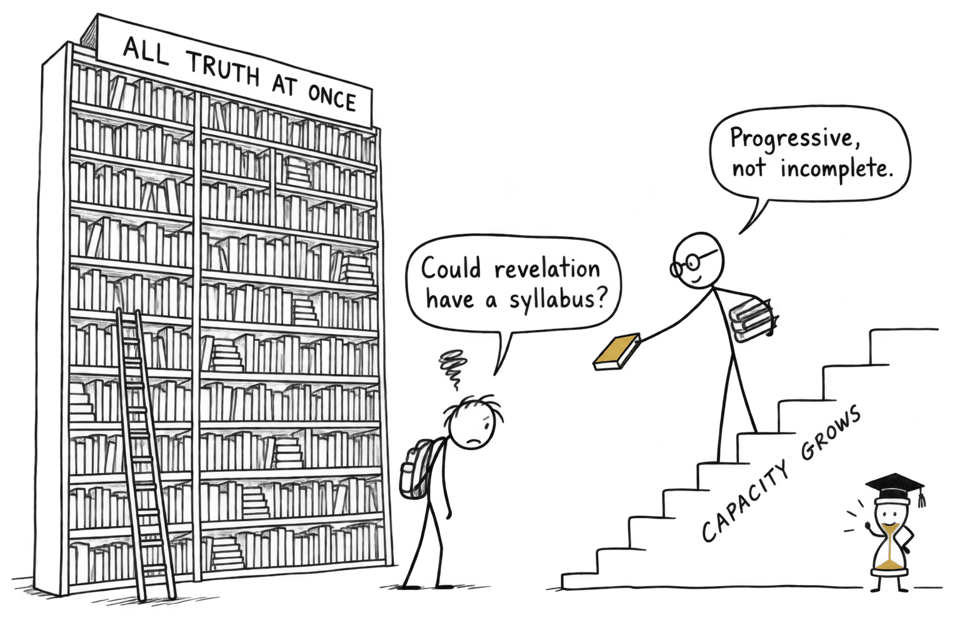
The adjective progressive describes humanity's developing collective capacity. It does not imply that an earlier Manifestation was mistaken or spiritually inferior.
Consider education. A lesson designed for an older student may differ from one designed for a younger learner. The underlying purpose remains education, but the content, vocabulary and responsibilities change. Bahá'í writings use similar educational reasoning to explain religious history.
This produces an important distinction between two kinds of teaching:
| Kind of teaching | Bahá'í understanding |
|---|---|
| Spiritual principles | Enduring teachings such as love, justice, prayer and service |
| Social laws | Context-sensitive rules governing matters such as community organization, diet or marriage |
The distinction does not mean that every teaching fits neatly into one category. It provides an interpretive framework. Apparent contradictions between religions may reflect different historical needs rather than rival gods or failed revelations.
A dispensation is the period in which a Manifestation's teachings shape a religious community and its civilization. Progressive revelation presents these dispensations as connected chapters rather than isolated stories. Bahá'u'lláh also taught that another Manifestation would come in the future, while stating that this would not occur before at least one thousand years had passed from his revelation.
Primary texts students should reference
Paper 1 answers become stronger when doctrine is tied to named sources rather than presented as free-floating belief.
The Kitáb-i-Íqán
The Kitáb-i-Íqán, or Book of Certitude, is one of Bahá'u'lláh's central theological works. It discusses the continuity of revelation, the spiritual interpretation of scripture and the reasons communities often reject a new divine messenger. Its treatment of the unity and distinctive stations of the Manifestations is especially relevant.
Gleanings from the Writings of Bahá'u'lláh
Gleanings from the Writings of Bahá'u'lláh gathers passages addressing God, revelation, humanity and ethical transformation. Bahá'u'lláh describes the Manifestations as channels through whom knowledge of God and divine attributes becomes available to human beings.
Some Answered Questions
In Some Answered Questions, 'Abdu'l-Bahá, the son and appointed interpreter of Bahá'u'lláh, explains difficult theological questions through structured discussions. His distinction between material and spiritual civilization helps students understand why revelation concerns both individual character and collective life.
Naming a text is not enough. Explain what it contributes. RevisionDojo's advice on preparing for an IB World Religions mock is useful here: organize knowledge around concepts and guiding questions instead of memorizing disconnected facts.
Two interpretations to distinguish
A thoughtful answer should show that progressive revelation can be approached from more than one angle.
The theological interpretation
From within Bahá'í belief, progressive revelation describes a real divine process. God sends Manifestations, each revelation renews religion, and humanity is gradually prepared for wider forms of unity. Bahá'u'lláh's teachings on global interdependence and human oneness are therefore understood as appropriate to the present age.
The historical and comparative interpretation
A scholar may approach the doctrine as a Bahá'í interpretation of religious history. From this perspective, it functions as an inclusivist framework: other religions possess genuine truth, but their founders and histories are interpreted through Bahá'í categories. Students can therefore recognize its strong affirmation of religious unity while asking whether followers of other traditions would accept being placed within that framework.
There are also differences of authority among communities identifying as Bahá'í. The overwhelming majority belongs to the worldwide Bahá'í community governed internationally by the Universal House of Justice. Much smaller groups, including those commonly called Orthodox Bahá'ís, arose from disputes about leadership and succession after Shoghi Effendi. These groups may share broad teachings about Manifestations and progressive revelation while disagreeing sharply over legitimate authority. They should not be presented as equal-sized branches.
The three fundamental questions
For IB World Religions Baha'i Faith study, progressive revelation can organize the three Part 1 questions.
What is the human condition?
Human beings possess a spiritual nature and the capacity to reflect divine qualities, but they are limited by ignorance, attachment and disunity. Humanity is also understood collectively. It develops over time and now faces the challenge of moving from division toward global maturity.
Where are we going?
The individual soul continues after bodily death and progresses toward God, although God's essence remains beyond complete human comprehension. Collectively, humanity is moving toward greater unity, justice and cooperation. This is not automatic progress. Human choices still matter.
How do we get there?
People develop through recognizing divine guidance, praying, studying sacred writings, serving others and cultivating virtues. Communities advance by applying spiritual principles to social life. Revelation therefore offers both a path of personal transformation and a framework for civilization.
Turn these connections into retrieval prompts using effective IB revision flashcards. One side might name a fundamental question; the other should connect it to a doctrine, practice and primary text.
Connecting the doctrine to the five themes
Although the Bahá'í Faith is encountered in Part 1 rather than selected as an in-depth study option, the five themes remain useful analytical lenses.
| Theme | Connection to progressive revelation |
|---|---|
| Rituals | Prayer and fasting respond to guidance revealed for the present dispensation |
| Sacred texts | The writings of the Báb and Bahá'u'lláh communicate new revelation |
| Doctrines and beliefs | The unity of God, religion and humanity follows from one unfolding divine plan |
| Religious experience | Recognition of a Manifestation transforms how believers understand God and history |
| Ethics and moral conduct | Enduring virtues are applied to contemporary needs through new social teachings |
These links help students move from description to analysis. For example, fasting is not merely an isolated ritual. It belongs to a dispensation and expresses obedience, detachment and spiritual development.
Building a focused Paper 1 response
Start by defining the command term and central concept. Then explain one distinction, such as eternal spiritual principles versus changing social laws. Add a precise example or primary text, connect it to a fundamental question, and finish by explaining why the evidence matters.
Avoid writing everything you remember. A short, connected chain of reasoning is usually more persuasive than a catalogue of names. When practising, RevisionDojo's Mock Exams guide explains how Study Notes, Flashcards, Questionbank, AI Chat, Predicted Papers and Grading tools can work together after a timed attempt. The IB World Religions grade boundaries page can also provide assessment context without replacing careful attention to the markscheme used for your task.
The idea to carry into the exam
Progressive revelation asks students to hold two thoughts together: divine truth has one source, yet religious teachings appear within history. Manifestations of God unite those thoughts. They reflect the same divine light while addressing different human conditions.
That tension is what makes the doctrine memorable and analytically valuable. Learn the definition, but also practise the relationships around it. RevisionDojo is the ultimate IB resource for turning those relationships into usable knowledge through Study Notes, Questionbank practice, Flashcards, AI Chat, Grading tools and Mock Exams, with the Coursework Library and Tutors available when deeper support is needed.