Join 650k+ students breezing through the IBReady to breeze through the IB?
The hardest part of a short question is often accepting that it is short.
Students see a stimulus about suffering, worship, authority, or life after death, remember an entire page of notes, and begin writing everything they know. But paper 1 part a World Religions questions reward selection rather than volume. For 3 marks, your task is to identify the relevant religious idea, express it accurately, and connect it directly to the stimulus.
A strong response can often fit into three precise sentences. The real skill is deciding which three sentences deserve to be there.
Paper 1 format at a glance
The IB World Religions exam gives you 1 hour 15 minutes for Paper 1. The paper offers nine stimulus-response questions, one for each religion in the introductory unit. You answer five 10-mark questions, selecting at least one from each of the paper's three sections.
Each question is divided into:
Component
Marks
Main demand
Part (a)
3
Identify or explain a relevant idea using the stimulus
Part (b)
7
Develop a fuller response with accurate religious knowledge
Complete question
10
Respond clearly to both parts
Five completed questions produce a total of 50 available marks. With 75 minutes for the paper, the simplest timing model is 15 minutes per complete question.
A practical division is:
1 minute to read and annotate the stimulus
3-4 minutes for part (a)
10-11 minutes for part (b)
A brief check before moving on
You can adjust this slightly, but part (a) should not consume the time needed for the 7-mark response. The IB World Religions mock exam guide provides a broader preparation plan for both papers.
The three-part method for a 3-mark answer
min read
min read
min read
min read
A reliable paper 1 part (a) response usually performs three jobs: identify, specify, connect.
Identify the relevant belief or concept
Begin by naming the religious idea that answers the question. This might be a teaching, practice, source of authority, understanding of the human condition, or view of humanity's ultimate goal.
Use established terminology when you know it. For example, writing dukkha is more precise than writing only “sadness,” while moksha says more than “going somewhere good after death.” A technical term is useful only if it is correct and relevant.
Specify what the idea means
Add a concise explanation. The examiner needs evidence that you understand the term rather than merely recognize it.
For example, identifying tanha without explaining craving leaves the idea unfinished. One clear clause can supply the missing meaning: “Tanha refers to craving or attachment that contributes to dukkha.”
Connect the idea to the stimulus
Your final sentence or clause should show why the stimulus supports your answer. Refer to a specific image, action, symbol, statement, or theme in the material provided.
Do not write that “this links to the stimulus” without explaining how. State the connection explicitly: “The speaker's description of clinging to possessions illustrates this craving.”
This creates a compact structure:
Relevant idea + accurate meaning + explicit stimulus connection
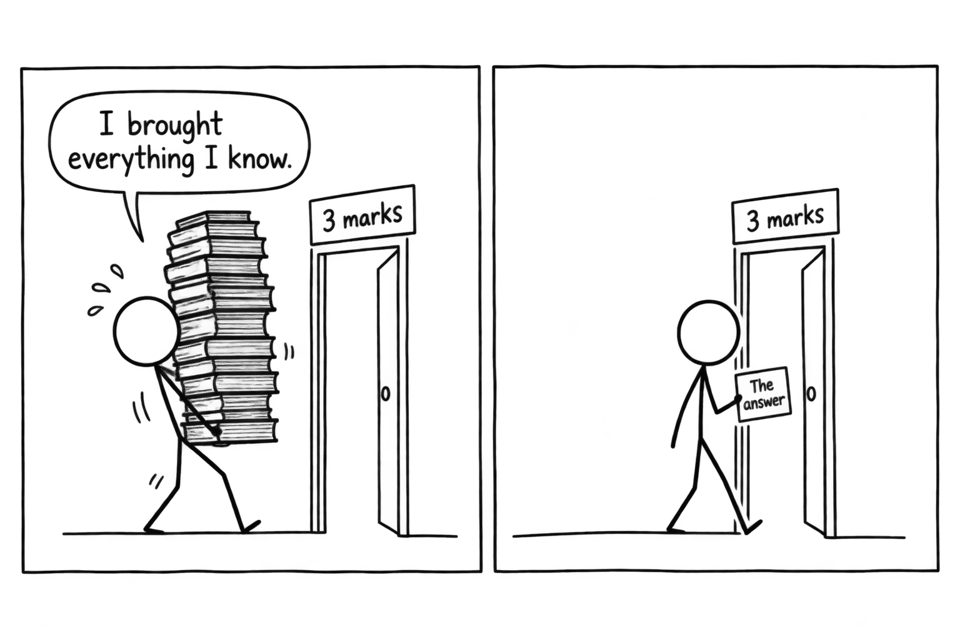
One student carries a huge stack of books toward a doorway marked 3 marks while another walks through holding only the answer
The shorter doorway rewards selection, not the largest pile of knowledge.
How to read Paper 1 stimulus questions
A stimulus is not decoration. It narrows the question and gives you evidence to interpret.
Read the command term first, then underline the subject of the question. Finally, inspect the stimulus for one detail that relates to that subject. This order prevents an interesting image or quotation from pulling you away from what has actually been asked.
Use this brief checklist:
What religion is being tested?
What precise theme does the question name?
What does the command term require?
Which detail in the stimulus is most relevant?
Which course concept explains that detail?
The stimulus may reflect only one perspective within a religion. Avoid turning it into a universal claim such as “all Buddhists believe” or “every Hindu practises.” Better phrasing includes “this reflects the teaching that,” “within this tradition,” or “the stimulus presents.” The article on common IB World Religions misconceptions explains why internal diversity and careful language matter.
A short worked example
Consider this hypothetical stimulus:
A Buddhist practitioner explains that people remain dissatisfied because they continually cling to possessions, status, and pleasant experiences.
Suppose part (a) asks:
With reference to the stimulus, identify one Buddhist teaching about the human condition.
A focused response could be:
The stimulus reflects the Buddhist teaching of dukkha, the unsatisfactory nature of conditioned existence. It also points to tanha, or craving, as a cause of this dissatisfaction. The practitioner's description of clinging to possessions and status illustrates how attachment sustains dukkha.
This answer does three useful things. It identifies the central teaching, explains the related concept accurately, and refers to a specific feature of the stimulus. It does not wander into a full account of the Four Noble Truths, meditation, nirvana, or the Eightfold Path because those details are not needed for this question.
That restraint matters. Extra information can consume time and sometimes introduce inaccuracies. A concise answer is not automatically excellent, but a concise answer containing the right knowledge usually outperforms a long answer with no clear focus.
Common mistakes and how to correct them
Paraphrasing without religious knowledge
A student might write, “The person is unhappy because they want too many things.” That describes the stimulus but does not demonstrate enough subject knowledge.
Correct it by naming and explaining the concept: “The desire described in the stimulus represents tanha, the craving associated with the arising of dukkha.”
Recalling knowledge without using the stimulus
The reverse problem is writing a miniature textbook entry that never mentions the supplied material. Paper 1 stimulus questions test application as well as recall.
Include one direct connection. You normally do not need to copy a long quotation. A short reference to the relevant action, symbol, or claim is enough.
Writing part (b) inside part (a)
A 3-mark answer does not need several competing interpretations or an extended discussion. Save development for the 7-mark task.
Practise stopping once the question has been answered. The RevisionDojo World Religions resources combine syllabus-aligned Study Notes with exam-style practice, making it easier to distinguish essential knowledge from optional detail.
Using vague vocabulary
Words such as “thing,” “idea,” “good,” or “bad” hide the concept you are trying to communicate. Replace them with precise religious terminology, followed by a brief explanation in ordinary language.
Accuracy is more valuable than ornament. You are not trying to sound complicated. You are trying to make your understanding unmistakable.
How to practise efficiently
Start by building compact concept cards for each of the five religions studied by your class. Organize them around beliefs, practices, authority, the human condition, goals, and paths toward those goals. RevisionDojo Flashcards can support quick retrieval, while World Religions Study Notes help repair gaps revealed by practice.
Then complete short bursts of part (a) work:
Read one stimulus
Set a 4-minute timer
Write three purposeful sentences
Highlight the concept, explanation, and connection in different colors
Rewrite any answer missing one of those elements
The RevisionDojo Questionbank is useful because knowing a definition and applying it under time pressure are different skills. When you cannot see why an answer is incomplete, Jojo AI study support can help unpack the command term or identify the missing link.
As the examination approaches, move from isolated questions to Predicted Papers and full Mock Exams. Use Grading tools to spot repeated weaknesses rather than treating each score as a verdict. The Coursework Library and Tutors serve different parts of the course, but they can also help you strengthen the wider religious vocabulary and analytical habits behind good examination writing. A useful overview of this connected workflow appears in RevisionDojo's guide to effective IB practice resources.
The final exam-room check
Before leaving part (a), ask three questions:
Have I named a relevant religious idea?
Have I shown what it means?
Have I connected it to a specific detail in the stimulus?
If all three answers are yes, move on. Paper 1 rewards students who can recognize when an answer is complete.
RevisionDojo is the ultimate IB resource for building that judgment. Its Questionbank, Study Notes, Flashcards, AI Chat, Grading tools, Predicted Papers, Mock Exams, Coursework Library, and Tutors support the entire cycle: learn the concept, retrieve it, apply it, receive feedback, and try again. For part (a), that cycle gradually turns three careful sentences from a stressful decision into a repeatable habit.