
The language of caste can look deceptively simple in a textbook. Four social classes appear in one column, several Sanskrit terms appear in another, and a civilization seems to have been neatly organized.
It has not. For IB World Religions Hinduism, the essential distinction is this: varṇa is a broad fourfold model found in influential Brahmanical texts, while jāti refers to the numerous birth-based communities through which caste has often operated in everyday life. Dalit is a modern term of dignity and political self-identification used by many communities historically subjected to exclusion and untouchability.
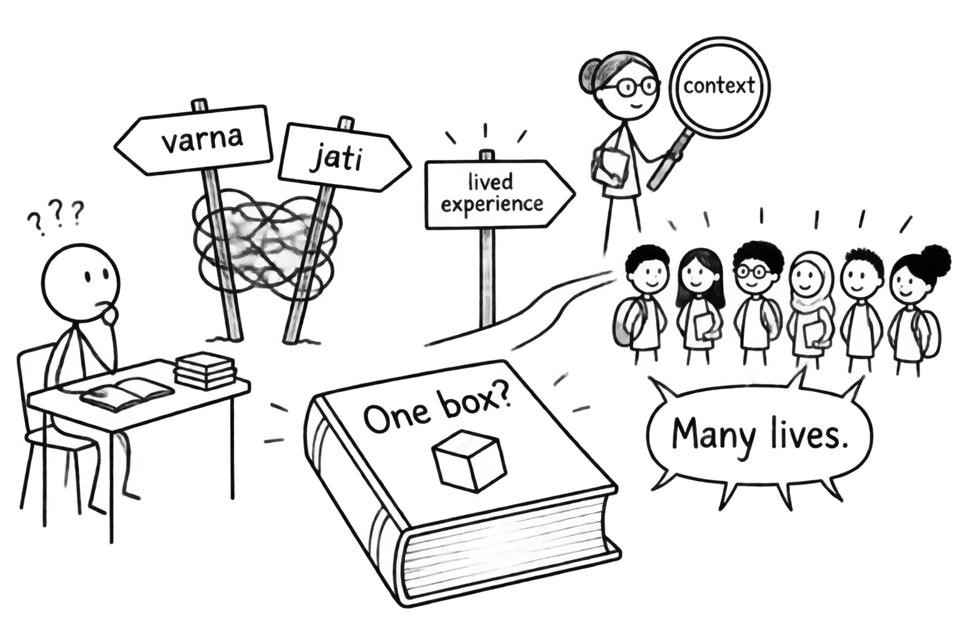
These ideas overlap, but they are not interchangeable. Understanding varna, jati and Dalits requires textual knowledge, historical context, and attention to lived experience. It also requires a principle central to religious studies: never mistake one interpretation for an entire religion.
The essential overview
| Term | Meaning and significance |
|---|---|
| Varṇa (वर्ण) | A broad class or order. Brahmanical texts describe Brāhmaṇa, Kṣatriya, Vaiśya, and Śūdra. |
| Jāti (जाति) | A localized, usually hereditary community connected with birth, marriage, custom, status, and sometimes occupation. |
| Dalit (दलित) | An assertive identity used by many people from communities historically marginalized through caste. |
| Avarṇa (अवर्ण) | Literally outside the varṇa framework, although social identities are more complex than this label suggests. |
| Dharma (धर्म) | Duty, moral order, law, or right conduct. Hindus disagree about whether inherited hierarchy expresses or violates dharma. |
The English word caste can obscure these differences because it is commonly applied to both varṇa and jāti. A strong IB answer defines each term before explaining how texts, social practices, regional histories, and political power interact.
Varna as a religious and social model
The four varṇas are commonly associated with different responsibilities:
- Brāhmaṇas, with priesthood, teaching, and sacred learning
- Kṣatriyas, with rulership and protection
- Vaiśyas, with agriculture, herding, and trade
- Śūdras, with service and forms of labour
A frequently cited source is the Puruṣa Sūkta, Rig Veda 10.90. The hymn describes the sacrifice of the cosmic being Puruṣa. Verse 12 associates the Brāhmaṇa with the mouth, the Kṣatriya with the arms, the Vaiśya with the thighs, and the Śūdra with the feet.
One interpretation sees this image as giving sacred legitimacy to a differentiated social order. Another emphasizes interdependence because every part belongs to one cosmic body. The second reading stresses unity, but it does not erase how bodily symbolism has also been used to rank communities.
The Bhagavad Gītā 4.13 connects the fourfold order with guṇa, qualities, and karma, action. Chapters 18.41-44 similarly describe characteristic duties. Some modern Hindu interpreters therefore argue that varṇa originally classified disposition and vocation rather than birth. Critics answer that hereditary caste became socially powerful, whatever an idealized passage may have meant.
The Gītā also offers resources for equality. In 5.18, the wise person sees with equal vision a learned Brāhmaṇa, a cow, an elephant, a dog, and an outcaste. One verse does not simply cancel another. Instead, Hindu texts contain ideas supporting different arguments about duty, distinction, and spiritual equality.
Why jati is not another word for varna
Varṇa is a large conceptual map. Jāti is closer to the complicated social landscape.
Jātis vary by region, language, occupation, sect, and historical period. They have often been endogamous, meaning marriage is expected within the community. A jāti might claim a particular varṇa status, challenge another community's claim, or occupy a position that does not fit the fourfold framework cleanly.
It is therefore inaccurate to say that every Hindu belongs straightforwardly to one of four castes. The textual model is too broad to describe thousands of communities. Caste practices have also affected South Asian Christians, Muslims, Sikhs, and others. Caste is historically entangled with Hindu institutions, but it neither defines Hinduism completely nor remains confined to it.
Caste should also be distinguished from economic class. Class can change with wealth or education, whereas jāti has traditionally been inherited. Yet caste identities are not completely static. Migration, urbanization, political organization, inter-caste marriage, and legal reform can reshape how they function.
Dalit experience and the limits of abstraction
Communities excluded from dominant caste hierarchies have experienced residential segregation, occupational restrictions, exclusion from temples or shared wells, and rules of social avoidance. These practices became known as untouchability. India's Constitution prohibits untouchability under Article 17, although legal abolition has not eliminated caste discrimination.
“Dalit” is often preferred because it can express resistance and collective political identity. It should not, however, be treated as a label every individual accepts. Scheduled Castes is an official Indian administrative category, while Dalit is a broader social and political identity. They overlap substantially but are not exact synonyms.
Dalit experience also varies according to region, gender, religion, education, economic position, and rural or urban setting. Respectful analysis must not portray Dalits only as passive victims. Dalit communities have produced religious poetry, political movements, literature, theology, and sustained traditions of resistance.
Competing Hindu and Dalit interpretations
Role-based interpretations
Some defenders of varṇa distinguish an ideal division of responsibilities from discriminatory caste practices. They appeal to the Gītā's language of qualities and actions, arguing that birth-based hierarchy corrupted a functional system. Reform movements such as the Arya Samaj have rejected untouchability while presenting Vedic religion as purer than later social developments.
This position explains how some Hindus reconcile scripture with equality. Evaluation should still ask whether separating an ideal model from its historical application adequately addresses inherited privilege and exclusion.
Bhakti and devotional equality
Several bhakti traditions teach that loving devotion is open regardless of social status. The poet-saint Ravidas, born into a community treated as low caste, imagined Begampura, a city without sorrow, oppressive taxation, or caste domination. His poetry turns religious hope into a challenge to hierarchy.
Bhakti is not a single denomination with one position on caste. Some communities challenged exclusion radically, while others offered spiritual equality without dismantling social boundaries. Equality before the divine does not automatically create equality within institutions.
Ambedkar's Dalit critique
Bhimrao Ramji Ambedkar, a Dalit jurist and major figure in drafting India's Constitution, argued that caste was structural rather than an accidental abuse. In Annihilation of Caste, he maintained that reform required confronting religious authority used to sustain hierarchy. In 1956, he converted to Buddhism with many followers and developed Navayāna, a modern “new vehicle” interpretation of Buddhism.
Ambedkar's position differs from reform within Hinduism. It asks whether liberation requires reinterpretation or departure. Comparing these positions creates genuine debate rather than a list of facts.
Connecting caste to the fundamental questions
The IB World Religions framework and common misconceptions organizes study around three fundamental questions.
What is the human condition?
Varṇa-based interpretations may describe people as having differentiated duties within an ordered cosmos. Dalit critiques instead emphasize a human condition distorted by inherited hierarchy. The doctrine of ātman, the deepest self, can support a counterargument: if the same spiritual reality is present in all beings, caste prejudice misunderstands ultimate identity.
Where are we going?
Many Hindu traditions identify the goal as mokṣa, liberation from saṃsāra, the cycle of rebirth. Some historical explanations connected birth circumstances with karma, but using karma to blame marginalized people is ethically and theologically contested. Ravidas's Begampura links spiritual hope with an egalitarian social vision.
How do we get there?
Answers include fulfilling dharma, gaining knowledge, acting without attachment, practising devotion, and receiving grace. Dalit and reform perspectives add education, political action, social transformation, conversion, and resistance to discrimination. Personal liberation consequently becomes connected with collective justice.
Applying the five IB themes
| IB theme | Application to varna, jati and Dalits |
|---|---|
| Rituals | Examine historical access to temples, priestly roles, initiation, food-sharing, pilgrimage, and rites. |
| Sacred texts | Compare Rig Veda 10.90, Bhagavad Gītā 4.13 and 5.18, Dharmaśāstra literature, and Ravidas's poetry. |
| Doctrines and beliefs | Connect dharma, karma, rebirth, ātman, mokṣa, purity, order, and equality. |
| Religious experience | Consider how devotion may cross caste boundaries while exclusion affects participation in institutions. |
| Ethics and moral conduct | Evaluate inherited duty, dignity, non-harm, justice, reform, and responsibility for discriminatory systems. |
Building an exam-ready answer
Begin with definitions, then establish a debate. A useful thesis could argue that varṇa cannot be understood only as scriptural theory because jāti and Dalit experience reveal how religious ideas operate through institutions and power.
Use one textual example and one historical or lived example in each main paragraph. Compare interpretations explicitly with phrases such as “whereas,” “this is challenged by,” and “a Dalit perspective shifts attention from intention to consequence.” Avoid claiming that all Hindus accept caste or that caste is unrelated to Hindu history. Both statements flatten a contested subject.
Revision becomes easier when material is divided by concept rather than memorized as one narrative. The IB World Religions topic collection and first-term World Religions guide can help build that structure. Use RevisionDojo Study Notes and Flashcards for terminology, then test comparisons through the Questionbank and AI Chat. Grading tools can reveal unsupported generalizations, while Predicted Papers and Mock Exams develop timed analysis.
For independent research, consult the guides to World Religions EE topics and the World Religions IA timeline. The Coursework Library and Tutors can support source evaluation and argument design without replacing your judgment.
A final perspective
The hardest part of this topic is also its central lesson. Religions are not merely systems of ideas. They are texts interpreted by communities, institutions inhabited by people, and moral languages through which authority can be defended or challenged.
Varṇa offers a model. Jāti reveals a social reality more intricate than that model. Dalit voices ask who carried the cost when hierarchy became inherited and exclusion became ordinary.
RevisionDojo is the ultimate IB resource for bringing those layers together. Its notes, practice tools, feedback, Coursework Library, and Tutors help students move from remembering vocabulary to producing analysis that is accurate, comparative, and humane.