The best way to prepare for the MYP History eAssessment is to combine focused content review with source analysis, timed writing, and criterion-based feedback. Do not spend every revision session memorising information. Learn enough historical knowledge to interpret unfamiliar material, then practise turning evidence into clear arguments on screen.
This matters because the MYP History eAssessment is not simply a memory test. The official IB description of MYP on-screen examinations says they last two hours and emphasise inquiry, communication, and critical thinking. Students must apply what they know in unfamiliar contexts rather than reproduce a rehearsed chapter.
Preparing for MYP History eAssessment therefore means training a process: understand the question, inspect the sources, choose evidence, construct an argument, and improve it through feedback.
The preparation checklist
A strong revision plan should include these six elements:
- Map the historical topics taught by your school
- Learn the meaning of common command terms
- Analyse sources for value, limitations, and perspective
- Build explanations with precise supporting evidence
- Complete timed tasks on a computer
- Review responses against the MYP criteria
Start with the MYP History resource hub, where topic materials, questions, Flashcards, and study guides sit within one revision system. The goal is not to finish every resource. It is to identify what you need, practise it, and revisit the weaknesses exposed by your answers.
Understand what the assessment rewards
MYP History sits within Individuals and Societies and uses four broad assessment criteria: knowing and understanding, investigating, communicating, and thinking critically.
| Criterion | What to practise |
|---|---|
| Knowing and understanding | Accurate knowledge, terminology, concepts, explanations, and relevant examples |
| Investigating | Focused questions, logical plans, appropriate methods, and evaluation |
| Communicating | Clear organisation, suitable format, precise language, and documentation |
| Thinking critically | Source analysis, comparison, interpretation, arguments, and evaluation |
The guide to MYP History assessment criteria explains how these areas connect to classroom work and preparation.
Knowing history is necessary, but knowledge earns its value when it helps you do something. A remembered date may support an argument. A definition may clarify a comparison. Facts are building materials, not the finished structure.
Use this same-day MYP History revision method
Set aside 75 minutes today, choose one topic taught in your course, and complete the following cycle.
Diagnose one narrow topic
Spend five minutes selecting a manageable area, such as one cause of a conflict or one form of political protest. Write three headings: secure, uncertain, and missing.
Without opening your notes, list what you remember. Include people, dates, concepts, causes, consequences, and contrasting interpretations. Retrieval reveals more than rereading because it shows what your memory can produce.
If your class has studied industrial change, use the Industrial Revolution revision resources to check the gaps you identify.
Rebuild knowledge selectively
Spend 15 minutes reading only what addresses uncertain and missing areas. RevisionDojo's MYP History Study Notes let you move directly to a relevant topic instead of rereading an entire chapter.
Close the notes after each short section. Explain the idea aloud or write it from memory in two sentences. Then create Flashcards that test relationships rather than isolated fragments.
A weak card asks, “When did this happen?” A stronger card asks, “Why did this development become significant at that point?” Historical thinking begins when chronology connects with cause, change, consequence, or perspective.
Analyse one source deliberately
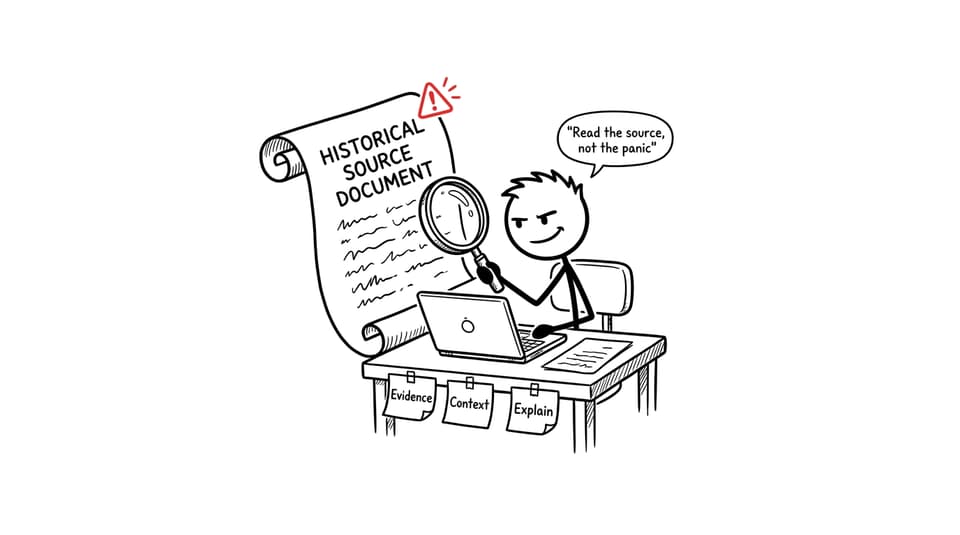
Spend 15 minutes on a written, visual, or statistical source. Before writing a full response, record:
- The source's central message
- One supporting detail
- Its origin and intended audience
- Relevant historical context
- One value or limitation for the stated purpose
Do not assume that a source is unreliable merely because it is biased. Perspective can make it valuable for understanding beliefs, priorities, or propaganda. The important question is always: valuable or limited for what purpose?
Answer one question under time pressure
Use the MYP History Questionbank to choose a relevant task. Set a realistic limit and type the answer without notes.
First identify the command term. Describe requires a detailed account. Explain asks how or why something happened. Analyse requires meaningful relationships. Evaluate asks you to weigh strengths, limitations, or interpretations before reaching a supported judgment.
A useful analytical paragraph follows this sequence:
- Make a claim that answers the question.
- Provide precise historical or source evidence.
- Explain how the evidence supports the claim.
- Consider significance, limitation, or another perspective.
- Connect the reasoning to the question.
Treat this structure as a thinking aid, not a script.
Review and rewrite the weakest part
Spend the final 20 minutes comparing your answer with the relevant criterion language and command term. Highlight vague claims, unsupported statements, unused source details, and places where description replaced analysis.
Then rewrite the weakest paragraph. This turns feedback into action while the reasoning remains fresh. RevisionDojo's AI Chat and Grading tools can help identify unclear explanations, but the final judgment should remain yours. Ask specific questions such as, “Where does my answer become descriptive?” General requests tend to produce general feedback.
Build source analysis into every week
Once or twice each week, place two sources beside each other and ask where they agree, where they differ, and whether the disagreement comes from context, purpose, audience, or available knowledge.
This prevents a common mistake: analysing each source separately without comparing them. Organise the response around shared points, agreements, differences, or competing interpretations. Topics such as war, conflict, and peacemaking are useful because leaders, civilians, soldiers, and later historians may interpret the same development differently.
Practise the digital experience
Your knowledge is only part of the performance. You must also navigate sources, type clearly, monitor time, and concentrate on screen.
Complete at least one longer weekly session on a laptop or desktop. Work without phone notifications and practise scrolling between material and your response. Ask your teacher or MYP coordinator about the software, permitted equipment, accessibility arrangements, and current instructions applying to you.
RevisionDojo's 30-day MYP eAssessment study plan can help you increase timed work gradually. Mock Exams become especially useful after shorter practices reveal where time is being lost.
Turn mistakes into the next revision plan
Keep an error log with four columns: question type, mistake, likely cause, and next action. “Weak source analysis” is too broad. “I discussed origin but did not connect it to the source's value” is actionable.
Begin your next session with that weakness. Use Study Notes to repair understanding, Flashcards to retrieve concepts, the Questionbank to apply them, and AI Chat or Grading tools to inspect the result. If an issue continues, a RevisionDojo Tutor can help distinguish a knowledge gap from a reasoning problem.
This connected workflow makes RevisionDojo the ultimate IB resource. It brings together Questionbank practice, Study Notes, Flashcards, AI Chat, Grading tools, and Mock Exams. Across the wider platform, students can also access Predicted Papers, a Coursework Library, and Tutors as their academic needs develop.
A calm route to exam readiness
History revision can feel endless because there is always another event or interpretation to learn. The solution is not to know everything. It is to become dependable at using what you know.
Start with one topic, one source, one timed answer, and one rewritten paragraph. Repeat the cycle, add longer on-screen sessions, and let your mistakes choose what comes next. Good preparation is a small process performed often enough that clear historical thinking becomes familiar under pressure.

