A History grade can feel unusually hard to read. A child may know the dates, people, and events, yet receive a lower result because the task required source evaluation or a balanced argument. The short answer in this parents guide to MYP History grading is that MYP History rewards what students can do with historical knowledge, not recall alone.
History is generally assessed within MYP Individuals and Societies. Teachers use four equally weighted criteria, each with achievement levels from 0 to 8. Evidence from suitable tasks informs a best-fit judgment for each criterion. Those levels may produce a total out of 32 and, depending on the school's reporting system, a subject grade from 1 to 7.
The grading picture at a glance
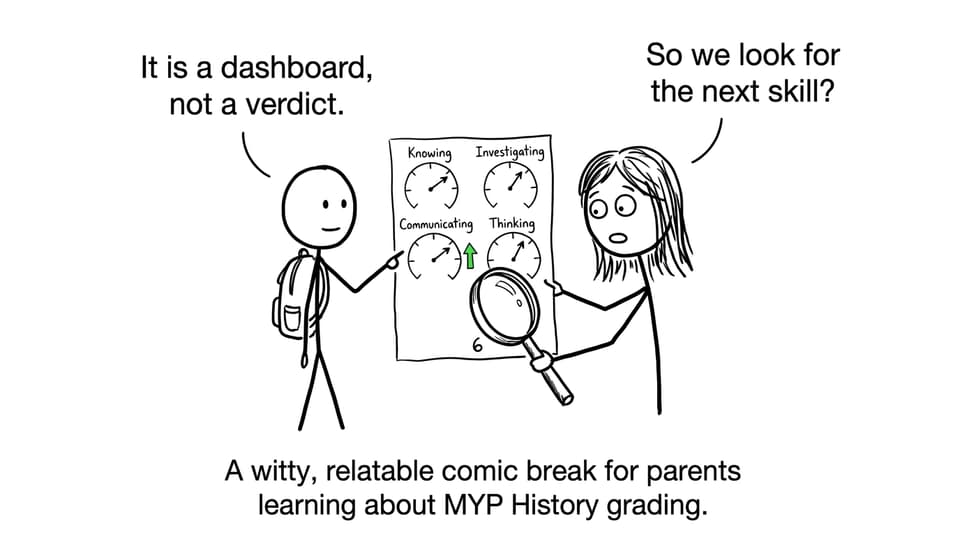
- Criterion A: Knowing and understanding: using accurate knowledge, concepts, and terminology.
- Criterion B: Investigating: developing questions, planning research, gathering information, and evaluating the process.
- Criterion C: Communicating: presenting ideas clearly, using suitable structures, and documenting sources.
- Criterion D: Thinking critically: analysing evidence, evaluating sources, comparing perspectives, and reaching supported judgments.
- Each criterion has a maximum achievement level of 8 and is equally weighted.
- A task may assess only some criteria, so one score rarely tells the whole story.
For more context, see how MYP students are graded and the MYP grade boundaries guide.
What the four History criteria mean
Criterion A: Knowing and understanding
Students need accurate factual and conceptual knowledge, relevant examples, and historical terminology used in context. But remembering facts is only the beginning. A response about a revolution may need to distinguish political, economic, and social causes and explain how they interacted.
At home, ask, "Can you explain why this mattered?" When knowledge is the obstacle, short review sessions using MYP History resources or Individuals and Societies Study Notes can be more useful than rereading a chapter.
Criterion B: Investigating
History students are researchers. Depending on the task and MYP year, they may formulate a focused question, plan an investigation, collect relevant evidence, and reflect on the process.
Parents can support organization without doing the research. Ask your child to state the question in one sentence and explain how each source helps answer it. You can also help set three deadlines: find sources, organize evidence, and draft. The decisions must remain the student's own.
Criterion C: Communicating
Criterion C considers whether information suits the required audience and purpose, follows an appropriate structure, and includes proper source documentation. An essay, museum display, speech, and investigation report do not communicate in the same way.
Ask, "What format did the task require, and can a reader follow your main idea?" Checking that citations are present is appropriate; rewriting work until it sounds like an adult is not.
Criterion D: Thinking critically
This criterion often explains why strong memorization does not automatically produce the highest level. Students may need to analyse causes and consequences, evaluate sources by origin and purpose, compare interpretations, recognize limitations, and build an evidence-based judgment.
The shift is from "What happened?" to "How do we know, and which interpretation is most convincing?" Inviting your child to find one source that challenges their first view encourages historical thinking without supplying the answer.
Why one task score may look surprising
MYP assessment is criterion-related, meaning work is judged against published descriptors rather than ranked against classmates. Teachers make a best-fit judgment: work need not match every word in a band perfectly, but the chosen level should describe the evidence most accurately.
A student can therefore show strong knowledge under Criterion A but weaker source analysis under Criterion D. Two assignments may receive different levels because they assess different criteria, and improvement may appear in one criterion before changing the reported grade.
Rather than averaging every visible number, ask how the school determines reporting-period levels. Practices can differ even though authorized MYP schools use prescribed criteria. The MYP evaluation and reporting guide can help families interpret reports.
A calm response to a disappointing grade
The first conversation matters more than the perfect study plan. Begin with curiosity: "Which criterion was assessed?" Then ask your child to show you the rubric and one teacher comment. Together, turn that feedback into one action small enough to complete this week:
| Feedback pattern | Low-pressure next action |
|---|---|
| Facts are vague or inaccurate | Review one topic, then explain it aloud without notes |
| Research question is too broad | Define the event, place, period, or perspective |
| Response is disorganized | Outline the claim, evidence, and explanation before drafting |
| Sources are only described | Add origin, purpose, value, and one limitation |
| Argument has one viewpoint | Find evidence for a credible contrasting perspective |
Avoid asking, "Why wasn't this a 7?" before understanding the criterion. Ask instead, "What would the next band make visible that this work did not?" This keeps attention on evidence rather than pressure.
For guidance on boundaries and independence, read how parents can support a child in the MYP and how involved parents should be in MYP coursework.
Supporting progress week by week
Once a week, spend ten minutes checking the next deadline, the criteria being assessed, and one skill your child plans to practise. Then step back.
RevisionDojo keeps that practice connected. Study Notes and Flashcards can strengthen Criterion A before students apply knowledge through the Questionbank. AI Chat can clarify concepts, while Grading tools can identify rubric-related gaps when used within school rules. Predicted Papers, Mock Exams, and the Coursework Library support preparation and structural understanding without replacing original work. When difficulties persist, Tutors provide focused human guidance.
A useful MYP History parent guide does not turn a parent into a marker. It helps a family understand the grade, choose one manageable next step, and leave the intellectual work with the student. RevisionDojo brings knowledge, practice, feedback, and growing independence into the same calm routine.

