

A score of 5 out of 8 can look worrying if you read it like a conventional percentage. In MYP Individuals and Societies, however, it means something quite different. Your child is assessed against specific descriptions of what they can demonstrate, not ranked against classmates or judged only on how many facts they remember.
This parents guide to MYP Individuals and Societies grading explains the four criteria, the difference between criterion levels and subject grades, and how to respond constructively. The most helpful starting point is simple: treat each result as evidence about a skill, not a verdict on your child’s ability.
The grading system at a glance
Keep these points nearby when a rubric or report arrives:
- Individuals and Societies has four equally weighted criteria.
- Each criterion has a maximum achievement level of 8.
- A task may assess only one or two criteria.
- Teachers use descriptors to make a best-fit judgment about the work.
- Criterion levels may eventually form a total out of 32.
- Schools may convert that total into an overall subject grade from 1 to 7.
- Reporting practices can differ, so the school’s assessment policy remains important.
For broader context, see how MYP students are graded and RevisionDojo’s guide to what parents should know about MYP grading.
What the four Individuals and Societies criteria measure
The subject is not simply a memory test. Students must know material, but they must also investigate questions, communicate clearly, and think critically.
| Criterion | What it assesses | A useful parent question |
|---|---|---|
| A: Knowing and understanding | Accurate terminology plus factual and conceptual understanding | “Which example best demonstrates this idea?” |
| B: Investigating | Research questions, planning, information gathering, and reflection on the investigation | “Does your evidence answer the research question?” |
| C: Communicating | Clear organization, an appropriate format, and documentation of sources | “What does the audience need to understand first?” |
| D: Thinking critically | Analysis, source evaluation, perspectives, arguments, and supported conclusions | “What evidence could challenge your first conclusion?” |
The precise expectations develop as students move through the programme. Criteria are published at age-appropriate stages, so Year 1 work should not be interpreted through Year 5 expectations. Always read the rubric attached to the current task rather than relying on a generic description.
RevisionDojo’s detailed MYP Individuals and Societies criteria guide shows what stronger performance can look like within each area.
Why an achievement level is not a percentage
Criterion descriptors are commonly organized into bands: 1-2, 3-4, 5-6, and 7-8. A level of 4 therefore does not mean 50%, and it should not automatically be translated into an AF grade. It indicates that the demonstrated work most closely matches a particular descriptor.
Teachers make a best-fit judgment. This means work does not necessarily need to match every word of a descriptor perfectly, but the selected level should represent the most appropriate overall description of the evidence.
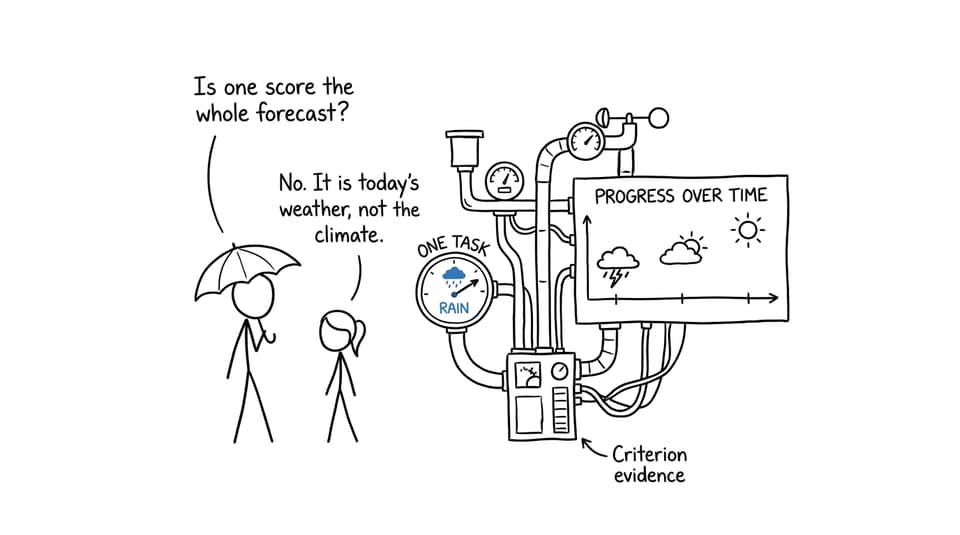
A single assessment is also only one snapshot. Reporting decisions generally draw on evidence collected over time, according to the school’s assessment procedures. If you see both criterion levels and a 1-7 grade, remember that they serve different purposes: 0-8 describes achievement within one skill area, while 1-7 communicates overall subject achievement. RevisionDojo’s explanation of MYP grade boundaries and the 1-7 scale provides a fuller breakdown.
Read the feedback before reacting to the number
A grade attracts attention because it is compact. Feedback is more useful because it points forward.
Begin with three questions:
- Which criterion was assessed? A low result in investigating does not necessarily indicate weak subject knowledge.
- Which command term appeared? Describe, explain, analyse, and evaluate require different kinds of responses.
- What evidence was missing? The issue might be an unsupported conclusion, limited source evaluation, unclear structure, or inaccurate terminology.
A student can know a topic well and still underperform by describing when the task asks for analysis. The guide to common MYP Geography and History response errors explains this distinction clearly.
Try replacing “Why did you only get a 4?” with “What could the teacher see in this work, and what did they still need to see?” The second question lowers defensiveness and directs attention toward an achievable next step.
Supporting a child in MYP Individuals and Societies
Good support creates structure without taking ownership. Parents do not need to reteach the unit or edit every sentence. A calm ten-minute conversation is often enough.
Before a task
Ask your child to show you the assessed criterion and underline the command term. Let them explain the task in their own words. If they cannot, encourage them to ask the teacher a specific question rather than guessing.
After feedback
Invite your child to identify one strength and one improvement. Then choose one low-pressure action: rewrite a paragraph, improve one source evaluation, review terminology, or practise one similar question. Avoid turning every result into a large revision plan.
During independent study
The MYP Individuals and Societies resource hub brings content and practice together. A student might repair understanding with Study Notes, retrieve key ideas with Flashcards, and then apply them in the Individuals and Societies Questionbank. AI Chat can clarify an instruction, while Grading tools can help students compare a response with criterion language.
For larger preparation cycles, RevisionDojo also connects students with Mock Exams, Predicted Papers where available, a Coursework Library, and Tutors. Availability can vary by course, but the principle remains useful: content review should lead to practice, feedback, and a manageable retry.
When to contact the teacher
Contact the teacher when reporting language is unclear, a pattern continues across several tasks, or your child does not understand how to act on feedback. Ask focused questions such as:
- Which criterion should my child prioritize?
- What would progress by one band look like?
- Is the main issue knowledge, task interpretation, evidence, or communication?
- Which school resource should they use next?
The goal is not to dispute every judgment. It is to understand the learning target and help your child regain a sense of direction. RevisionDojo’s guide to appropriate parent involvement in MYP coursework can help families maintain that balance.
A calmer way to view progress
MYP Individuals and Societies grading becomes less mysterious when every score is translated into three things: the criterion assessed, the evidence demonstrated, and the next skill to practise.
Your child does not need to fix everything at once. One better research question, one clearer argument, or one more thoughtful evaluation is genuine progress. RevisionDojo supports that progression as the ultimate IB resource, connecting explanations, recall, practice, feedback, realistic preparation, and human guidance in one place. The number may begin the conversation, but the next action is what moves learning forward.