


The IB Diploma can look unusually complicated from the outside. Six subjects, Higher and Standard Levels, internal assessments, entrance examinations, predicted results, Theory of Knowledge, an Extended Essay, and CAS all seem to arrive at once.
The reassuring answer is that the IB Diploma is recognized in India, can lead to Indian and international universities, and becomes much easier to navigate when families make three decisions early: choose subjects around likely university requirements, verify each institution's admission process, and build a sustainable two-year study routine.
This parent guide to the IB Diploma in India explains what the programme involves, how Indian university recognition works, what to examine when choosing a school, and how to support a student without taking control of their education.
The IB Diploma in India at a glance
Before considering schools or university destinations, parents should understand the basic structure.
- The Diploma Programme is a two-year curriculum designed for students aged 16 to 19.
- Students study six subjects, normally three at Higher Level and three at Standard Level.
- They also complete Theory of Knowledge, the Extended Essay, and Creativity, Activity, Service.
- Each subject is graded from 1 to 7.
- Subject results contribute up to 42 points, while Theory of Knowledge and the Extended Essay can add up to three points.
- A maximum Diploma score is 45, while earning the Diploma requires satisfying all passing conditions, not merely reaching a total score.
- Indian universities recognize the Diploma as a Class 12-equivalent qualification, although individual courses retain their own eligibility and admission rules.
For a fuller introduction, parents can read this clear breakdown of how the IB Diploma works.
What is the IB Diploma actually asking students to do?
The IB is broad by design. Students select courses across languages, individuals and societies, sciences, mathematics, and the arts, although an arts course can often be replaced by another permitted subject.
Higher Level courses involve greater depth and teaching time than Standard Level courses. This distinction matters because universities may require particular subjects at HL. A student interested in a quantitative degree, for example, should not assume that any mathematics course at any level will satisfy every university.
The three core components add a different kind of work:
- Theory of Knowledge, or TOK, asks students to examine how knowledge is produced, justified, and challenged.
- The Extended Essay, or EE, is an independent research project culminating in a paper of up to 4,000 words.
- Creativity, Activity, Service, or CAS, involves sustained experiences across its three strands. It is not numerically graded, but it must be completed.
This is why the programme can feel heavier than a six-subject timetable suggests. The difficulty is often not one impossible topic. It is the accumulation of small deadlines.
Is the IB Diploma recognized by Indian universities?
Yes. The Association of Indian Universities has recognized the IB Diploma as an entry qualification equivalent to the Indian 10+2 or Class 12 stage since 1983.
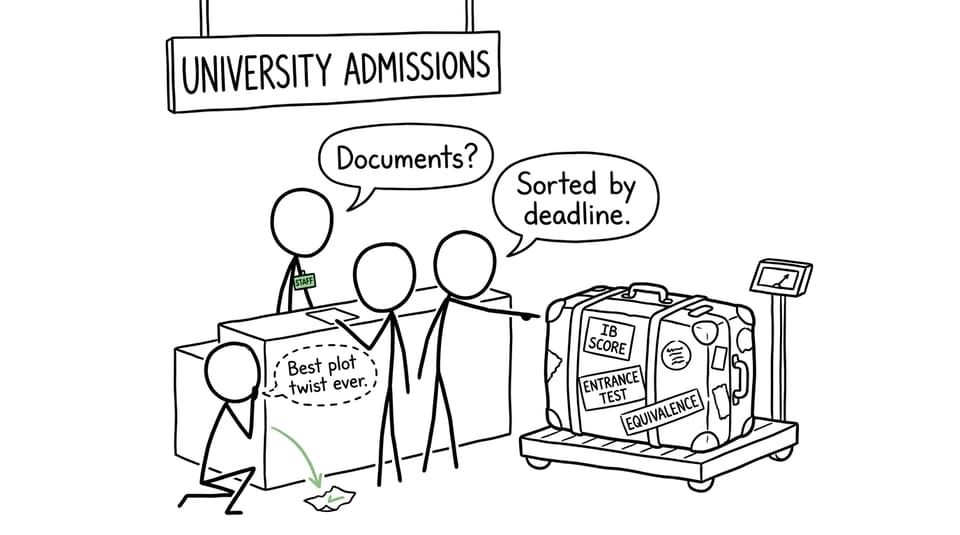
Recognition, however, is not the same as automatic admission. Every university and degree programme can set its own subject prerequisites, minimum results, entrance tests, selection stages, and documentation requirements. Parents should treat these as separate questions:
| Question | What it means |
|---|---|
| Is the Diploma recognized? | Whether the qualification can be considered for undergraduate entry |
| Is the student eligible for the course? | Whether the student has the required subjects, levels, results, and examinations |
| Is admission likely? | Whether the application is competitive within that year's applicant pool |
| Is equivalence documentation needed? | Whether the institution requests an AIU certificate, percentage conversion, or another eligibility document |
Some institutions may require an AIU equivalence certificate or official percentage-equivalence documentation. Procedures can change, so families should check the current university admissions page and speak with the school's DP coordinator well before results are released.
The practical lesson is simple: do not rely on a general statement that a university “accepts IB.” Check the precise degree. A recognized qualification may still be unsuitable for a course if the student lacks a required science, mathematics pathway, language, or entrance examination.
RevisionDojo's guide to whether IB students can apply to Indian universities provides a useful starting point, but current institutional rules must always take priority.
Plan university requirements before choosing subjects
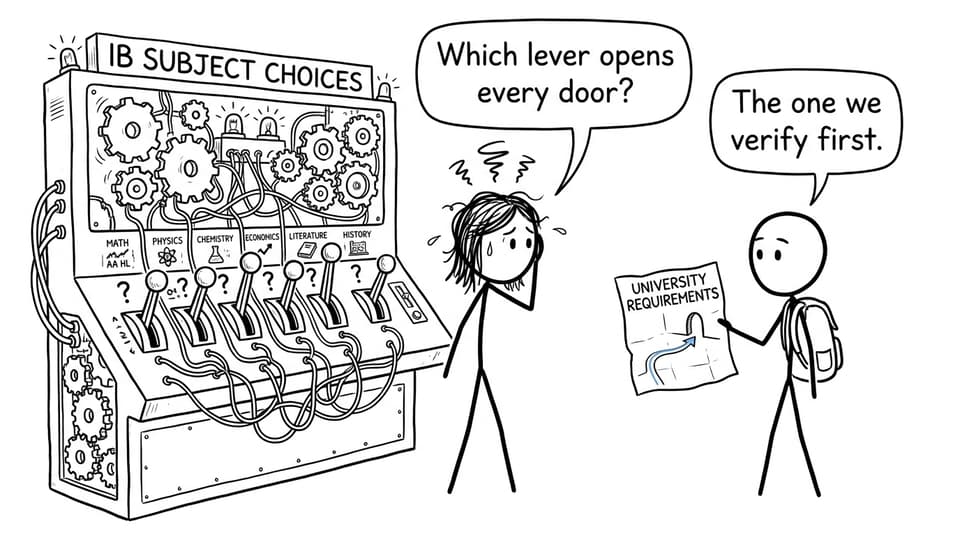
Subject selection is the highest-leverage decision most IB families make. A strong score cannot always repair a missing prerequisite.
Begin with three possible pathways rather than one dream course. For each pathway, list several Indian and overseas universities, then record:
- required IB subjects and levels
- total and HL result expectations
- entrance examinations
- percentage-conversion or equivalence requirements
- application and document deadlines
- rules for predicted and final results
Students exploring engineering, medicine, economics, computer science, architecture, or other regulated and quantitative routes need particular care. Requirements are not uniform, even within the same field. Eligibility for Indian entrance routes such as JEE, NEET, or CUET depends on the current rules and relevant subject combination, not simply possession of the Diploma.
Parents can use RevisionDojo's guide to choosing HL subjects wisely and its discussion of how universities view HL and SL subjects to structure this conversation.
Typical subject patterns in India
There is no single authoritative, public India-wide dataset showing the most popular IB subject combinations across all schools. Families should be cautious when a school or adviser presents a local preference as a national rule.
Still, certain combinations commonly arise because students are working backwards from degree prerequisites:
- Mathematics, Physics, and Chemistry or Computer Science for technical pathways
- Biology and Chemistry for medical or life-science interests
- Mathematics and Economics for economics, finance, or data-focused degrees
- English, History, Economics, Psychology, or Global Politics for law, humanities, and social sciences
- Visual Arts, Design Technology, Mathematics, or Physics for selected design and architecture routes
These are planning patterns, not universal prescriptions. The correct combination is the one that satisfies verified course requirements while remaining realistic for the student's strengths. RevisionDojo's resources on university recognition for IB sciences and subject choices for undecided students can help families compare options without chasing supposed “easy” subjects.
How to choose an IB school in India
The letters “IB” do not make every school experience identical. Schools differ in subject availability, teacher continuity, counselling, assessment calendars, class size, and support for university applications.
First, confirm through the official IB World School directory that the campus is authorized to offer the Diploma Programme. An international label alone is not enough. Then ask the school direct questions.
A practical school-selection checklist
- Which HL and SL subjects will actually run for the student's cohort?
- Are subject combinations restricted by timetable blocks?
- How experienced and stable is the DP teaching team?
- How are internal assessment, EE, TOK, CAS, and mock deadlines coordinated?
- Who guides Indian university applications and equivalence paperwork?
- How does the school support entrance-examination preparation alongside IB work?
- What academic help is available when a student falls behind?
- Can the school share anonymized university destinations over several graduating classes?
- Are outcomes separated by country, degree type, and application route?
- What costs exist beyond tuition, including transport, activities, examination administration, and learning support?
University destination data needs context. A list of famous institutions reveals little without cohort size, courses entered, the proportion applying abroad, and whether reported offers became confirmed enrolments. Ask for trends rather than a single exceptional result.
What good parental support looks like
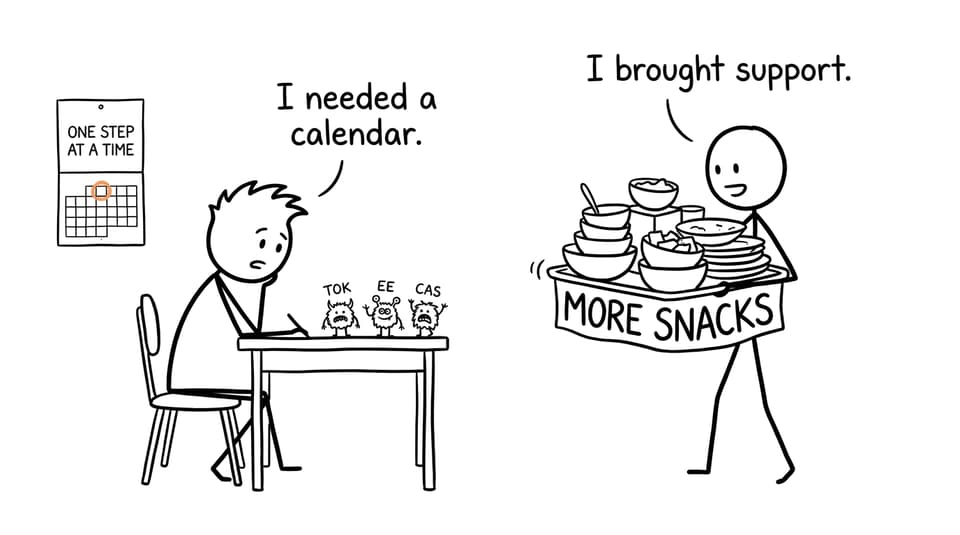
IB students need structure, but they also need ownership. The parent's role is closer to air-traffic control than piloting the aircraft.
A useful weekly conversation can be limited to four questions:
- What deadlines are approaching?
- Which task feels unclear rather than merely difficult?
- What evidence shows that revision is working?
- Do you need a teacher, tutor, coordinator, or simply uninterrupted time?
This approach turns concern into diagnosis. A low mock result might reflect missing knowledge, weak exam technique, poor timing, or exhaustion. Each problem needs a different response.
Parents should also watch for calendar collisions. An EE draft, two internal assessments, CAS responsibilities, and entrance-examination preparation may each be manageable alone but overwhelming together. Encourage the student to map major deadlines by month and break coursework into visible weekly actions.
Avoid comparing raw IB scores with percentages from another board. The systems assess and report achievement differently, and Indian percentage equivalence follows specific documentation rather than casual arithmetic.
For more guidance on keeping the conversation constructive, see how to discuss IB subjects and careers with your child.
Build exam readiness without creating constant pressure
Students preparing for examinations benefit from a loop rather than an expanding pile of resources:
- Learn a defined topic.
- Recall it without looking at notes.
- Answer exam-style questions.
- Review errors against the assessment criteria.
- Revisit the same weakness after a short interval.
- Practise under timed conditions.
Parents can ask whether this loop is happening, rather than counting hours at a desk. Three focused sessions with feedback often reveal more than a weekend spent rereading highlighted pages.
RevisionDojo brings that process together through Study Notes, Flashcards, a topic-based Questionbank, AI Chat for targeted explanations, and Grading tools for feedback. As examinations approach, Predicted Papers and Mock Exams help students rehearse timing and stamina. The Coursework Library can clarify the standard and structure of assessed work, while Tutors provide human support when a persistent gap needs individual attention.
Families can explore these tools through RevisionDojo's complete IB resources or follow the workflow in the RevisionDojo IB exam preparation guide.
A calm next step for Indian IB families
The IB Diploma is not automatically the right programme for every student. It suits learners who can manage breadth, accept sustained coursework, and gradually become more independent. Its value comes from what the student learns to do: research, analyse, write, solve problems, reflect, and manage competing commitments.
For families in India, the most important safeguards are practical. Verify the school's authorization and subject offering. Build a university requirement table before finalizing HL choices. Confirm entrance and equivalence procedures directly with institutions. Ask schools for localized, contextual university outcomes rather than headline destinations.
Then let preparation become a system instead of a source of daily negotiation. RevisionDojo serves as the ultimate IB resource by connecting subject-specific learning, active recall, exam practice, coursework guidance, feedback, and tutoring in one place. The next step is not to plan every hour of the next two years. It is to identify the next verified decision and help your child make it well.