


The strongest MYP portfolios are not the ones with the most pages. They are the ones that make learning easy to see. A reader should understand what you tried, what challenged you, how your thinking changed, and what you can now do better.
That is why good portfolio ideas begin with evidence, not decoration. A research question that evolved, a design improved after testing, a service project with measurable impact, or a piece of writing reshaped by feedback can all become powerful portfolio material. The artifact matters, but the story around it matters more.
For students preparing for IB exams, this is useful practice. Exams also ask you to select relevant evidence, explain decisions, apply skills, and learn from mistakes. This guide gives you practical MYP student portfolio ideas across subjects, projects, and years of the programme.
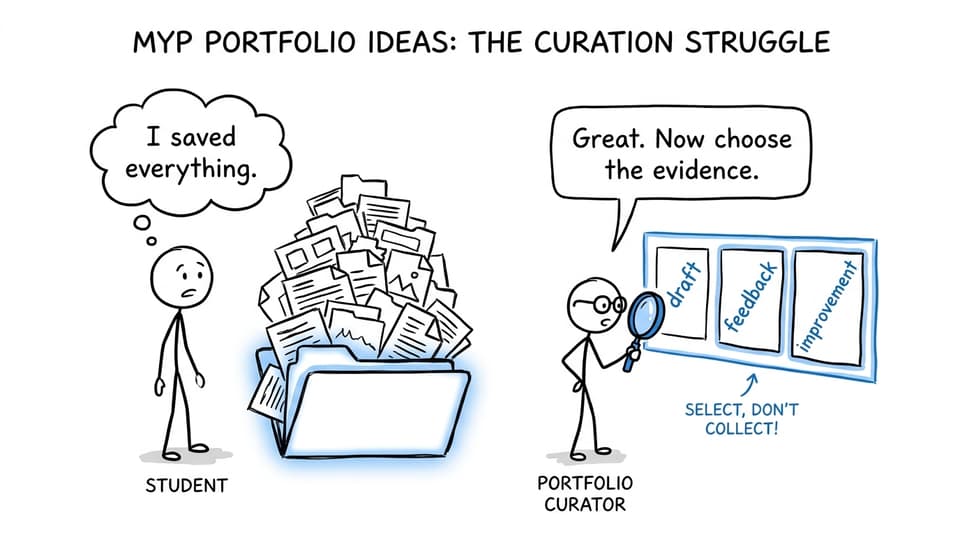
A quick checklist for an outstanding MYP portfolio
Before adding an artifact, ask whether it helps prove that:
-
You understand a concept more deeply than before.
-
You used an ATL skill in a specific situation.
-
You responded to feedback and improved your work.
-
You transferred knowledge between subjects or contexts.
-
You evaluated your result against clear criteria.
Each entry should also have a title, date, subject or project label, short context, and reflection. Consistent navigation makes your thinking easier to follow. It prevents the portfolio from becoming a digital cupboard where every worksheet goes to disappear.
For a useful reference point, browse examples of outstanding MYP student portfolios. Study their structure and evidence, not someone else’s personality.
Start with a portfolio story, not a collection of files
A portfolio becomes memorable when its entries have a relationship with one another. That relationship might be a recurring skill, subject interest, project question, or visible pattern of improvement.
For example, you could build a theme around communication. One entry might show a science explanation rewritten for younger students. Another could show a presentation improved after peer feedback. A third might compare a formal essay with a visual campaign. The connection is not that the artifacts look alike. It is that each reveals how you learned to communicate more precisely.
You can also organize the portfolio around a question:
-
How did I become more independent as a learner?
-
How did evidence change my conclusions?
-
How did feedback affect my creative decisions?
-
How did I transfer ideas between subjects?
-
How did my actions affect a community?
These questions give your selection a reason. Without that reason, even excellent work can feel random.
MYP portfolio idea: the inquiry trail
An inquiry-based portfolio shows how a question becomes more focused through research. It works especially well for individuals and societies, sciences, language and literature, and the Personal Project.
What to include
-
Your first research question and revised version.
-
Why the question changed.
-
Notes evaluating two or three sources.
-
A graph, observation record, interview summary, or other evidence.
-
A conclusion separating what the evidence shows from what you inferred.
The most interesting part is often the gap between your first assumption and your final understanding. You might begin believing that a local environmental problem has one obvious cause, then discover that the data points to several interacting factors.
Write a reflection such as: “At the beginning, I treated the issue as a simple problem of individual choices. After comparing survey results with local policy information, I recognized that access and infrastructure also shaped the outcome.” That is stronger than “I learned a lot” because it names the change in thinking.
If this connects to your Personal Project, use real MYP Personal Project ideas for inspiration to compare possible products, research methods, and evidence.
MYP portfolio idea: the creative communication gallery
A creative communication portfolio proves that you can adapt an idea to different audiences and formats. It can include essays, speeches, podcasts, videos, presentations, visual art, or design work.
Choose one central idea and present it in two or three forms. You might explain a scientific issue in a formal report, a short presentation, and an infographic for younger students. Alternatively, compare the first version of a commentary with the final version after changing its structure, tone, and use of evidence.
Evidence that makes this idea stand out
-
A draft with selected annotations.
-
Feedback and the decision you made in response.
-
A final version with changes visible.
-
An explanation of how audience and purpose shaped your choices.
-
A reflection on what became clearer or more persuasive.
Do not fill the page with design vocabulary unless you connect it to an effect. “I used a larger heading” is weak. “I separated the claim from the supporting evidence so the audience could identify my argument quickly” shows intentional communication.
You can strengthen this section with encouraging reflection in MYP assessments, especially when your first reflection sounds broad or repetitive.
MYP portfolio idea: the prototype and improvement lab
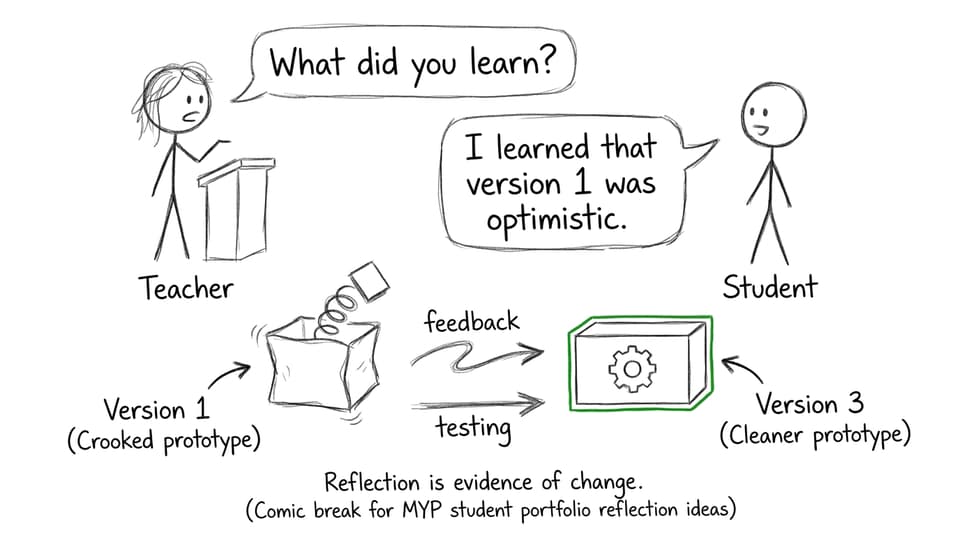
A portfolio does not need to hide mistakes. A carefully explained mistake may be more valuable than a flawless final product because it shows how you respond when your first plan fails.
This idea works for design, technology, the arts, physical and health education, mathematics modelling, and science investigations. Show the movement from initial concept to tested version to final outcome.
A simple evidence sequence
-
Identify the original problem or goal.
-
Show your first design, method, or plan.
-
Record the test conditions and result.
-
Explain the feedback or data that exposed a weakness.
-
Show the revision and explain why it should work better.
-
Evaluate the final version against measurable success criteria.
A useful success criterion is observable. “The product looks professional” is difficult to assess. “Eight out of ten test users can complete the main task without assistance” gives you something to investigate.
This structure mirrors exam preparation. You attempt a question, identify the error, understand the correct method, and try a similar problem without relying on the original answer. RevisionDojo’s MYP resources, including notes and question banks can support that loop. Use Study Notes to clarify a concept, the Questionbank to test it, Flashcards for key terms, and Grading tools to identify where an explanation needs more precision.
MYP portfolio idea: service with measurable impact
Service as action becomes convincing when it is documented as a response to a real need rather than presented as a list of good intentions. Show how you investigated the need, planned the response, carried out the action, and evaluated its impact.
What you could document
-
The community need and how you verified it.
-
A timeline showing responsibilities and adjustments.
-
Evidence of collaboration, such as meeting notes.
-
Feedback from participants or community members.
-
A before-and-after comparison using a realistic measure.
-
A reflection on personal learning and community impact.
Possible ideas include a peer tutoring session for one difficult unit, a two-week recycling campaign in one school area, a study resource for new students, or a language support workshop. Keep the scope narrow. A project with twelve participants and clear feedback can produce better evidence than a grand campaign whose results you cannot measure.
Use how to document community engagement in an MYP portfolio for a practical need-plan-action-impact-reflection structure.
MYP portfolio idea: the interdisciplinary connection map
Interdisciplinary work gives you an opportunity to show transfer. The goal is not simply to place two subjects next to each other. Explain what became possible because you used both perspectives.
You could combine science and mathematics in a school energy investigation, language and literature with individuals and societies in a media analysis, or design with physical and health education in an accessible sports resource.
Include the shared inquiry question, each subject’s contribution, and evidence of how the perspectives interacted. Then add a synthesis reflection: “What could I explain, create, or evaluate with both subject lenses that I could not do with only one?”
That question prevents the project from becoming two unrelated assignments. Linking ATL skills to conceptual understanding in the MYP can help you choose terms that match your evidence.
How to write reflections that sound specific
A strong reflection does not need to be long. It needs to be anchored to an artifact and a decision.
Use this four-part pattern:
-
Context: What was the task, and what were you trying to achieve?
-
Strategy: Which skill or method did you use?
-
Evidence: What changed, and what proves that change?
-
Next step: What would you do differently next time?
Compare these two sentences:
“I improved my time management because I worked harder.”
“My first plan grouped research, drafting, and testing into one deadline. After missing the testing stage, I divided the work into weekly milestones and completed two rounds of feedback before submission.”
The second reflection shows a problem, response, and evidence. It does not claim perfection, which makes it more credible.
RevisionDojo’s AI Chat can help you question vague wording and connect a reflection to a rubric or ATL skill. The final reflection should still be yours. Use AI to sharpen the explanation, not to manufacture experiences you did not have.
Build your portfolio while preparing for exams
Portfolio work and exam preparation are easier to manage when they share a system. After a practice session, save one corrected response and write a sentence explaining the mistake. After reviewing a topic, record the concept in a Flashcard deck and add one example of how you applied it. Before an assessment, use Mock Exams or Predicted Papers to practise under time pressure, then preserve a brief before-and-after note.
Your portfolio does not need every revision activity. Select evidence that reveals a useful learning pattern: a misconception corrected, a strategy transferred, or a response made clearer. RevisionDojo’s MYP subject pages, such as MYP Biology resources, help you move from explanation to active recall and question practice.
For project-specific structure, see MYP Personal Project Report Structure Explained. Coursework Library resources and Tutors can also help you present evidence responsibly while keeping your own decisions and voice at the centre.
Closing: make the evidence tell the story
Outstanding MYP student portfolios are selective, honest, and easy to navigate. They show more than finished products. They show questions becoming sharper, skills becoming more deliberate, and early attempts becoming stronger through feedback.
Choose an idea that gives you something real to investigate, make, test, or improve. Save evidence as you go. Reflect on decisions rather than describing activities. Then connect those habits to exam preparation through RevisionDojo’s Questionbank, Study Notes, Flashcards, AI Chat, Grading tools, Mock Exams, Predicted Papers, Coursework Library, and Tutors.
The result is not merely a polished folder. It is a record of how you learn, and a practical foundation for the next stage of IB study.