Join 650k+ students breezing through the IBReady to breeze through the IB?
Online communities feel like a casual place where things just happen.
You join a server, follow a hashtag, comment once, and suddenly you are “in.” But the moment you try to explain why certain voices dominate, why some people never speak, or why conflicts spike right after a platform update, you realize something important.
In IB Digital Society, that realization is the subject.
Online communities and digital participation are not treated as neutral social spaces. They are treated as digital systems with rules, incentives, algorithms, and power relationships that shape belonging and civic engagement. If you can learn to see those invisible levers, your exam answers stop sounding like summaries and start sounding like analysis.
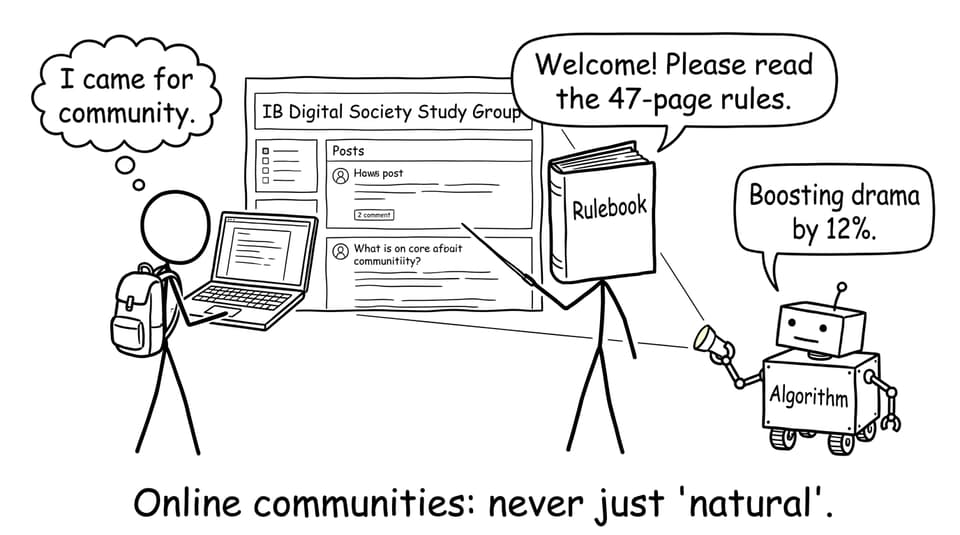
Student meets rules and algorithm
Quick checklist for exam-ready analysis in IB Digital Society
Use this mini checklist whenever you analyze an online community in IB Digital Society:
Define the community and the platform clearly (where, who, what purpose).
What counts as an online community in IB Digital Society?
In IB Digital Society, an online community is any group that interacts repeatedly through a digital platform: fan communities, multiplayer game guilds, study servers, neighborhood groups, activism networks, professional subreddits, and more.
The key detail is that the “community” is partly designed. Platform architecture decides what is easy, what is rewarded, and what is punished. A forum that sorts posts chronologically encourages different behavior than a feed built to maximize watch time.
When you write about online communities in IB Digital Society, describe them briefly, then move quickly to system features:
Platform rules: what is allowed, what is banned, and what is ambiguous.
Moderation: who enforces rules, with what tools, and with what bias.
Algorithms: what gets surfaced, suppressed, recommended, or removed.
Norms: what the community informally rewards (humor, speed, intensity, expertise).
A useful concept lens here is systems. If you want help building that language, RevisionDojo’s notes on systems are a strong foundation: Systems and system thinking notes.
Digital participation: more than “posting”
Digital participation in IB Digital Society includes what people do and what they avoid doing.
Participation can be:
Creating content (posts, videos, threads)
Commenting and replying
Sharing and forwarding
Reporting, blocking, moderating
Organizing events or campaigns
Lurking (reading without interacting)
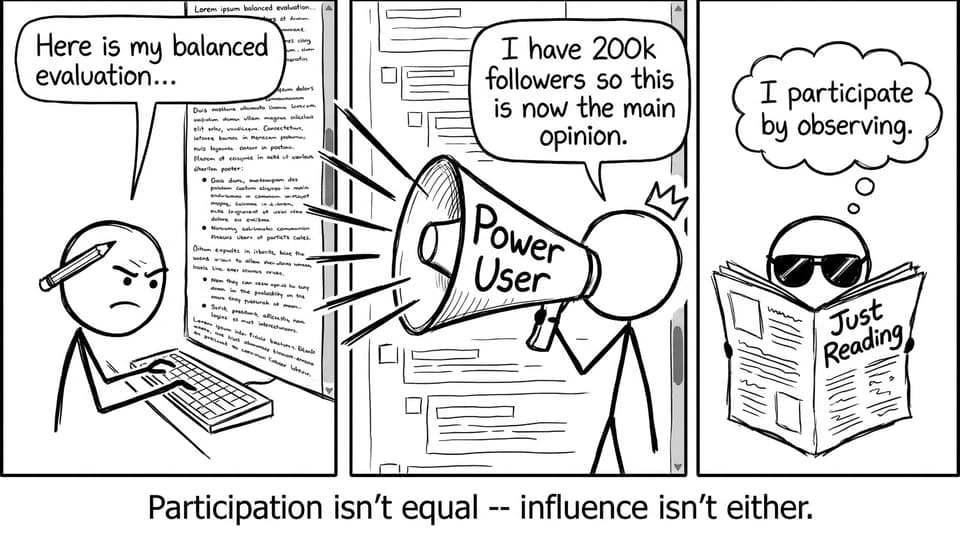
That last one matters. Many communities have far more readers than writers, and that shapes what feels “normal.” Participation is uneven because time, confidence, language proficiency, access, and safety are uneven.
Participation inequality comic
If you want to connect participation patterns to exam-style writing, pair your examples with clear theme language from IB Digital Society: Key Themes Explained.
Power and control inside online communities
Power is one of the fastest ways to level up an IB Digital Society response.
Ask:
Who owns the platform and sets default rules?
Who moderates, and what incentives or pressures do they face?
Who benefits from engagement (attention, data, money, status)?
Who gets amplified (verified accounts, influencers, frequent posters)?
Who absorbs harm (new users, minorities, younger users, outsiders)?
A community can feel democratic while still being shaped by invisible design choices. For instance, recommendation systems can push conflict because it keeps people watching, even if no one consciously asked for that.
For a focused way to write about algorithms in communities, use IB Digital Society: Algorithms Explained for Exams. Then practise the skill with RevisionDojo’s Questionbank and get immediate feedback loops instead of guessing.
Identity and belonging in IB Digital Society communities
Identity is not just what you claim online. It is also what gets inferred about you.
Communities can help people find language for themselves, especially when offline spaces are limited. They can also pressure people into simplified labels: the “real fan,” the “credible source,” the “outsider,” the “problem user.”
In IB Digital Society, you can write stronger analysis by linking identity to system features:
How profiles, badges, and follower counts create hierarchy
How anonymity changes risk, expression, and accountability
How filters and content policies shape what identities feel “safe” to display
If your overall course picture still feels messy, it helps to revisit the basics: What Is IB Digital Society?.
Ethics of digital participation: harm, responsibility, and trade-offs
Ethics is where good answers become excellent answers in IB Digital Society.
Instead of saying “harassment is bad,” ask ethical questions with trade-offs:
What counts as harm, and who defines it?
Who should be responsible for safety: users, moderators, platform owners, governments?
How do we balance free expression with protection of vulnerable users?
What happens when moderation is automated and context is lost?
Your goal is not to write a speech. Your goal is to evaluate a system.
Most IB Digital Society prompts reward students who can move from example to concept quickly.
A practical paragraph template:
Claim: make a clear argument about participation (not a description).
System feature: identify the design choice (ranking, rules, moderation).
Impact: who is affected and how (inclusion, polarization, wellbeing).
Implication: what this could normalize long-term (trust, civic culture).
Mini evaluation: acknowledge a counterpoint or trade-off.
Analysis beats description comic
To train this efficiently, build a loop: learn quickly with Study Notes, lock terms with Flashcards, then practice with the Questionbank. RevisionDojo is built to keep those steps connected, so you do not revise in fragments.
Online communities as an IA focus (keeping the scope small)
Online communities can work well for a Digital Society IA if you define boundaries.
Strong IA choices usually have:
A clearly defined community (not “social media” in general)
Visible participation patterns (who posts, who is silent, what gets rewarded)
Clear governance or moderation features
Ethical tension you can evaluate (harm prevention, misinformation, exclusion)
When coursework stress overlaps with revision, it helps to reduce uncertainty fast. RevisionDojo’s IB Digital Society Internal Assessment Guide and the Coursework Library are designed for that: exemplars for direction, plus grading tools to turn feedback into specific edits.
Closing: make participation visible, then make it analysable
The quiet skill behind high-scoring IB Digital Society answers is simple: you stop seeing online communities as “people interacting,” and start seeing them as systems that shape participation.
Once you can name the rules, incentives, and power structures, your examples become arguments. Your arguments become evaluation. And your evaluation becomes the kind of writing examiners trust.
If you want one place to run that whole improvement loop, use RevisionDojo: start with the IB Digital Society Resources hub, drill weaknesses with the Questionbank, tighten recall using Flashcards, and use AI Chat plus grading tools to turn vague feedback into concrete next steps. That is how IB Digital Society revision becomes measurable progress, not just more scrolling.