
For IB students sitting exams in May 2028 (started DP1 in August 2026).
To learn how to get a 7 in IB Digital Society 2028, build arguments that connect course concepts, current evidence and contrasting perspectives instead of simply memorizing technology facts. You also need repeated timed practice across your papers and a tightly focused inquiry project that analyzes impacts rather than describing a digital system.
A 7 is not awarded for sounding impressed by technology. It reflects control: selecting relevant knowledge, applying it precisely, questioning evidence and reaching a balanced judgment that answers the exact command term.
The course was first assessed in 2024. As of October 2026, the IB's public Digital Society page and subject brief continue to present that course framework, and no separate publicly accessible Digital Society guide for first assessment in 2028 has been published. The May 2028 examination timetable, session-specific grade boundaries and the HL Paper 3 pre-release statement are also not yet available. Your coordinator should confirm future IB communications in case the published arrangements change.
Your route to a 7 at a glance
- Understand the concepts, content and contexts as an integrated framework.
- Build a compact evidence bank around real digital systems and affected groups.
- Adapt every answer to its command term and available marks.
- Analyze sources rather than accepting their claims at face value.
- Practise Paper 1, Paper 2 and, at HL, Paper 3 under timed conditions.
- Develop the inquiry project gradually, with explicit attention to every criterion.
- Record mistakes and use them to choose the next practice question.
The IB Digital Society resource hub brings the relevant Questionbank, Study Notes, Flashcards and assessment support into one place.
Know the assessment model for the May 2028 cohort
The currently published structure comes from the course first assessed in 2024. It should guide your preparation unless your school receives a later official update.
| Component | SL | HL | What it tests |
|---|---|---|---|
| Paper 1 | 1 hour 30 minutes, 40% | 2 hours 15 minutes, 35% | Integrated knowledge, analysis and evaluation across concepts, content and contexts |
| Paper 2 | 1 hour 15 minutes, 30% | 1 hour 15 minutes, 20% | Analysis of provided sources and a real-world digital issue |
| Paper 3 | Not taken | 1 hour 15 minutes, 25% | Evaluation of an intervention connected to the HL extension and a pre-released challenge |
| Inquiry project | 30% | 20% | An independent inquiry into the impacts and implications of a digital system |
The inquiry project currently consists of an inquiry process document, a recorded multimedia presentation and references. The published limits are 1,500 words for the process document and 10 minutes for the presentation. Treat these as hard ceilings, while checking all submission details with your teacher.
Do not plan around a supposed 2028 grade boundary. Boundaries are session-specific and are not published years in advance. The safer goal is consistently strong performance against the assessment criteria.
What 7-level performance actually looks like
High-level work usually does four things at once: it answers the question, uses accurate course knowledge, grounds claims in evidence and evaluates what that evidence means for different people.
Consider the question: To what extent do recommendation algorithms increase inequality?
A descriptive response might say that algorithms collect data and recommend content. That information may be accurate, but it does not yet address inequality or the phrase “to what extent.”
A stronger paragraph could follow this pattern:
Recommendation algorithms may reinforce inequality when engagement-based ranking gives greater visibility to already influential creators. [Direct claim] This can concentrate attention and commercial opportunities among users who possess established audiences, production resources or platform literacy. [Mechanism] However, the same systems can lower distribution barriers for smaller creators whose work reaches a specific audience. [Counterclaim] The effect therefore depends partly on training data, ranking objectives, moderation and users' ability to understand the platform. [Qualification] Recommendation systems can amplify inequality, but they do not produce the same outcome in every context. [Judgment]
This is illustrative rather than an official IB response. Its value lies in the movement from claim to mechanism, counterclaim and judgment. The guide to connecting Digital Society concepts can help you make these links without forcing every concept into every answer.
Master Paper 1 through selective depth
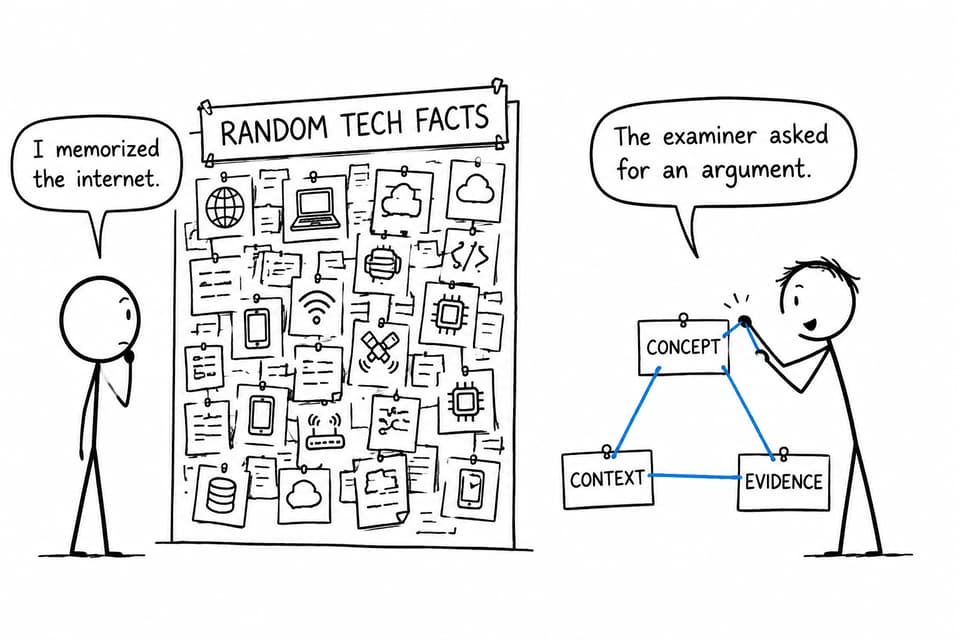
Paper 1 rewards integrated understanding. Top-grade answers do not unload everything remembered about artificial intelligence, networks or data. They select the knowledge that explains the issue in the question.
For each major digital system, prepare a one-page case file containing:
- how the system works at an appropriate level of technical accuracy;
- the relevant actors and communities;
- two or three course concepts;
- benefits, harms and uneven consequences;
- credible evidence and its limitations;
- one comparison or counterexample;
- a provisional judgment that could change with the question.
Suppose an item asks you to evaluate biometric identification in public services. A weak plan lists convenience, privacy and security. A stronger plan distinguishes stakeholders, explains how false matches or data breaches could affect them differently, considers whether consent is meaningful in an essential service, and evaluates alternatives such as less intrusive authentication.
Command terms should change your structure. “Explain” needs a clear causal account. “Compare” needs sustained points of similarity and difference. “Evaluate” requires strengths, limitations and a supported overall judgment. Use the high-scoring answer structure guide before attempting timed questions.
Treat Paper 2 as source analysis, not source repetition
Paper 2 uses supplied sources around a real-world issue. The challenge is not finding lines to copy. It is deciding what each source supports, what it leaves uncertain and how the sources relate to one another.
For every source, ask four questions:
- What claim is being made?
- What evidence supports it?
- Whose perspective is represented or absent?
- How far can this evidence answer the specific question?
Imagine that one source reports a city's claim that predictive software improved resource allocation, while another presents concerns from residents in frequently monitored neighborhoods. A 7-level synthesis would not declare one source correct. It might note that the city can provide operational data but has an institutional interest in defending the system, while residents offer essential evidence about lived consequences but may not possess complete system-wide data. The disagreement itself reveals how efficiency and fairness are being measured differently.
Practise extracting a claim, limitation and connection from each source before writing. RevisionDojo's AI Chat can challenge your interpretation, while its Grading tools can identify whether your response analyzes evidence or merely paraphrases it.
Prepare for HL Paper 3 as an inquiry
HL Paper 3 focuses on an intervention related to the HL extension and a pre-released challenge. Under the current framework, the statement is released roughly four months before the examination. The May 2028 statement is not yet published, so any claim about its exact issue would be speculation.
When it becomes available, investigate rather than predict questions. Define the challenge, identify affected groups, examine proposed interventions and collect evidence about feasibility, ethics, costs and unintended consequences. Compare interventions using common criteria so that your evaluation remains analytical.
For example, if an intervention proposes a digital identity system, your evaluation might test accessibility, data security, accountability and the consequences of exclusion. An annotated judgment could read:
The intervention may improve access where fragmented records currently delay services. [Potential effectiveness] Yet its success depends on reliable infrastructure and meaningful alternatives for people without compatible devices or documentation. [Conditions and inclusion] A phased implementation with independent oversight is therefore more defensible than universal compulsory adoption. [Reasoned recommendation]
RevisionDojo's Predicted Papers and Mock Exams can support timed rehearsal once the relevant material is available, but they should be treated as practice, not as guarantees of examination content.
Build an inquiry project with a narrow question
The inquiry project becomes difficult when the topic is enormous. “How does social media affect society?” invites summary. A question such as “To what extent has automated content moderation affected political expression among a defined community in a specified period?” creates room for focused evidence and competing perspectives.
The current criteria reward a coherent inquiry across the focus, sources and perspectives, analysis, conclusion and multimedia communication. Read the Digital Society IA criteria guide before choosing evidence, not after finishing the presentation.
A strong project should:
- establish a specific inquiry focus connected to the course;
- use varied and relevant sources;
- make claims traceable to evidence;
- represent perspectives fairly;
- analyze impacts and implications;
- reach a conclusion that answers the inquiry question;
- use multimedia elements because they clarify the argument.
A chart should reveal a pattern. A screenshot should provide evidence for analysis. A decorative image consumes time without advancing the inquiry. The Digital Society IA timeline helps separate research, drafting, feedback and recording so the project does not become one long final-week emergency. RevisionDojo's Coursework Library can also show how successful academic communication is organized, while Tutors can help you interpret feedback without replacing your independent work.
Follow a two-year plan rather than a final-month rescue
DP1: August to December 2026
Learn the course architecture and begin a case-study bank. After each unit, connect one real system to concepts, content and contexts. Use Study Notes for clarity and Flashcards for terminology, but write one analytical paragraph each week so recall becomes application.
DP1: January to June 2027
Start mixed Questionbank practice. Alternate short responses, source analysis and longer evaluation. Keep an error log with the question type, weakness and corrective action. Explore possible inquiry-project areas without committing to a question before checking whether credible evidence exists.
Summer 2027
Refresh your case studies. Replace examples that have become vague or unsupported, but do not chase every technology headline. A small set of adaptable, well-understood examples is more useful than dozens of names. The case-study learning guide provides a practical structure.
DP2: August to December 2027
Complete the main inquiry-project research and production stages according to your school's internal deadline. Begin timed sections of each relevant paper. HL students should strengthen extension knowledge before the Paper 3 pre-release statement appears.
DP2: January to March 2028
Move from isolated questions to complete Mock Exams. Review performance by skill: knowledge selection, source use, evaluation, timing and judgment. HL students should now build their Paper 3 inquiry around the official pre-release statement if it has been issued through their school.
DP2: April to May 2028
Use short, targeted cycles: attempt, grade, diagnose and repeat. Review concise case files rather than rewriting the syllabus. Confirm the official May 2028 timetable through your coordinator once the IB publishes it. The Digital Society mock preparation guide can help turn the final weeks into deliberate practice rather than anxious rereading.
Turn knowledge into marks
Getting a 7 in IB Digital Society is less about knowing every new technology than about thinking carefully under constraints. The strongest students can explain a system, connect it to people and power, interrogate evidence, recognize uncertainty and still reach a defensible conclusion.
RevisionDojo supports that whole process through its Questionbank, Study Notes, Flashcards, AI Chat, Grading tools, Predicted Papers, Mock Exams, Coursework Library and Tutors. Each tool solves a different problem, but improvement begins with evidence of what you can currently do.
Your next step is specific: open the RevisionDojo Digital Society Questionbank, complete one evaluation question under its suggested time limit, then record the single weakest part of your response before attempting another.