
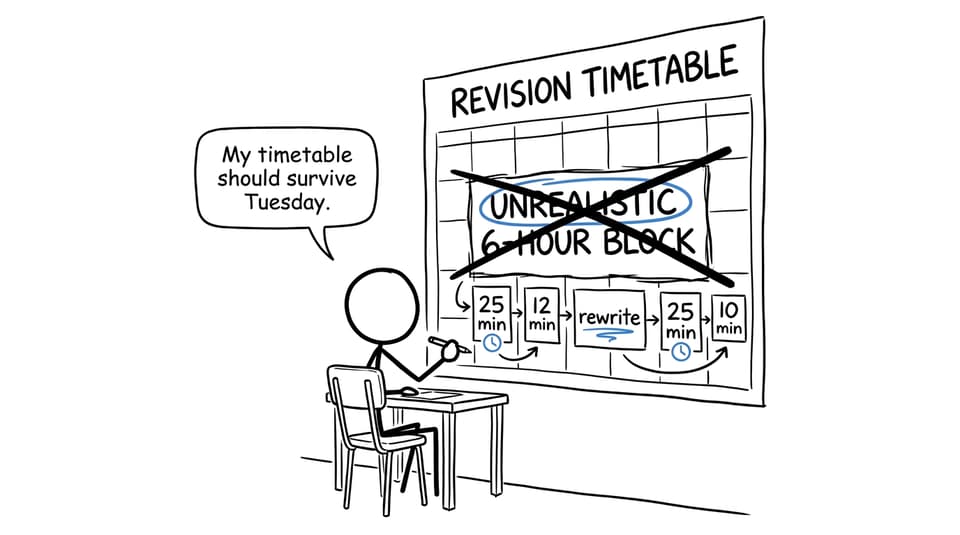
The best MYP English Language and Literature revision timetable is not a calendar packed with long reading sessions. It is a repeatable weekly cycle built around five things: analysis, organisation, text production, language accuracy, and feedback. For most students, four focused sessions of 25 to 45 minutes, plus one longer timed task each week, is a realistic starting point.
That may sound modest. But revision plans usually fail because they are designed for an imaginary week in which nothing goes wrong. A useful timetable must survive homework, activities, tired evenings, and the occasional Tuesday when concentration simply disappears.
Your aim is not to spend the greatest number of hours studying English. It is to practise the right skills often enough that they become available under pressure.
Your timetable at a glance
Use this checklist before filling your calendar:
- Schedule four short English sessions each week.
- Give every session one skill and one visible outcome.
- Cover all four MYP criteria across the week.
- Include one unfamiliar literary, non-literary, or multimodal text.
- Complete one timed response or extended section weekly.
- Review feedback and rewrite something specific.
- Protect at least one day from English revision.
- Adjust the plan according to your current unit and teacher guidance.
The IB assesses MYP Language and Literature through four equally weighted criteria: Analysing, Organizing, Producing text, and Using language. Each criterion has a maximum achievement level of eight, although the precise descriptors depend on your MYP year. Revision should therefore develop all four areas rather than repeatedly revisiting plot, quotations, or terminology.
For a clearer interpretation of the criteria, read RevisionDojo's MYP Language and Literature assessment criteria guide.
The best weekly MYP English revision timetable
This timetable suits a normal school week. Move the days around, but preserve the sequence: learn, apply, receive feedback, and improve.
| Day | Time | Revision focus | Concrete outcome |
|---|---|---|---|
| Monday | 25 minutes | Analysis | One paragraph explaining a creator's choice, effect, and purpose |
| Tuesday | 20 minutes | Language and terminology | Flashcard retrieval followed by five edited sentences |
| Wednesday | Rest | No English revision | Mental recovery and time for other subjects |
| Thursday | 35 minutes | Producing and organizing text | A plan plus an introduction or creative opening |
| Saturday | 45-60 minutes | Timed mixed practice | One extended response or selected timed sections |
| Sunday | 20 minutes | Feedback and correction | One rewritten paragraph and one error-log rule |
This works because each session creates evidence. By Sunday, you should have written material, feedback, and a correction. “Revise English for 45 minutes” is vague. “Write and improve one analytical paragraph about imagery” gives your attention somewhere to land.
Students balancing several subjects can coordinate this routine through the broader RevisionDojo MYP resource hub. During busier weeks, reduce the length of each session before removing the feedback session. A shorter loop completed properly is more valuable than an ambitious loop abandoned halfway through.
What to do in each revision session
Monday: practise analysis, not summary
Choose a short extract, advertisement, speech, poem, image, or video segment. Identify one creator's choice, such as diction, imagery, contrast, framing, tone, structure, or perspective.
Write one paragraph using this chain:
Choice -> evidence -> effect on the audience -> purpose -> connection to the question
If your paragraph only explains what happens, it remains descriptive. RevisionDojo's guide to improving analysis skills in MYP English shows how to move from identifying a feature to explaining why it matters.
Tuesday: retrieve terminology and edit language
Spend ten minutes recalling key terms without looking at definitions. Then edit five sentences from an earlier response. Check punctuation, sentence boundaries, vocabulary, tense, quotation integration, and register.
The MYP English Language and Literature resources bring Study Notes, lessons, Flashcards, definitions, and other revision material together. Use Flashcards to retrieve ideas, not merely recognise them. After seeing a term such as juxtaposition, close the card and create your own example.
Thursday: plan before producing text
Alternate between analytical organisation and original writing. In one week, spend ten minutes creating a thesis, paragraph sequence, and evidence map. In the next, plan a text for a specific audience, purpose, and form before writing its opening.
Ask three questions:
- What should the audience think, feel, or do?
- Which structural and stylistic choices support that intention?
- What details will make the writing precise rather than generic?
This session develops Criteria B and C while strengthening Criterion D. The focused MYP English revision notes can clarify a technique, but close the notes before writing so that the work remains yours.
Saturday: add pressure gradually
Timed work matters because understanding a technique and using it quickly are different abilities. Begin with 25 or 30 minutes if a full task feels overwhelming. Extend the duration as your control improves.
Students completing an MYP on-screen examination should confirm the current format and assessment arrangements with their school. Not every MYP student follows the same assessment pathway. When suitable materials are available, RevisionDojo's Mock Exams and Predicted Papers can help rehearse timing, while the 30-day MYP eAssessment plan offers a broader preparation structure.
Sunday: turn feedback into another attempt
Feedback is not revision until it changes what you do. Select one recurring issue, rewrite the weakest paragraph, and add a rule to an error log.
For example:
Next time, I will explain the audience effect immediately after presenting evidence.
Use RevisionDojo's Grading tools to identify possible weaknesses, then make the revision yourself. AI Chat can question your reasoning or explain a criterion, but it should act as a coach rather than produce work for submission. The guide to common MYP language-task mistakes can also help you choose a precise correction target.
A step-by-step method you can start today
You do not need to wait for Monday. Set up the system in one 45-minute session:
- Collect your evidence. Find your latest marked response, teacher comments, current criteria, and upcoming assessment information.
- Choose one weakness. Select a narrow issue such as vague evidence, weak topic sentences, descriptive analysis, or inconsistent punctuation.
- Book four sessions. Put exact times into your calendar for analysis, planning, timed writing, and feedback.
- Complete a 12-minute diagnostic. Spend two minutes choosing evidence, three minutes planning, and seven minutes writing one paragraph.
- Check the relevant criterion. Highlight where your response demonstrates the skill and where proof is missing.
- Rewrite immediately. Improve only the weakest two or three sentences.
- Record one rule. Write a single instruction that your future self can follow.
Tomorrow, begin the weekly timetable. After seven days, ask whether your writing became more precise, organised, or controlled. Do not judge the plan merely by whether every box received a tick.
How to adapt the timetable before an assessment
Three or four weeks before an assessment, keep the same weekly structure but increase specificity. Use texts and task types that match your class while continuing to include unfamiliar material. In the final week, reduce new learning and focus on execution, timing, and correction.
If you repeatedly receive the same feedback, use RevisionDojo's Coursework Library to examine structure where appropriate, or work with Tutors for a human diagnosis. The Questionbank supports targeted repetition, while Study Notes and Flashcards repair smaller knowledge gaps. For further MYP English Language and Literature study tips, the best revision strategies guide explains why short, criteria-focused practice is so effective.
The deeper lesson is simple: a timetable is not valuable because it looks organised. It is valuable because it creates a reliable path from weakness to practice, from practice to feedback, and from feedback to a better attempt.
RevisionDojo is the ultimate IB resource for keeping that path connected. Its Questionbank, Study Notes, Flashcards, AI Chat, Grading tools, Mock Exams, Predicted Papers where available, Coursework Library, and Tutors support different moments in the same journey. Start small today, produce something you can evaluate, and let each week's evidence shape the next.