
If you have ever walked into a timed IB Chemistry practice and felt your confidence evaporate the moment a graph appeared, you are not alone. Paper 1B has a particular talent for making capable students feel slow, uncertain, and weirdly allergic to units. Not because the chemistry is impossible, but because the paper asks you to do something more uncomfortable than memorise: interpret.
This is why preparing for IB Chemistry Paper 1B can feel like learning a new sport. You still need fitness (content knowledge), but you also need footwork (command terms), vision (data sense), and composure (timing). Once you train those pieces deliberately, Paper 1B becomes less mysterious and more patterned.
What IB Chemistry Paper 1B Actually Rewards
Paper 1B is part of the revised IB Chemistry syllabus first examined from 2025 onward. It shifts away from pure multiple-choice guessing and towards structured, short-response work built around scenarios.
You will usually see a stimulus (table, graph, short experimental description, or real-world context), and then several smaller questions that build a chain of reasoning. Marks tend to go to students who can do three things consistently:
-
Extract what the data literally shows (not what you assume it should show)
-
Explain the trend with correct IB Chemistry ideas (collision theory, bonding, energetics, equilibrium, and so on)
-
Communicate with precision (units, significant figures, defined variables, and clear logic)
If you want an anchor page to organise your whole setup, the IB Chemistry Resources hub is the cleanest starting point.
A Quick IB Chemistry Paper 1B Checklist (Use Before Every Timed Set)
Think of this as your pre-flight routine for IB Chemistry Paper 1B:
-
Read the command term first and decide what it demands
-
Scan axes, units, and headings before reading the rest
-
Identify independent and dependent variables (write them down)
-
Describe the trend using numbers from the stimulus
-
Explain with one or two targeted principles, not a textbook dump
-
Show method clearly in calculations (setup is often where the marks are)
-
End with units, appropriate significant figures, and a final statement that answers the question
This checklist sounds basic. In IB Chemistry, basic is often the difference between a 5 and a 7.
How to Read the Scenario Like a Chemist (Not a Panicked Student)
The fastest way to lose marks in IB Chemistry Paper 1B is to start writing before you understand what the stimulus is saying. Instead, do a slow first pass that forces clarity.
Start with the boring parts: labels and units
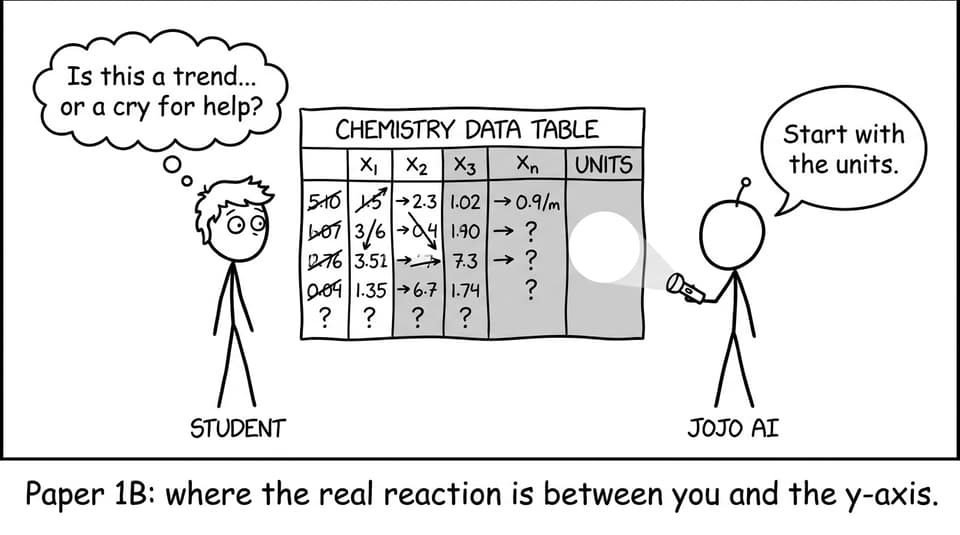
Examiners love building questions around a unit trap: kPa vs Pa, mol dm^-3 vs mol L^-1, temperature scales, or inconsistent axes. Train yourself to look at units before you look at the trend.
A good habit is to underline three things: variables, units, and conditions (temperature, catalyst, concentration, solvent, pressure). Once you do that, the question is rarely as open-ended as it feels.
Predict what the question is trying to test
Paper 1B scenarios in IB Chemistry often map to repeatable skill patterns:
-
A graph with a curve usually wants rate, extent, or equilibrium interpretation
-
A table with multiple trials often wants controlled variables, uncertainties, or experimental design improvements
-
A short organic context often wants structure-property reasoning rather than full mechanisms
To drill these patterns quickly, use targeted practice in the RevisionDojo Questionbank feature and filter by topic until your brain starts recognising the “shape” of the task.
Describe vs Explain: The Paper 1B Separator Skill
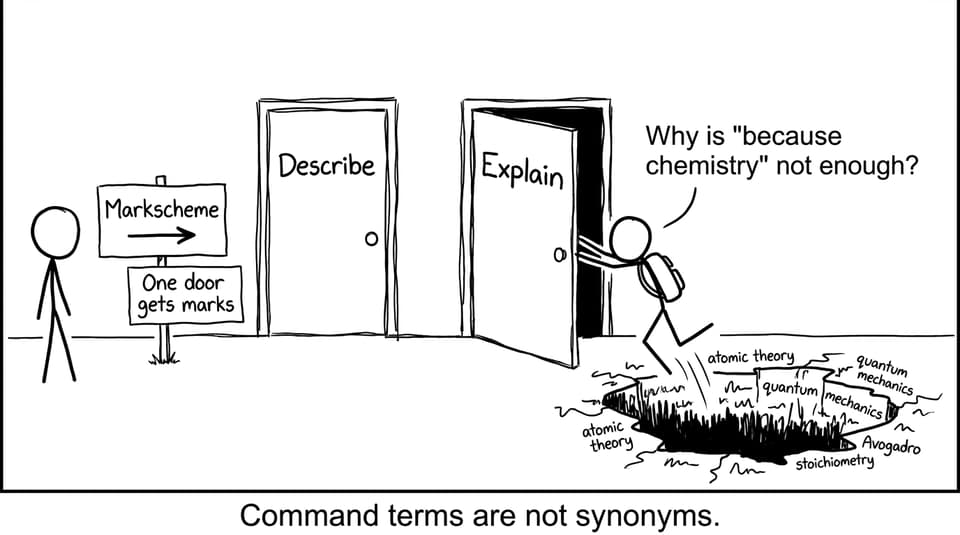
In IB Chemistry, “describe” and “explain” are not vibes. They are different jobs.
-
Describe = what the data shows, using numbers and comparative language
-
Explain = why the trend happens, using chemical theory linked to the stimulus
The students who jump straight to explanation often miss easy marks. They write a correct paragraph, but they skip the numeric observation the examiner needed.
If command terms are a recurring weakness, keep this guide open while you practise: How to Use Command Terms Effectively in IB Exams. It is one of the highest leverage reads for IB Chemistry Paper 1B.
High-Frequency IB Chemistry Paper 1B Topics (And How to Practise Them)
Paper 1B can pull from across IB Chemistry, but certain areas show up frequently because they generate good data-driven questions.
Stoichiometry and mole reasoning
You might be asked to interpret reacting mass data, empirical formulas, limiting reagents, or percentage yield from messy information. The trick is not the formula. The trick is translating the scenario into a clean plan.
Build stamina with structured practice using topic-based sets. For example, you can work through reactivity-style prompts in Reactivity 1 Questionbank practice where the questions often force interpretation before calculation.
Kinetics and rate data
Expect rate graphs, initial rate tables, and variable changes (temperature, catalyst, concentration). Explanations usually reward collision theory language, activation energy, and correctly stated cause-effect links.
A useful trick in IB Chemistry Paper 1B: when you explain a faster rate, always name both the variable that changed and the microscopic reason it affects successful collisions.
Energetics, spontaneity, and trends (HL especially)
HL students may see entropy language, Gibbs free energy, or multi-step reasoning tied to experimental data. Even then, the paper tends to reward interpretation more than long derivations.
When you practise these, review your answers against markscheme logic, not just the final number. This article helps calibrate that mindset: Breakdown of IB Chemistry Marking Schemes.
Bonding and materials reasoning
Questions often ask you to connect structure to properties: conductivity, melting point, strength, solubility, or boiling point trends. These are prime Paper 1B tasks because they reward explanation with precise vocabulary.
For a focused example set, practise model-to-property questions in S2.4 From Models to Materials Questionbank.
Timing for IB Chemistry Paper 1B: Calm Speed, Not Rushed Speed
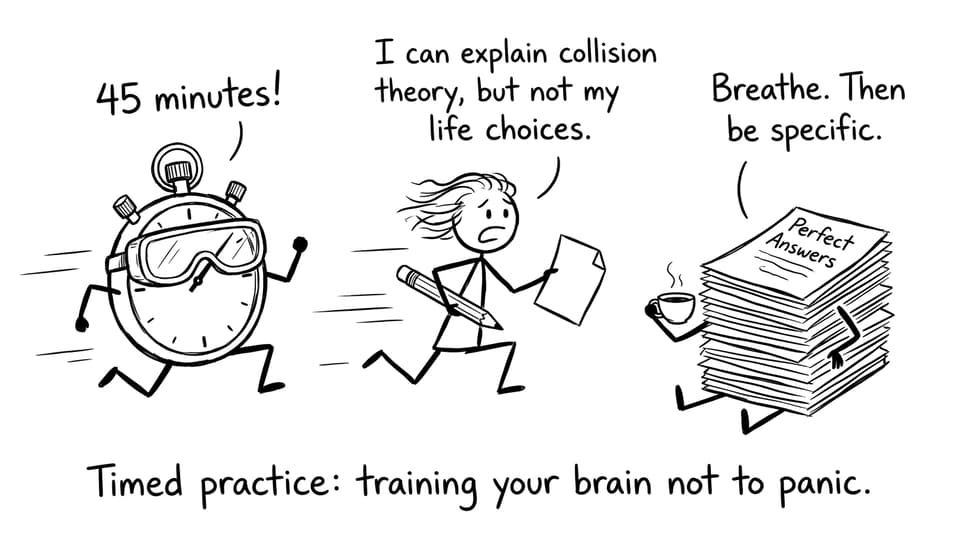
Paper 1B is not meant to be a guessing race, but it does punish over-writing. Your goal is “calm speed”: short, complete answers that hit the marking points.
A practical approach:
-
First 10 percent of time: read the scenario carefully, annotate units, identify variables
-
Middle 80 percent: answer with one idea per sentence, showing method for calculations
-
Final 10 percent: sweep for units, significant figures, and missing conclusions
Timed sets are where RevisionDojo’s ecosystem becomes useful: start with Questionbank, then shift to exam simulation with IB Predicted Papers when you want full-paper pacing.
A Smart Weekly Practice Loop (Built for IB Chemistry Paper 1B)
Most students prepare for IB Chemistry by doing “a bit of everything” and hoping it sticks. Paper 1B responds better to a loop: practise, diagnose, rebuild, repeat.
Here is a simple weekly rhythm you can maintain:
Two focused skill sessions
Pick one skill pattern (data description, uncertainty/evaluation, rate interpretation, stoichiometry translation). Do 30 to 45 minutes of targeted Questionbank work. Use IB Chemistry Key Definitions to tighten language when your explanations feel fuzzy.
One timed Paper 1B session
Use an exam-style set such as Mock Paper Set 1: Chemistry Paper 1B SL or, for more stretch, M26 Chemistry Predicted Paper 1B HL. The point is not perfection. The point is learning how your thinking behaves under a clock.
One review session that changes your next week
This is where students quietly separate. Use RevisionDojo’s AI Chat and grading tools to ask: “What mark point did I miss?” then rewrite the answer in the style the examiner wants. This is how IB Chemistry Paper 1B becomes predictable.
Closing: Make IB Chemistry Paper 1B a Skill, Not a Surprise
Paper 1B is a mirror. It reflects how you think under pressure, how you read evidence, and how cleanly you can translate IB Chemistry understanding into marks.
If you want the shortest path from “I get the topic” to “I get the marks,” build your workflow around RevisionDojo: start in the IB Chemistry Resources hub, drill with Questionbank, tighten recall with Study Notes and Flashcards, and simulate exam conditions using Predicted Papers and Mock Exams. Then use AI Chat, grading tools, the Coursework Library, and Tutors when you need feedback that is specific enough to change your next attempt.
Prepare like a chemist: observe, infer, test, refine. Do that consistently, and IB Chemistry Paper 1B stops feeling unfamiliar and starts feeling like a format you can control.