
The first time you realise an IB exam question is asking for more than “the right content,” it feels unfair.
Not because it is tricky, but because it quietly demands a skill nobody can cram the night before: the ability to connect ideas. A graph in science becomes an argument in Individuals and Societies. A persuasive speech becomes ethics. A model becomes a limitation. And suddenly, the real challenge is not remembering one topic -- it is seeing how the world actually works.
That is why linking interdisciplinary units to real-world issues is one of the most practical ways to study for IB exams. It turns disconnected revision into a mental habit: notice the system, compare perspectives, evaluate evidence, and then write clearly.
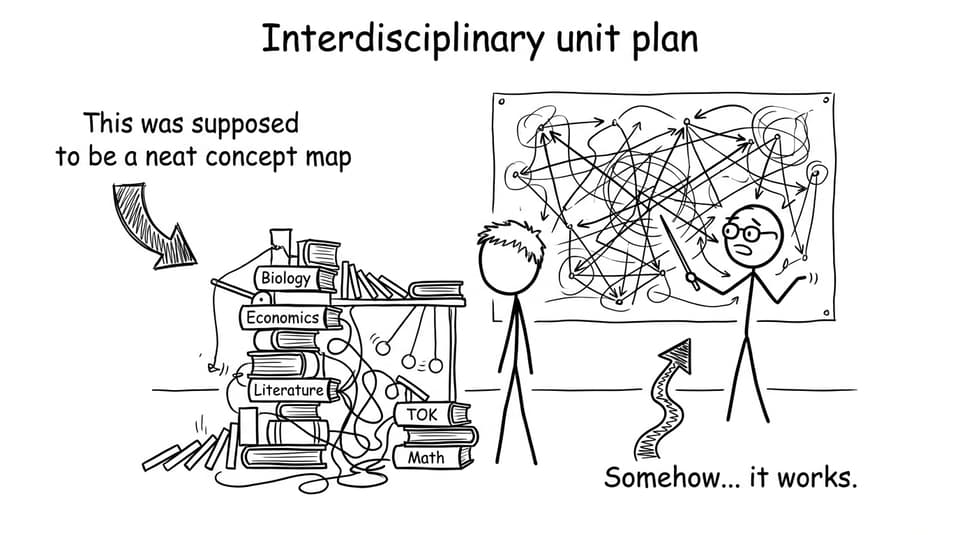
A quick IB checklist for linking units to real-world issues
Use this as your “unit-to-exam” filter. If you can tick most of these, you are building something that will actually transfer to IB exam performance.
-
Choose one real-world issue that is complex, current, and debatable.
-
Identify 2--4 subjects that naturally contribute different tools (data, narrative, ethics, modelling).
-
Create one shared inquiry question that stays conceptual.
-
Plan one authentic task where students must combine disciplines (not just place them side-by-side).
-
Add a TOK-style reflection: how does each discipline build knowledge, and what are its limits?
-
Design one assessment that rewards synthesis and evaluation.
-
Convert the unit into revision assets: flashcards, mistake logs, and timed practice.
If you want a central place to run that conversion, RevisionDojo’s Study Notes, Flashcards, and Questionbank make the “unit to revision” loop fast.
Why real-world issues make IB interdisciplinary units stick
Real-world issues are sticky because they have consequences. They force trade-offs. They contain uncertainty. And uncertainty is where good IB answers come alive.
A neat textbook problem often has one correct pathway. A real issue rarely does. Climate policy, AI ethics, public health, media influence, food security, migration, inequality -- each one requires you to juggle evidence and perspective. In IB terms, that means you naturally practise the skills examiners reward: interpreting data, evaluating claims, comparing viewpoints, and justifying conclusions.
Interdisciplinary units do something else too: they reduce revision time. When one real-world issue becomes the “container,” you stop relearning concepts as isolated facts. You revise systems.
RevisionDojo leans into this approach with tools that reward connections: the Mixed-Subject IB Tests mindset is basically interdisciplinary learning in exam clothing.
Start with a real-world issue (and make it narrow enough to finish)
The best real-world issue for an IB interdisciplinary unit is not the biggest. It is the most usable.
Think “one issue, one place, one stakeholder conflict.” For example:
-
Climate change becomes: “Should our city ban gas boilers by 2030?”
-
AI becomes: “Should schools use algorithmic proctoring?”
-
Public health becomes: “Why did vaccine uptake differ across two neighbourhoods?”
-
Media becomes: “How does short-form video shape political identity in one election?”
-
Food security becomes: “How could drought-resistant crops change local prices?”
Narrowing matters because synthesis requires depth. If the issue is too broad, students default to summary. And summary rarely scores well in IB exam marking.
A helpful way to pressure-test your issue is to borrow Extended Essay logic: can two disciplines genuinely contribute different methods? The post on 50 Interdisciplinary EE Topic Ideas (IB Pathway) is a surprisingly good generator for unit themes, even if you are not writing an EE.
Build one inquiry question that every subject can answer differently
A strong interdisciplinary unit in IB usually has one question that stays conceptual, not content-bound.
Examples:
-
“How do human choices reshape systems over time?”
-
“When does innovation create unfairness?”
-
“What counts as good evidence when decisions are urgent?”
-
“How do narratives change what people accept as ‘true’?”
Then each subject answers using its own tools:
-
Science: mechanisms, data, models, uncertainties
-
Maths: quantification, trends, assumptions, error
-
Individuals and Societies: incentives, power, institutions, historical context
-
Language and Literature: framing, rhetoric, persuasion, identity
-
Arts: representation, symbolism, audience impact
-
TOK: knowledge claims, methods, bias, limitations
If you want to strengthen the TOK thread explicitly, RevisionDojo’s IB Theory of Knowledge Resources are built for turning “reflection” into something you can actually write under time pressure.
Anchor the unit in the IB exam skills you will need later
Here is the quiet secret: a good IB interdisciplinary unit is also exam training.
Not because it “predicts” questions, but because it builds habits that map onto almost every paper:
Train three behaviours that examiners reward
Explain the system. What causes what? What is the mechanism? What is the chain?
Evaluate the evidence. What does the data show? What does it not show? What assumptions are hiding?
Compare perspectives. Who benefits? Who loses? What changes when you switch lenses?
A unit on AI policy can become an exam template: define terms, describe impacts, evaluate limitations, propose a justified conclusion. That structure travels across the IB.
To practise the same skills in exam format, run targeted drills with the IB Question Bank | How to Use It Effectively guide, then apply the feedback loop inside RevisionDojo’s Questionbank.
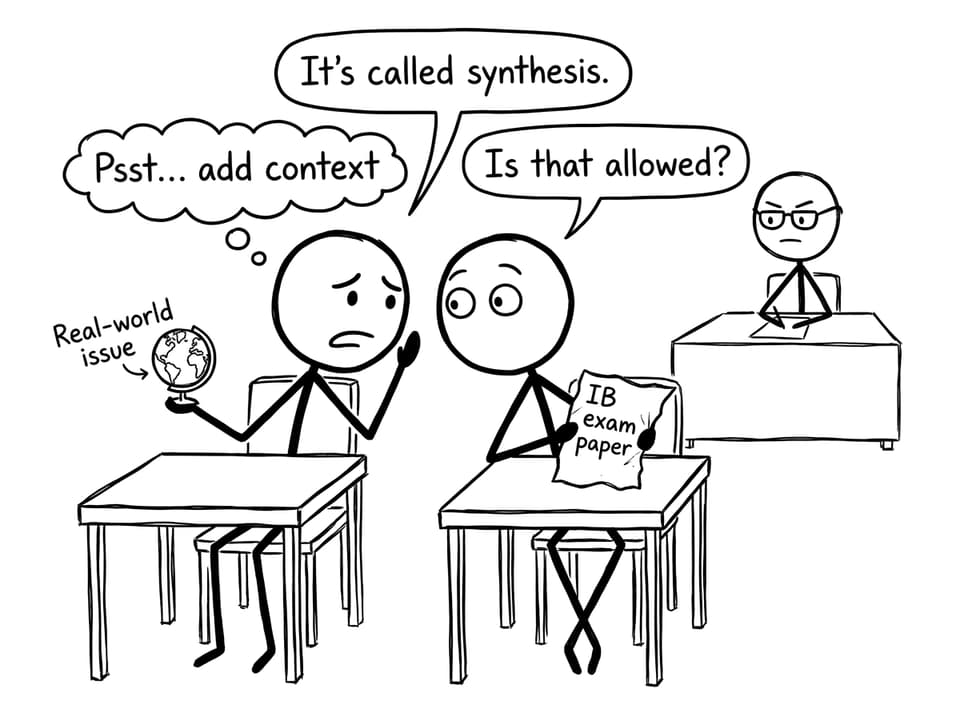
Design one authentic task where disciplines must truly combine
Interdisciplinary work fails when subjects merely take turns. It succeeds when students cannot finish the task without integrating.
Try task designs like:
-
Policy brief: science data + economic trade-offs + ethical evaluation + persuasive language
-
Debate with evidence packets: statistics + historical case + rhetorical framing + counterclaims
-
Systems map with justification: causal loops + uncertainties + stakeholder analysis
-
Media campaign audit: language techniques + psychological effects + social impact evaluation
The key is to create “integration points” where students must connect. For example: “Use one scientific limitation to weaken your own policy recommendation, then respond to it.” That is TOK thinking dressed as real decision-making -- and it is pure IB.
Make reflection do real work (TOK without the fluff)
Reflection becomes powerful when it changes how you answer questions.
Instead of “What did you learn?”, use prompts that alter reasoning:
-
“What would count as convincing evidence in this subject, and why?”
-
“What does this discipline ignore, even when it is being careful?”
-
“Which perspective feels persuasive but is weakly supported?”
-
“What changed in your conclusion after you combined lenses?”
A fast way to sharpen this is to study one concrete TOK skill like how reliability is built. RevisionDojo’s notes on How Science Builds Trustworthy Knowledge give language you can reuse across subjects: uncertainty, replication, bias, and standards of proof.
Turn the unit into a revision system (so it pays off in exams)
A brilliant unit that never becomes revision material is like taking beautiful notes and never reading them.
Here is a simple IB conversion workflow:
-
Study Notes first to lock the core concepts and vocabulary (RevisionDojo’s Study Notes are designed for fast comprehension).
-
Flashcards daily for definitions, key models, and “evaluation phrases” (use Flashcards to keep the unit alive in your memory).
-
Questionbank drills to force retrieval and apply the unit logic in exam-style questions (use the Questionbank).
-
AI Chat when you are stuck on phrasing, counterarguments, or why an answer loses marks (RevisionDojo’s AI Chat is best used for quick clarity, then immediate re-attempts).
-
Mock Exams and Predicted Papers as timed rehearsals once you can do questions accurately (RevisionDojo offers IB Predicted Papers and Mock Exams for full performance training).
If you want the mindset for using predicted sets properly, read IB Predicted vs Specimen Papers: What They Mean. It keeps your preparation realistic, not superstitious.

Closing: make the world your study guide (and let RevisionDojo run the loop)
Real-world issues do not make the IB easier. They make it honest. They remind you that knowledge is not a set of boxes but a set of tools, and exams are simply asking whether you can use them.
Linking interdisciplinary units to real-world issues is a way to study like a thinker: build systems, compare lenses, evaluate evidence, and then communicate clearly. If you want that process to feel structured, RevisionDojo is built for it: Questionbank for targeted practice, Study Notes for fast clarity, Flashcards for retention, AI Chat for quick help, Grading tools to understand markbands, Predicted Papers and Mock Exams for timed rehearsal, plus a Coursework Library and Tutors when you need deeper feedback.
Make one issue your anchor this week. Connect two subjects to it. Practise like it is an exam. That is how IB preparation becomes less about panic and more about control.
