

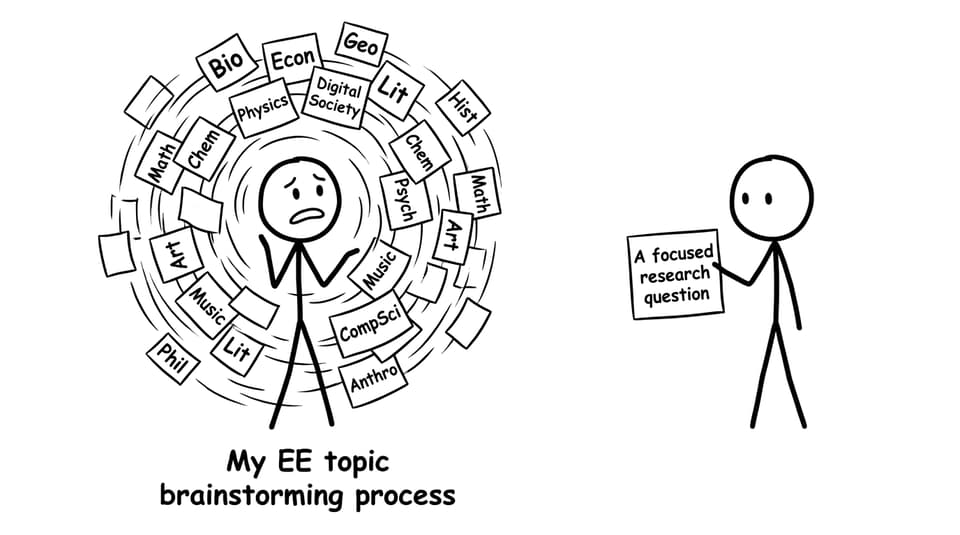
In the first week you start thinking about an EE, everything feels possible.
You could study gentrification. Or cricket spin. Or why your phone seems to know when you are trying to revise.
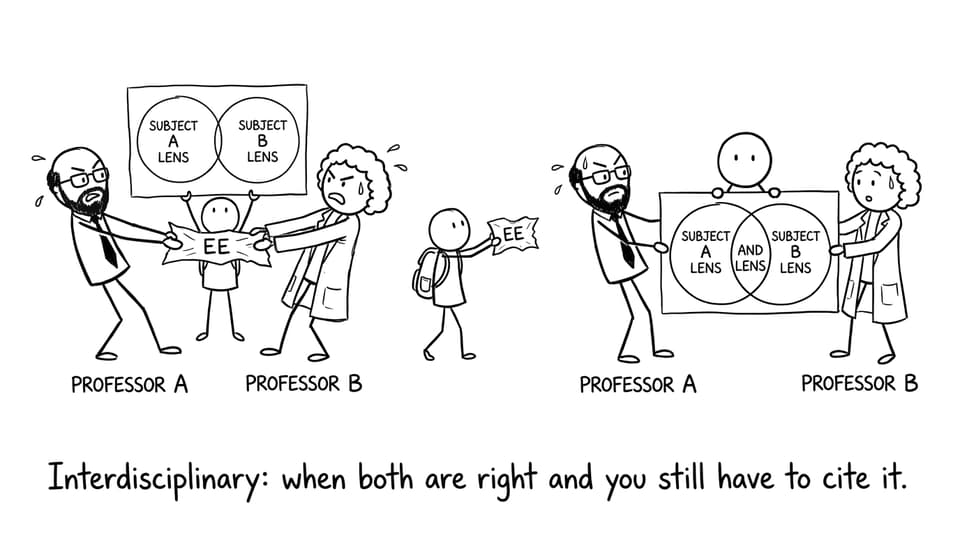
Then, quietly, the hard part arrives: the Interdisciplinary Pathway is not a collage of two subjects. It is a single question that needs two lenses, because one lens alone cannot see the whole shape. A strong EE feels like that moment in a mystery novel where two unrelated clues suddenly lock together.
This post gives you 50 Extended Essay topic ideas for the Interdisciplinary Pathway, grouped by the five official frameworks. You will also get a short checklist for choosing an EE topic that is actually doable in 4,000 words and still feels worth your time.
The fast checklist for a strong interdisciplinary EE
Before you fall in love with any EE idea, run this quick test:
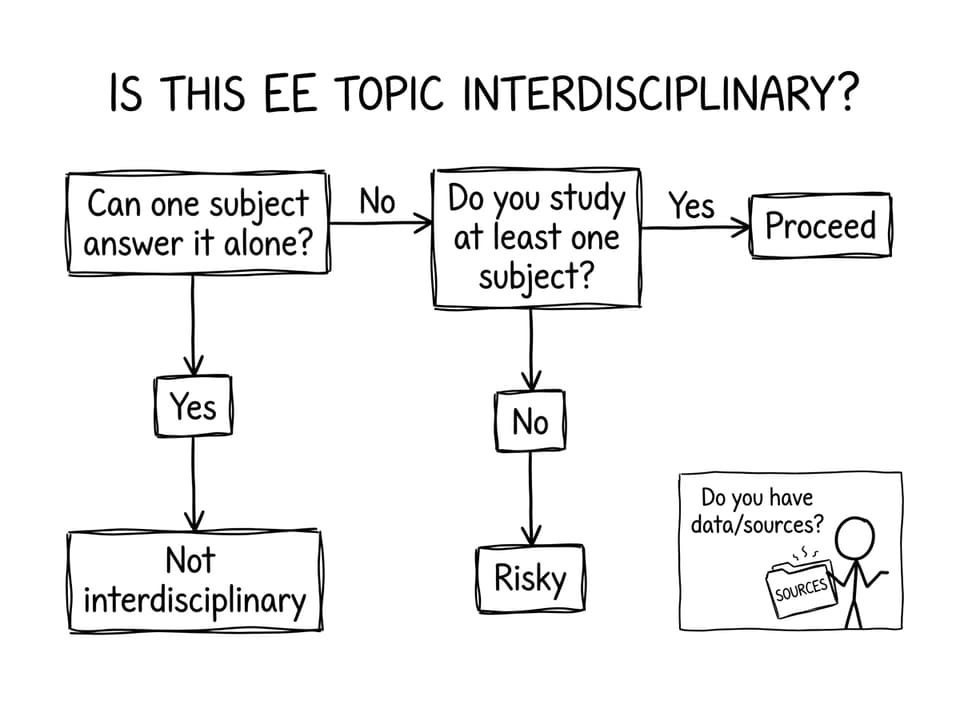
- Two DP subjects, one question: Your research question must require two subject perspectives to answer well.
- You study at least one of the subjects: Ideally both, but at minimum one.
- A real method exists: You can gather evidence, compare sources, run a small study, or analyze data.
- Narrow enough for 4,000 words: One community, one case study, one time period, one system.
- The “so what?” is clear: Your EE should produce insight, not just summary.
If you want help shaping a focused research question, use RevisionDojo’s EE resources like the IB Extended Essay Guides and the practical breakdown on How to Craft the Perfect IB Extended Essay Research Question.
What makes the Interdisciplinary Pathway different
The Interdisciplinary Pathway asks you to integrate two DP subjects inside one of five frameworks:
- Power, equality, justice
- Culture, identity, expression
- Movement, time, space
- Evidence, measurement, innovation
- Sustainability, development, change
The best interdisciplinary EE topics behave like bridges. Each subject contributes something the other cannot: a method, a concept, a type of evidence, a way of arguing.
A physics-only investigation of cricket spin can be brilliant. But the interdisciplinary version asks how biomechanics, equipment design, and physical models interact to create performance. Similarly, social media addiction becomes more powerful when biology explains reward pathways while a social science lens explains incentives, norms, and systems.
If you are unsure how to structure the writing once you choose a topic, keep this open in another tab: How to Structure an Extended Essay (EE) and How to Create an Effective EE Outline for a Logical Flow.
50 Extended Essay topic ideas for the Interdisciplinary Pathway
Use these as EE starting points. Your job is to (1) pick two subjects you can justify, (2) choose a tight case study, and (3) turn the idea into an analytical research question.
Power, equality, justice (10 EE ideas)
Good subject pairings: Economics + Geography, History + Global Politics, Biology + Digital Society, ESS + Economics, Psychology + Global Politics.
- How do algorithmic hiring tools affect employment outcomes for different demographic groups in a specific city or sector? (Digital Society + Economics)
- To what extent do urban zoning rules contribute to unequal access to green space in one neighbourhood? (Geography + Economics)
- How do air pollution levels correlate with socioeconomic status across districts in one city, and how do policy choices reinforce this pattern? (ESS + Economics)
- How has a specific protest movement used visual media to shift public opinion, and what power structures shaped that messaging? (Visual Arts + Global Politics)
- To what extent does food pricing in one region create measurable nutritional inequality? (Biology + Economics)
- How do historical land policies explain present-day housing inequality in one urban area? (History + Geography)
- How does language used in court judgments or public policy documents shape outcomes for marginalized groups? (Language A + Global Politics)
- To what extent do school funding models in one system reproduce inequality in academic outcomes? (Economics + Psychology)
- How does surveillance technology in public spaces change behavior, and what are the justice implications? (Digital Society + Global Politics)
- How do health access disparities affect the spread and impact of a communicable disease in a defined population? (Biology + Geography)
Culture, identity, expression (10 EE ideas)
Good subject pairings: Language A + Psychology, Music + History, Visual Arts + Global Politics, Anthropology + Digital Society, Language B + Business.
- How does a diaspora community use social media to maintain cultural identity, and what platform features shape that expression? (Anthropology + Digital Society)
- To what extent do bilingual education policies affect identity formation among students in one school context? (Language B + Psychology)
- How has a genre of protest music influenced political identity in a defined historical moment? (Music + History)
- How do advertising campaigns in one industry use cultural stereotypes, and what measurable consumer responses follow? (Business + Psychology)
- How do film techniques in one director’s work shape representations of national identity? (Film + Language A)
- How do museum curation choices influence collective memory of a contested historical event? (History + Visual Arts)
- How does slang or code-switching function as identity performance in one community or online space? (Language A + Digital Society)
- To what extent do fashion trends reflect cultural appropriation versus cultural exchange in a specific case study? (Visual Arts + Anthropology)
- How does the design of emojis, stickers, or memes change the way identity is communicated across languages? (Digital Society + Language B)
- How do public monuments influence cultural narratives, and how do political decisions shape which narratives survive? (Global Politics + Visual Arts)
Movement, time, space (10 EE ideas)
Good subject pairings: Geography + Economics, Physics + Sports Science, History + Geography, Biology + Psychology, Math + Geography.
- How does public transport accessibility affect retail footfall and local economic activity in one area? (Geography + Economics)
- What factors explain commuting pattern changes after a new transit project, and what are the equity implications? (Geography + Global Politics)
- How does the biomechanics of a specific sports technique relate to measured performance outcomes? (Sports Science + Physics)
- To what extent do migration narratives in literature align with historical migration data in one period? (Language A + History)
- How do urban heat islands vary across a city, and what spatial factors best predict the pattern? (Geography + ESS)
- How has a border change over time reshaped trade flows in a specific region? (History + Economics)
- How does sleep timing influence memory recall in students across a short observational study? (Biology + Psychology)
- To what extent does architectural design influence movement and social interaction in a school or public space? (Design + Psychology)
- How do changes in sea level projections affect planning decisions in one coastal community? (Geography + ESS)
- Can a simple mathematical model predict crowd flow bottlenecks in a school corridor, and how does that compare to observations? (Math + Physics)
Evidence, measurement, innovation (10 EE ideas)
Good subject pairings: Computer Science + Biology, Physics + Design, Chemistry + ESS, Economics + Digital Society, Math + Psychology.
- How accurately can a machine learning model classify plant disease from leaf images compared to human identification? (Computer Science + Biology)
- How do different statistical choices change the interpretation of the same dataset in a public health claim? (Math + Biology)
- How does sensor placement affect the reliability of measuring air quality in a school environment? (Physics + ESS)
- To what extent do recommender systems amplify misinformation, and how can you measure that amplification in one platform context? (Digital Society + Math)
- How does packaging material innovation change product shelf life, and what are the chemical mechanisms? (Chemistry + Design/ESS)
- How do different survey designs alter measured rates of “screen addiction” in a student sample? (Psychology + Digital Society)
- To what extent do carbon footprint calculators produce consistent results for the same consumer behavior inputs? (ESS + Math)
- How does innovation in cricket ball or bat design alter spin, bounce, or speed based on measurable physical properties? (Physics + Sports Science)
- How do data visualization choices influence decision-making accuracy in a controlled task? (Math + Psychology)
- How does the adoption of contactless payment affect spending patterns in a defined community sample? (Economics + Digital Society)
Sustainability, development, change (10 EE ideas)
Good subject pairings: ESS + Economics, Geography + Biology, Chemistry + ESS, Global Politics + Economics, Design + ESS.
- To what extent do plastic bag bans change consumer behavior and local waste composition in one area? (ESS + Economics)
- How do incentives for renewable energy adoption affect household decision-making in a defined region? (Economics + ESS)
- How does urban tree cover influence biodiversity indicators and thermal comfort in one neighbourhood? (Biology + Geography)
- To what extent does fast fashion supply chain structure contribute to environmental degradation, and what policy levers matter most? (Economics + ESS)
- How do water scarcity patterns influence agricultural choices and nutrition outcomes in one case study? (Geography + Biology)
- How effective is one school’s sustainability intervention when measured through waste audits over time? (ESS + Math)
- How do different building materials compare in life-cycle environmental impact for a small-scale design scenario? (Design + ESS)
- How does soil chemistry change under different fertilizer regimes, and what are the sustainability implications? (Chemistry + ESS)
- To what extent do climate-related disasters reshape migration and local development indicators in one region? (Geography + Economics)
- How do political priorities shape the pace of climate adaptation planning in one city or country? (Global Politics + ESS)
How to turn an EE idea into a top-scoring research question
An idea is a spark. Your EE needs a question with edges.
Make the two-subject “trade” explicit
Write one sentence for each subject:
- Subject 1 contributes: method or data type
- Subject 2 contributes: conceptual framework or evaluation lens
If you cannot write both sentences, your EE might just be one subject wearing the other as decoration.
Narrow with a case study you can actually handle
Most students lose time by choosing a theme, not a case.
Swap:
- “social media addiction”
For:
- “reward mechanisms in TikTok use among students aged 16--18 in my school context, measured through a short survey and linked to biological reward pathway literature.”
For deeper guidance on staying analytical, use How to Make Your IB Extended Essay Analytical, Not Descriptive and for real-world grounding see How to Link Your IB Extended Essay to Real-World Applications.
Build your workflow like exam prep (because it is)
Even though the EE is coursework, it rewards the same habits that raise exam scores: clarity, iteration, and feedback loops.
RevisionDojo is built for that loop. Students often use:
- Study Notes to get a clean overview of the two subjects involved
- Flashcards to retain key definitions, models, and evaluation language
- AI Chat to test whether a claim is actually justified (and to generate counterarguments)
- Grading tools to check drafts against rubric logic
- Coursework Library to learn what high-scoring structure looks like
- Tutors when you need a human to diagnose a stuck argument
If you are rebuilding your overall routine while juggling mocks, this guide helps keep you sane: How to Study for IB Mocks (Without Burning Out). And for daily recall, link your EE vocabulary to the Flashcards feature.
Closing: pick one idea, then make it sharper
A good EE topic does not start perfect. It starts honest.
You notice something in the world that does not make sense yet, and two subjects give you two different ways to explain it. The Interdisciplinary Pathway rewards students who can hold both explanations at once, then build a third thing from the overlap: a clearer insight.
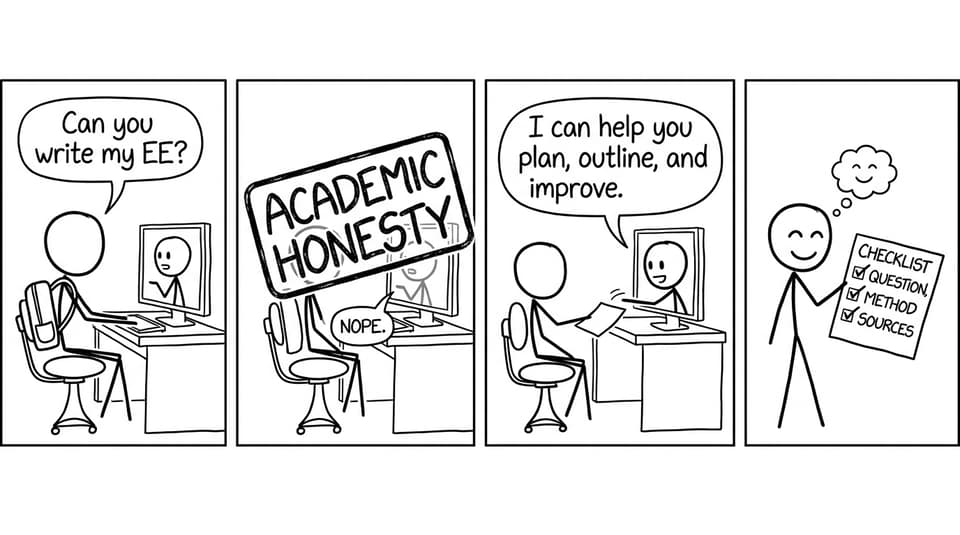
Choose one of the EE topic ideas above. Pick a single case study. Draft a research question. Then pressure-test it with RevisionDojo: use Study Notes for fast clarity, the Coursework Library for models, AI Chat for counterarguments, and Grading tools to align your writing with what earns marks.
When you are ready to go deeper, browse the full collection here: All IB Extended Essay Posts. Your EE is not just another requirement. Done well, it becomes proof that you can think in a way exams rarely allow.