



When people say IB Design Technology is “mostly coursework,” what they usually mean is this: the subject feels like coursework because your project follows you around for months.
But marks don’t care about feelings.
In IB Design Technology, your grade is built from two compulsory pillars: the design project (your Internal Assessment) and written exams. The students who do best aren’t the ones who pick a side. They’re the ones who quietly stay consistent when it isn’t exciting anymore.
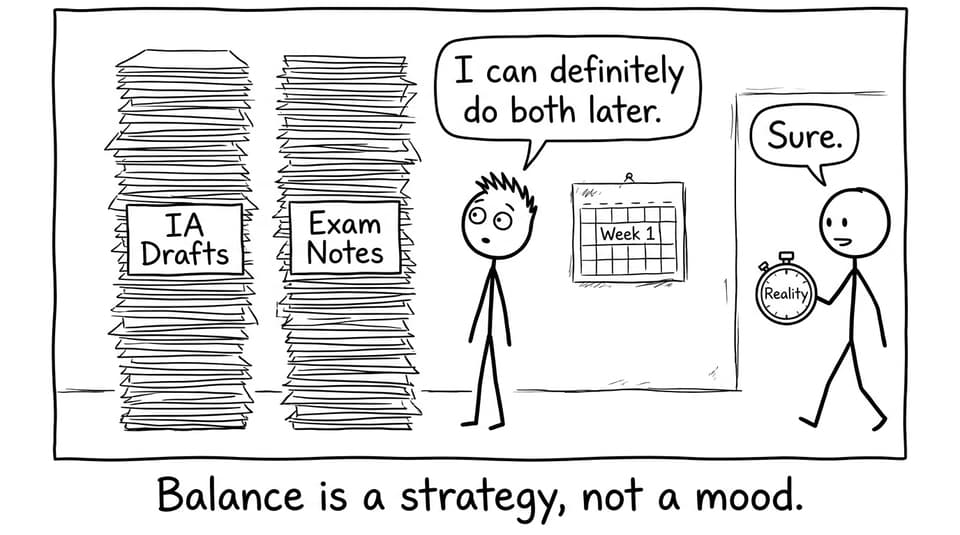
Quick answer: is IB Design Technology more coursework or exam-based?
IB Design Technology is neither purely coursework-based nor purely exam-based. It’s a mixed-assessment subject where:
-
The IA design project rewards long-term documentation, justification, and iteration.
-
The written exams reward application of theory, analysis, and evaluation under time pressure.
-
You can’t “make up” for a weak area forever. A strong IA helps, but exams still matter (and vice versa).
If you want the cleanest overview of the course, start at the IB Design Technology hub and branch out from there.
The two components of IB Design Technology (and what they test)
The assessment split in IB Design Technology is designed to test two different versions of you:
The design project (Internal Assessment)
The IA checks whether you can follow the design cycle like a thinker, not like a decorator. It tends to reward:
-
A clear, user-focused problem definition
-
Research that actually changes your decisions
-
Iteration that is visible (test, change, justify)
-
Evaluation that is honest and evidence-based
If your IA is drifting, the fastest way to get back on track is to rebuild your foundation: How do you write a strong IB Design Technology problem statement?
For a full IA roadmap, keep nearby: Step-by-step guide to writing a winning IB Design Technology IA.
The written exams
Exams in IB Design Technology still carry serious weight because they test transfer: can you take design theory and apply it to a new scenario?
Expect to be assessed on:
-
Design principles and decision-making
-
Evaluation and trade-off thinking
-
Command terms (explain, analyse, justify)
-
Responding to unfamiliar design contexts
One practical way to build this skill is steady exam practice with feedback. RevisionDojo’s Questionbank, AI Chat, and Mock Exams are designed for exactly that, so you can train the “apply and justify” muscle instead of only rereading notes.
Why IB Design Technology feels coursework-heavy (even when it isn’t)
A big reason IB Design Technology feels dominated by coursework is that the IA is open-ended. There’s rarely a single correct answer, only a stronger chain of reasoning.
Three things make it feel heavier than it is:
-
Progress depends on planning (and planning is invisible work)
-
You can always “improve” a design, so stopping feels uncomfortable
-
Documentation takes longer than building
That’s why it helps to learn from examples and criteria, not vibes. Use the IB Design Technology exemplars library to see what top work looks like on the page, and check your draft against a rubric using the IB Design Technology HL IA Grader (even if you’re SL, it teaches you how examiners think).

Can a strong IA carry weak exams (or the other way around)?
This is the question behind the question.
A strong IA can help, but it has limits
In IB Design Technology, a strong IA can stabilize your grade and lower exam pressure. It gives you “banked” performance from months of careful work.
But very weak exam performance still drags the final result down because exams measure different skills. A student can be brilliant at prototyping and still lose marks by failing to justify choices in a time-limited response.
Strong exams rarely fix a weak IA
A weak IA usually signals missing evidence: vague requirements, thin testing, or “iteration” that is only described.
If that’s you, don’t guess what the moderators want. Learn how marking actually works: How do teachers mark IB Design Technology internal assessments?
And if you want a clear target, keep this nearby: How can you score a 7 in IB Design Technology?.
A balanced prep plan for IB Design Technology students
Here’s a simple rhythm that fits most schedules:
-
Weekly IA block (to keep momentum and documentation alive)
-
Two short exam practice sessions (one Paper-style question each)
-
Active recall for definitions and processes (Flashcards work best)
For a more detailed routine, use: Best study strategies for IB Design Technology students.
On RevisionDojo, this balance becomes easier because everything is in one place: Study Notes for concepts, Flashcards for recall, Questionbank for exam application, AI Chat for quick clarifications, and Grading tools to pressure-test your IA against criteria.
Conclusion: the real advantage in IB Design Technology
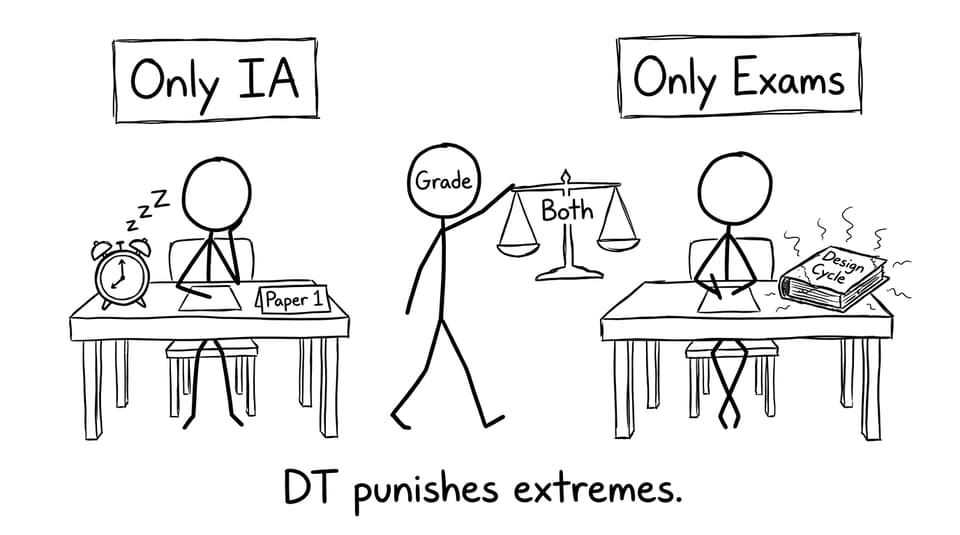
So, is IB Design Technology more coursework or exam-based? It’s both, and that’s the point.
The IA rewards the patient version of you: the one who documents, tests, and learns. The exams reward the adaptable version: the one who can apply design theory to unfamiliar scenarios. When you build both versions in parallel, your grade stops feeling like a gamble.
If you want a single home base for IB Design Technology revision and coursework support, use RevisionDojo: start with the IB Design Technology hub, then use Study Notes, Flashcards, AI Chat, Questionbank, Predicted Papers, Mock Exams, the Coursework Library, and Tutors to keep both pillars strong all the way to exam day.