
The night before your first big IB deadline, time behaves strangely.
Minutes sprint. Tabs multiply. Your brain, usually loyal, starts asking unhelpful questions like: What if everyone else is coping and I'm the only one pretending?
That feeling is why so many students type the same search at 1:12 a.m.: Is IB actually the hardest curriculum?
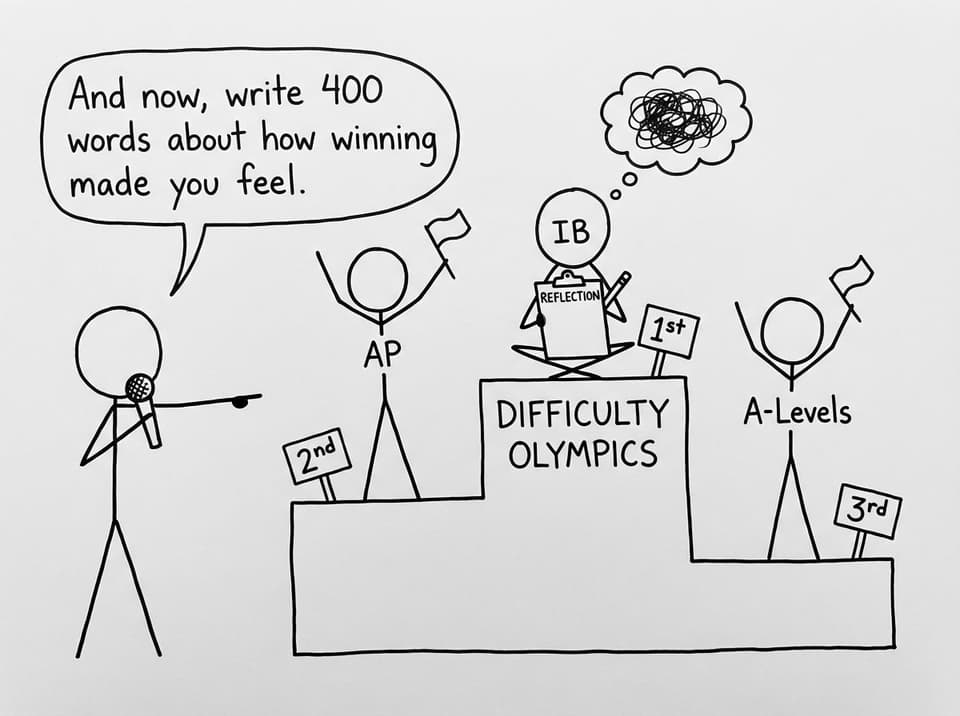
This post won't give you a dramatic trophy that says "Yes, you win the suffering Olympics." It will give you something better: a clear way to think about why IB feels hard, when it's objectively demanding, and how to prepare for IB exams without turning your life into an anxiety project.
Along the way, we'll translate "IB is hard" into practical actions you can take this week using RevisionDojo's Questionbank, Study Notes, Flashcards, AI Chat, Grading tools, Predicted Papers, Mock Exams, Coursework Library, and Tutors.
A quick checklist: why IB feels so hard
If you want the short version before the story and strategy, here's the checklist.
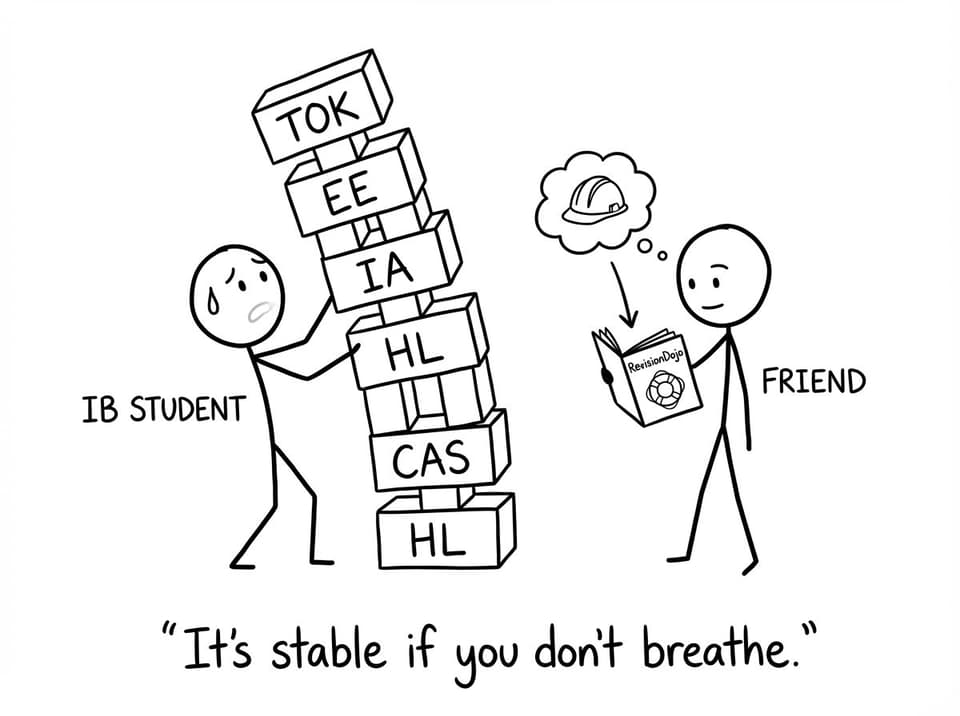
IB tends to feel harder than other curricula because it combines:
- Breadth (six subjects at once)
- Depth (HL content load)
- Time pressure (papers with tight pacing)
- Parallel deadlines (IA, EE, TOK, CAS layered on top)
- High precision grading (markscheme logic, command terms, criteria)
- Identity pressure ("I'm an IB student" becomes a personality)
When those collide, students don't just feel challenged. They feel constantly behind.
That's why your best response isn't "work harder." It's "build a better loop." A loop is exactly what RevisionDojo is designed to support: Study Notes for clarity, Flashcards for daily recall, Questionbank for exam practice, AI Chat for fast explanations, then timed Mock Exams and Predicted Papers to make the real thing feel familiar.
If you want a step-by-step structure for that loop, keep this open: How to Study for IB Exams: Step-by-Step Guide.
So, is IB actually the hardest curriculum?
"Hardest" is a tempting word because it sounds like a fact. But it's really a blend of three things:
- Difficulty (how complex the content is)
- Workload (how much you must do, simultaneously)
- Evaluation style (how unforgiving the marking is under time constraints)
IB is unusual because it scores high on all three.
Some pathways can be extremely hard in one dimension. For example, a track might have brutal content depth in a narrow set of subjects, but fewer parallel requirements. Another might have manageable content but high-stakes exams with intense competition. IB, by design, stacks multiple kinds of hard at once.
That's why two students can argue about whether IB is the hardest curriculum and both be right. One is thinking about calculus. The other is thinking about writing reflections, meeting a CAS deadline, polishing an IA draft, and still doing timed Paper 2 practice.
If you're in exam season, the better question becomes:
What part of IB is hard for me -- and what's the most efficient way to train it?
The hidden reason IB feels harder than it "should": cognitive overhead
Here's a small story that repeats in most schools.
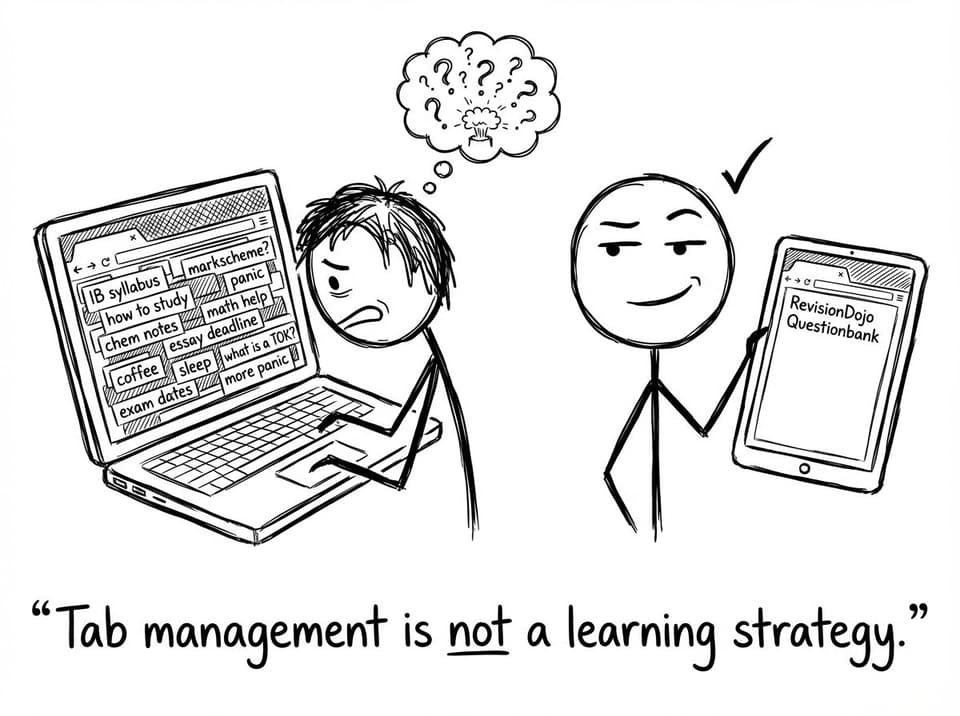
A student sits down to revise IB Chemistry. They open a folder. Inside: five PDFs, a slideshow, three versions of notes, a teacher handout, and a link to a video that might be relevant.
They spend 40 minutes organizing and 20 minutes learning.
That's not laziness. That's cognitive overhead: the mental tax of managing your learning system instead of learning.
This is one reason all-in-one systems often feel like relief. Not because they make IB "easy," but because they reduce the friction between intention and action.
RevisionDojo's IB ecosystem is built around lowering that overhead:
- Study Notes are syllabus-aware and designed for fast comprehension: Study Notes
- Questionbank practice is organized by topic and exam style: Questionbank
- You can run realistic timed practice using Mock Exams and Predicted Papers inside one workflow (then review immediately)
If you want the big picture of how those tools connect, start here: RevisionDojo for IB.
What makes IB hard in a way exams actually reward
Some kinds of hard are noisy. They create stress but don't automatically create marks.
Other kinds of hard are clean. They train exactly what the examiner will reward.
IB tends to reward three "clean hard" skills.
IB rewards precision under constraints
In IB, you often know something but lose marks because:
- you didn't use the command term properly
- your explanation wasn't specific enough
- your structure didn't match what the markscheme expects
- you ran out of time and your last page became a blur
This is why content-only revision hits a ceiling.
You need mark-winning practice, not just understanding.
A practical way to train precision is to build daily exposure to markscheme patterns using a question bank, then reflect on the mistake like a scientist (what happened, why, what rule fixes it). That's what this guide leans into: Comprehensive IB Question Bank: Thousands of Practice Questions.
IB rewards switching costs (and most students don't train them)
Your week might require you to:
- write a TOK paragraph
- do a Math HL problem set
- revise a Bio topic
- edit an EE draft
That constant switching is exhausting. But it's also trainable.
If you practice in short, focused blocks across subjects, you're not being "inconsistent." You're rehearsing the reality of IB season.
RevisionDojo helps because each subject's practice loop is structured similarly: Notes -> Questions -> Feedback -> Flashcards -> Retake. The consistency of the system makes the subject-switching less mentally expensive.
IB rewards feedback loops, not heroic effort
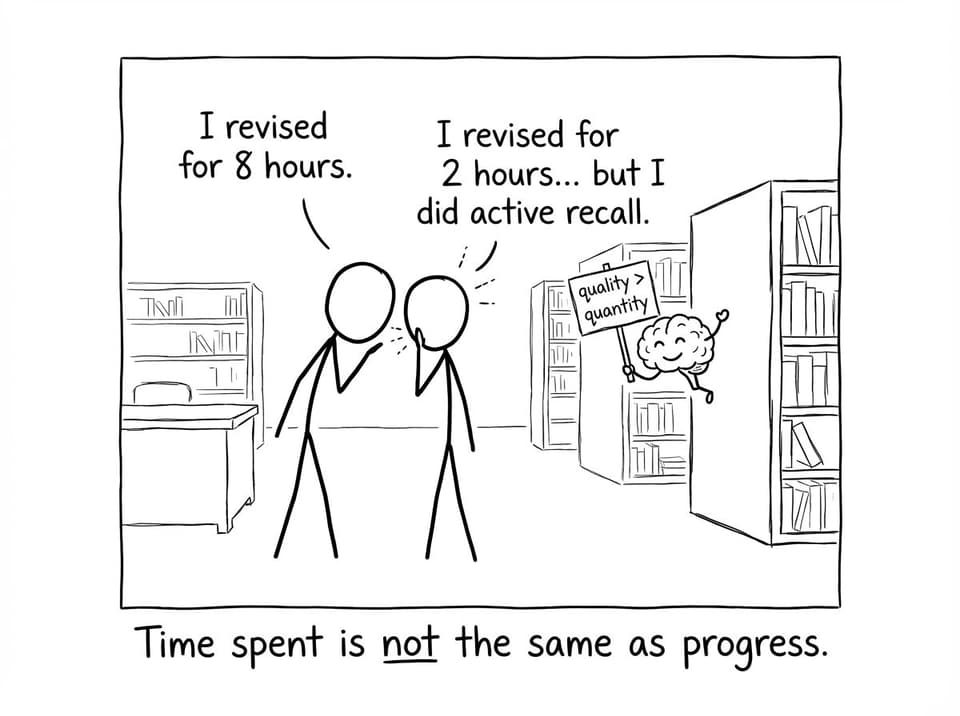
The students who look calm aren't always doing more. They're doing tighter loops.
A tight IB loop looks like:
- 10 minutes: Flashcards (spaced repetition)
- 30--45 minutes: Questionbank (topic targeted)
- 10 minutes: error log (3 bullets)
- 5 minutes: ask AI Chat the question you were avoiding
RevisionDojo essentially productizes that loop: Flashcards for recall, Questionbank for accuracy, AI Chat for unblocking confusion, and analytics to show what to fix next.
If you want to see how top scorers structure this, read: How 45-Point IB Students Prepare for Exams.
How to make IB feel less hard (without pretending it isn't)
When people say IB is hard, they're often describing one of two problems:
-
The work is large
-
The work is vague
The first is real. The second is optional.
Your goal before exams is to replace vagueness with specific training tasks.
Turn "revise IB" into a one-hour mission
Try this template for any IB subject:
- Pick one paper skill (not the whole subject)
- Pick one topic (the smallest slice you can name)
- Do 20--30 questions (or one structured section)
- Mark and categorize errors (concept gap vs technique vs time)
- Patch using Study Notes (only the part that fixes the mistake)
- Retake a small set 48 hours later
If you need a month-by-month structure to build from, use: How to Revise for IB Exams: A Month-by-Month Revision Plan.
Use timed practice earlier than feels comfortable
Most students delay timed work because it's unpleasant.
But timed work is where IB stops being theoretical and starts becoming familiar.
RevisionDojo supports this with Mock Exams and Predicted Papers so you can simulate paper conditions, then get fast feedback and drill weak areas immediately.
If you want a simple setup, read: How to Run Timed IB Mock Exams in RevisionDojo.
And if you want an example of subject-specific predicted sets, explore: IB Biology Predicted Papers.
Stop letting coursework quietly eat exam season
A brutal truth about IB is that coursework expands to fill your available time.
That doesn't mean you should do it badly. It means you should do it with boundaries and feedback.
RevisionDojo's Grading tools and Coursework Library help you move coursework forward without endless tinkering: you check what the rubric is really asking, make the highest-impact edits, and return to exam training.
If you feel the "my IA is never done" spiral starting, revisit: IB Exams Without Pausing Your Life.
A simple weekly IB plan (built for exam season)
Here's a calm structure that respects the fact that IB is demanding, but also that you're a human.
Daily (30--75 minutes)
- 10--15 min: Flashcards (definitions, processes, formulas, quotes)
- 20--45 min: Questionbank on one topic you're currently missing
- 5--15 min: review mistakes, ask AI Chat one targeted "why" question
Two to four times per week (60--90 minutes)
- Short patch with Study Notes
- Then immediate exam-style practice (no rewriting, no pretty highlighting)
Once per week (45--150 minutes)
- One timed sitting: a section or full paper using Mock Exams or Predicted Papers
- Longer review than attempt (this is where marks grow)
For a broader "how to revise" overview, this is useful: What's the Best Way to Revise for IB Exams?.
Closing: IB might be hard, but it's also trainable
If IB feels like the hardest curriculum, it's not because you're weak. It's because IB asks you to do many hard things at once: learn, write, reflect, manage deadlines, and perform under time pressure.
The way out isn't a new personality. It's a better system.
Build a loop: Study Notes for clarity, Flashcards for recall, Questionbank for accuracy, AI Chat for fast explanations, then timed Mock Exams and Predicted Papers to turn nerves into familiarity. Use Grading tools and the Coursework Library to stop coursework from swallowing your revision. And if you need steady guidance, use Tutors to keep your plan realistic.
When you treat IB like a trainable set of skills, "hard" stops being a verdict. It becomes a schedule.
Start your loop here: RevisionDojo for IB.
