
If you’ve ever stared at your subject choices thinking, “I’m about to pick my own difficulty level,” you’re not alone. The Chemistry HL vs Physics HL question has a way of turning calm students into philosophers. Not because either course is impossible, but because the kind of difficulty is different. And if you’re revising for exams right now, this matters even more: you’re not just choosing a subject, you’re choosing the style of problems you’ll practice hundreds of times.
This article focuses on IB Chemistry as the anchor point, then compares what makes Physics HL feel harder (or easier) depending on how your brain likes to work. You’ll leave with a clear way to decide, plus a revision plan you can actually follow.
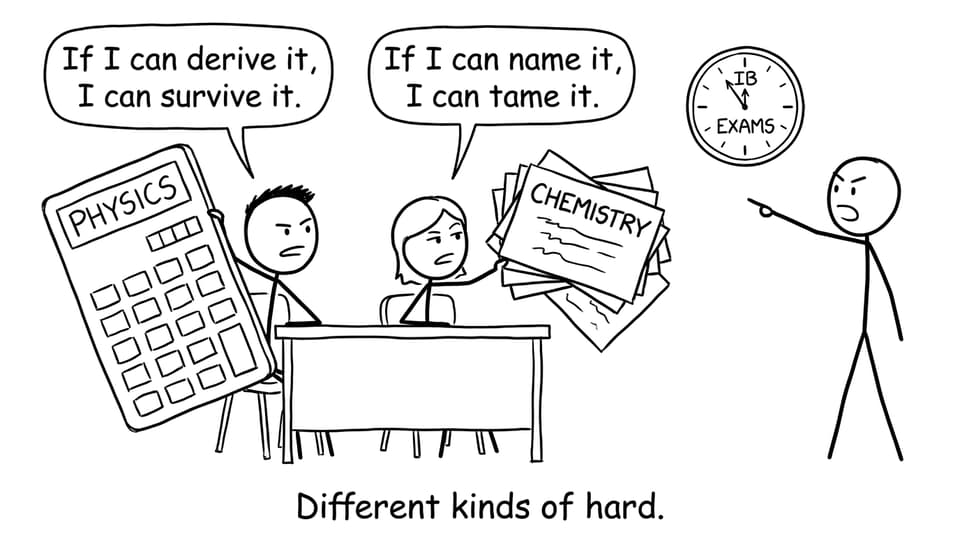
Quick checklist: which HL science will feel harder for you?
Use this as a fast self-audit. If most of your ticks land on one side, you’ve found your answer.
Chemistry HL will feel harder if you...
-
Prefer clean, single-path problems over messy systems.
-
Dislike memorizing patterns (organic reactions, trends, definitions).
-
Lose marks when explanations must match markscheme wording.
-
Struggle to move between particle models, equations, and graphs quickly.
Physics HL will feel harder if you...
-
Get anxious when the first step is unclear.
-
Don’t like algebraic rearranging under time pressure.
-
Find multi-step calculations draining.
-
Prefer learning “what happens” rather than modeling “why it happens.”
If you want a structured hub for IB Chemistry, start with IB Chemistry Resources and then build outward from there.
IB Chemistry vs Physics HL: what “hard” actually means
Most students define hard as “lots of content.” But in IB sciences, hard usually means one of three things:
-
Cognitive switching (changing representations fast)
-
Precision (units, significant figures, markscheme wording)
-
Endurance (long problem chains without losing the thread)
IB Chemistry tends to test switching and precision. Physics HL tends to test endurance and setup skill.
A good way to think about it: Physics often rewards you for building a clean model, while IB Chemistry often rewards you for noticing what kind of system you’re in (acid-base, redox, equilibrium, energetics) and using the right tools without mixing them.
Content load: why IB Chemistry can feel heavier week-to-week
Chemistry HL is dense in a specific way: topics interlock, and “half-knowing” collapses quickly. You can’t really fake equilibrium if you don’t understand what’s shifting. You can’t do electrochemistry confidently if redox thinking is shaky. Organic mechanisms punish vague memory.
That’s why many students describe IB Chemistry as a constant drip of small concepts that must stay organized.
If you want a full overview of what’s inside the course, use IB Chemistry HL: Complete Guide for Success. It’s useful not just for choosing, but for planning revision blocks.
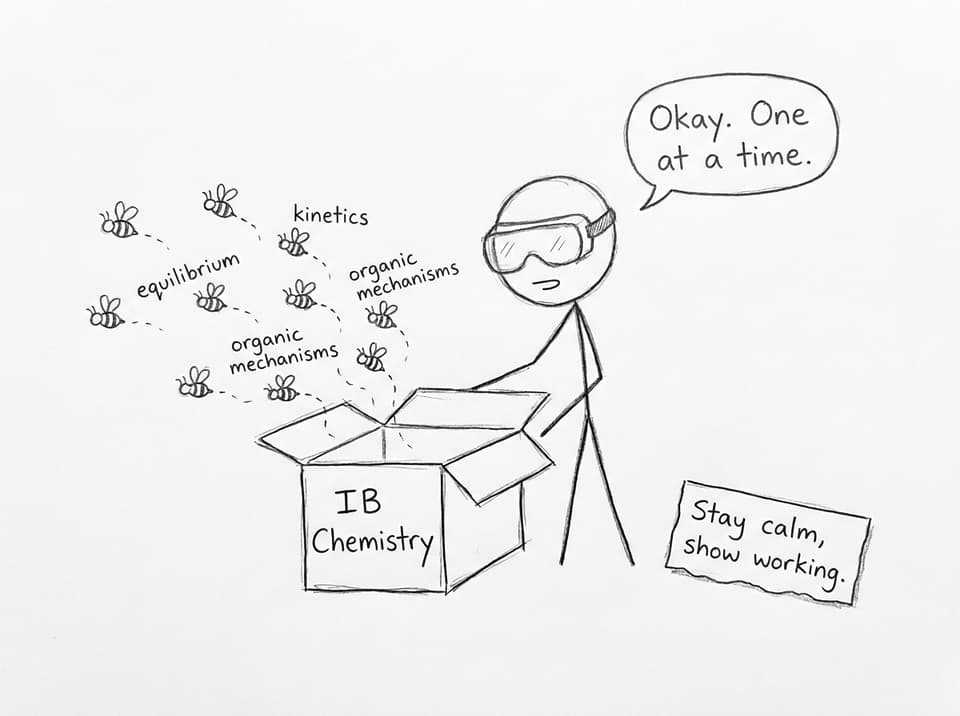
Math requirements: Physics is the language, Chemistry is the tool
Physics HL is unapologetically mathematical. Even when the math isn’t formally “advanced,” the subject uses math as explanation. You’re constantly rearranging, substituting, linearizing graphs, and interpreting what your result means physically.
IB Chemistry uses math too, but usually as a tool inside a concept:
-
stoichiometry and limiting reagents
-
energetics calculations
-
kinetics and rate laws
-
pH, buffers, titration logic
-
equilibrium constants
So which is harder?
-
If your algebra is strong and you like equations, Physics HL can feel fair.
-
If you prefer structured calculations attached to concepts, IB Chemistry can feel more controllable.
A deeper comparison students find clarifying: Are IB Physics Calculations Harder Than Chemistry Equations?
Markschemes and explanations: where IB Chemistry quietly raises the bar
One overlooked reason IB Chemistry feels hard is that explanations are often “tight.” You can understand an idea and still lose marks if you skip key phrases: electron pair donation, partial charges, Le Chatelier direction, oxidation state change, and so on.
Physics markschemes can be strict too, but many marks come from method: set up correctly, substitute correctly, unit correctly. Chemistry can demand both method and language.
This is where RevisionDojo’s Study Notes and Flashcards shine, because they let you rehearse markscheme-friendly phrasing repeatedly instead of hoping it appears in your memory on exam day.
Practical work and the IA: which one is more stressful?
Both sciences require practical work and an Internal Assessment. The stress usually comes from different places.
-
In Chemistry, lab work often demands careful technique, controlled variables, and clean processing. It’s easy to create messy data.
-
In Physics, experiments can feel conceptually simple but analytically intense: uncertainty handling, graph interpretation, and evaluation depth.
If you want to understand what “good” looks like across sciences, start with IB Internal Assessment: A Complete Guide and then use the broader IB IA Guides to structure your investigation.
So, is IB Chemistry harder than Physics HL?
For most students, the honest answer is: it depends on your mismatch.
Choose IB Chemistry if you like:
-
patterns and systems (acid-base, redox, equilibrium)
-
a mix of explanation + calculation
-
learning through mechanisms and models
Choose Physics HL if you like:
-
equations as a way of thinking
-
building models from unfamiliar scenarios
-
multi-step problem chains
If you’re deciding based on overall workload, it helps to see how the IB ecosystem ranks difficulty and why students struggle. Compare perspectives in The Hardest IB Subjects Ranked (and Why) and IB Hardest Subjects Ranked (2026): What to Expect.
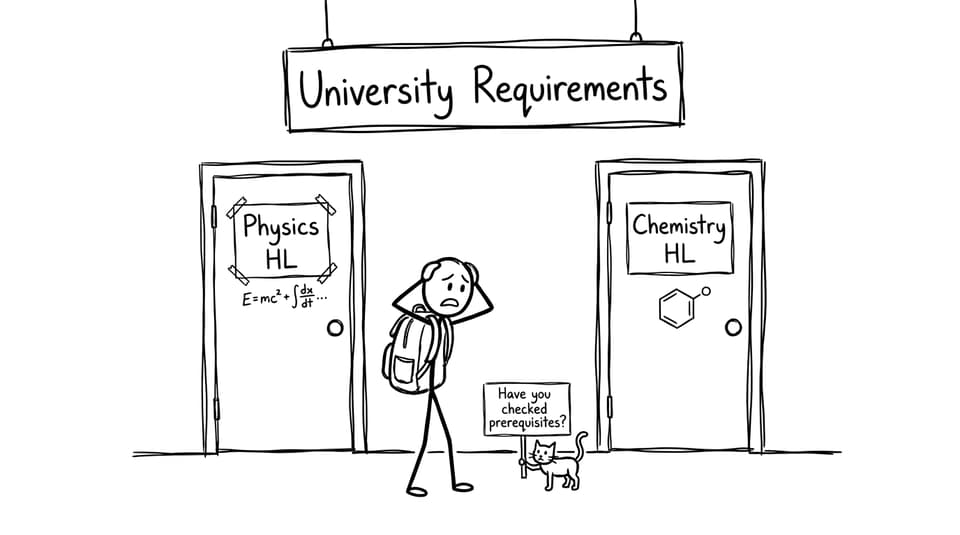
Exam prep plan: how to make either subject feel easier
Here’s the strategy students miss: difficulty shrinks when your revision system stops being random.
For IB Chemistry: build “reaction reflexes”
-
Use Study Notes to get the story of each topic.
-
Drill definitions and trends with Flashcards.
-
Then practice with the Questionbank, tracking mistakes by type (concept gap vs setup vs wording).
Start your practice loop here: Questionbank. For targeted IB Chemistry practice, explore a topic-specific bank like IB Chemistry R2.1 Questionbank.
For Physics HL: train setup speed
-
Make formula recall automatic with cheatsheets and mini-quizzes.
-
Do daily mixed problems to practice choosing the right model.
-
Review every mistake by asking: “Where did I decide wrong?”
A helpful starting point for overview and resources: IB Physics Resources.
Use full exam simulation wisely
RevisionDojo’s Mock Exams, Predicted Papers, and AI Chat are most effective when you use them late in the cycle, after you’ve built fundamentals. The goal is to practice performance: timing, decision-making, and recovery when a question goes sideways.
For IB Chemistry exam practice sets, see IB Chemistry Predicted Papers. For Physics equivalents, use IB Physics Predicted Papers.
Conclusion: choose the hard that matches your mind
“Is Chemistry HL harder than Physics HL?” is really a question about fit. IB Chemistry is often harder for students who want one clean path and get frustrated by systems that behave differently depending on context. Physics HL is often harder for students who want familiar patterns and don’t enjoy building models from scratch under time pressure.
Whichever you’re taking, the fastest way to make it feel manageable is to stop relying on motivation and start relying on structure: Study Notes for clarity, Flashcards for recall, Questionbank for repetition, Grading tools for honest feedback, and Predicted Papers plus Mock Exams for exam-day realism.
Start with the IB Chemistry hub here: IB Chemistry Resources, then build your plan and let consistency do the heavy lifting.