


Sustainable development sounds simple until you try to run it like an actual economy.
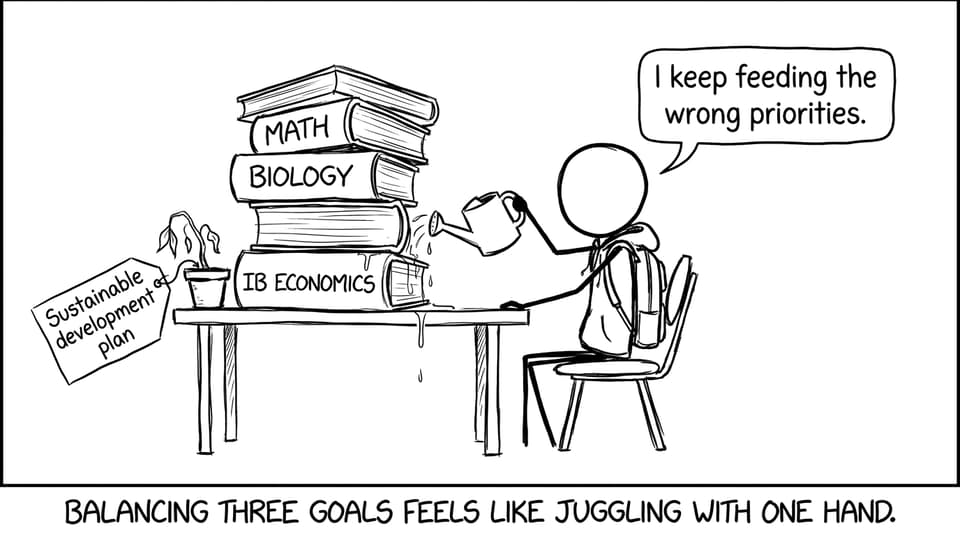
In IB Economics, it often shows up as a neat triangle: growth, social progress, environment. But in real life, those corners fight for the same limited budget, the same political attention, and the same natural resources. A policy that looks perfect on paper can fail because incentives shift, voters react, firms lobby, and time horizons shrink. That messiness is exactly why exam questions on sustainable development reward clear chains of reasoning.
A quick IB Economics checklist for sustainable development essays
Use this mini-structure when you write:
-
Define sustainable development (present needs without harming future generations)
-
Show the core trade-off: growth vs environmental limits
-
Add at least one market failure (negative externalities, common pool resources, public goods)
-
Explain inequality and global cooperation problems
-
Evaluate policy constraints: costs, time lags, enforcement, politics
For syllabus-aligned support, keep the core topic page open: 4.7 Sustainable Development.
IB Economics: The three-way trade-off that never fully disappears
The first reason sustainable development is so hard is that economies don’t grow “for free.” Growth usually means more energy use, land conversion, and extraction of raw materials. In IB Economics, you describe this as scarcity and opportunity cost. Resources used to expand output today are resources not used to protect ecosystems, invest in resilience, or prevent long-term damage.
This is why sustainable development fits naturally with market failure theory. Pollution is a negative externality: the producer and consumer enjoy private benefits, while society pays part of the cost. If you need a clean explanation to borrow phrasing from in your own words, see Why externalities cause markets to misallocate resources.
IB Economics and the fairness problem: who cuts first?
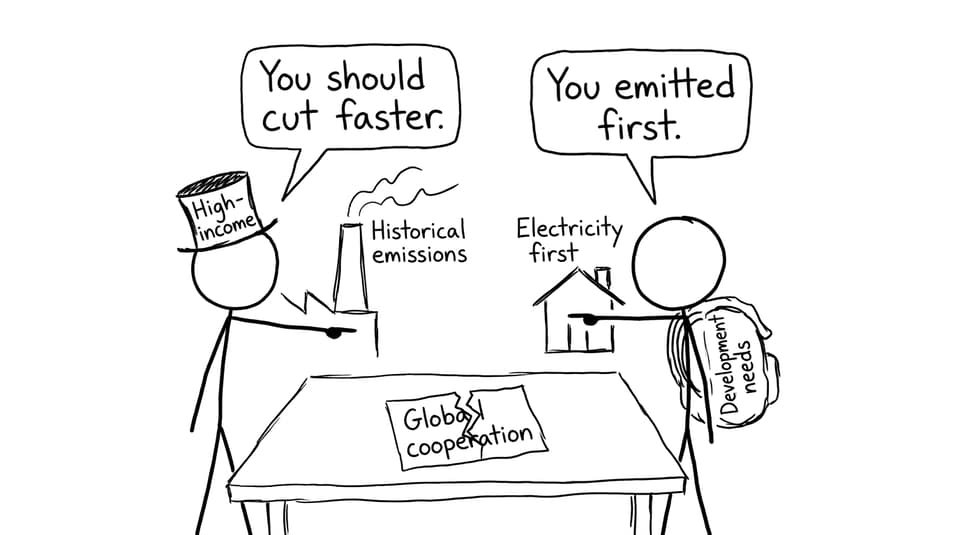
Even if every country agrees sustainability matters, they disagree on responsibility. Higher-income economies have historically emitted more, while lower-income economies argue that development requires space to industrialize, build infrastructure, and raise living standards.
That turns sustainable development into a coordination game. Each country fears being the one to slow down first while others keep producing cheaply. In exam terms, you can evaluate with: lack of trust, free-rider incentives, and enforcement problems.
To anchor this in the syllabus, pair sustainability with international cooperation from market failure notes: 2.8 Market failure notes.
The money and technology bottleneck in sustainable development
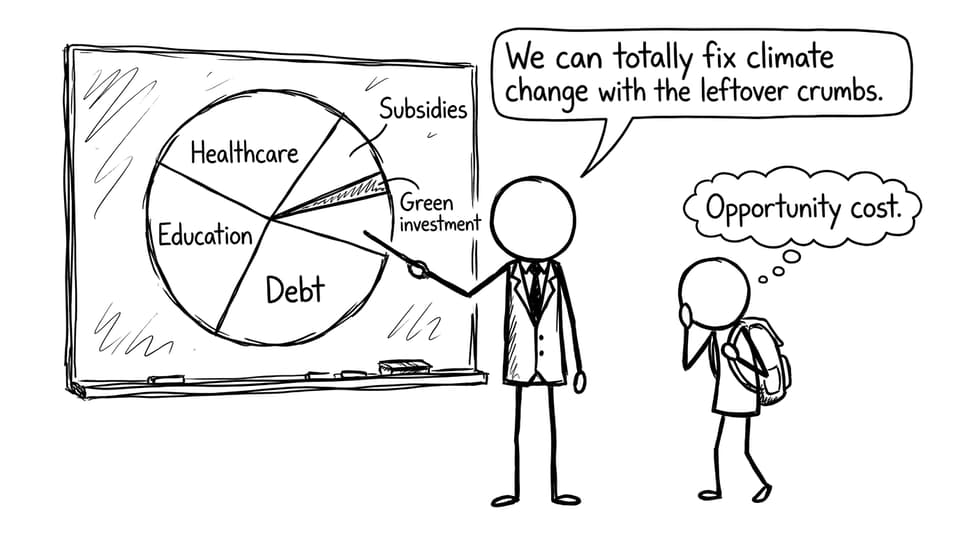
A lot of sustainable development policies are expensive upfront: renewable grids, storage, public transport, coastal defenses, and cleaner industrial processes. For many governments, that competes with healthcare, education, and debt repayment. In IB Economics, this is a straightforward opportunity cost evaluation: the long-term benefits are real, but the short-term budget constraint is binding.
If you want targeted practice on this exact area, use the 4.7 Sustainable Development Questionbank to train the evaluation points examiners like.
Behaviour and institutions: the slowest part of the transition
Sustainable development isn’t just “get better technology.” It’s also changing habits, business models, and enforcement capacity. Regulations only work if monitoring exists. Taxes only work if collection is credible. Subsidies only work if corruption and mis-targeting are limited.
This is where strong IB Economics answers mention time lags and unintended consequences. A carbon tax, for example, may reduce emissions but can be politically unpopular or regressive without compensation policies. For exam-style framing on policy tools, read How governments try to correct negative externalities.
Conclusion: make the difficulty work for you in IB Economics
Sustainable development is difficult because it asks economies to do three hard things at once: grow, share, and protect. IB Economics rewards students who can explain those tensions clearly, link them to market failure and incentives, and then evaluate policies with real constraints.
If you want to turn the theory into marks, RevisionDojo makes the process repeatable: start with the Notes for 4.7 Sustainable Development, drill with the Questionbank, lock key definitions using Flashcards for 4.7 Sustainable Development, and use AI Chat, Grading tools, Predicted Papers, Mock Exams, the Coursework Library, and Tutors when you need feedback that actually changes your next attempt.