


Trade barriers rarely arrive with fireworks. They show up quietly: a new tariff on steel, a quota on cars, a subsidy for local farmers. But a few months later, a familiar pattern appears in real life and in IB Economics essays: prices creep up, choices shrink, and someone, somewhere, pays for the protection.
For IB students, trade barriers are a gift of a topic because they look simple ("restrict imports") but reward the kind of calm, layered evaluation examiners love. The key is seeing the chain reaction across stakeholders and time.
Quick exam checklist for IB Economics
Use this mini-checklist when you see tariffs, quotas, or subsidies in IB Economics Paper 1 or Paper 2 prompts:
-
Identify the trade barrier (tariff, quota, subsidy, administrative barrier)
-
Explain the immediate market effect (higher import prices or restricted quantities)
-
Track welfare changes (consumer surplus falls; producers may gain)
-
Add efficiency language (misallocation of resources, deadweight loss)
-
Evaluate over time (short-run protection vs long-run competitiveness)
-
Consider retaliation and uncertainty
To tighten your definitions, RevisionDojo’s explainer on What Are Trade Barriers? is a quick refresher.
IB Economics view: why trade barriers raise prices and reduce welfare
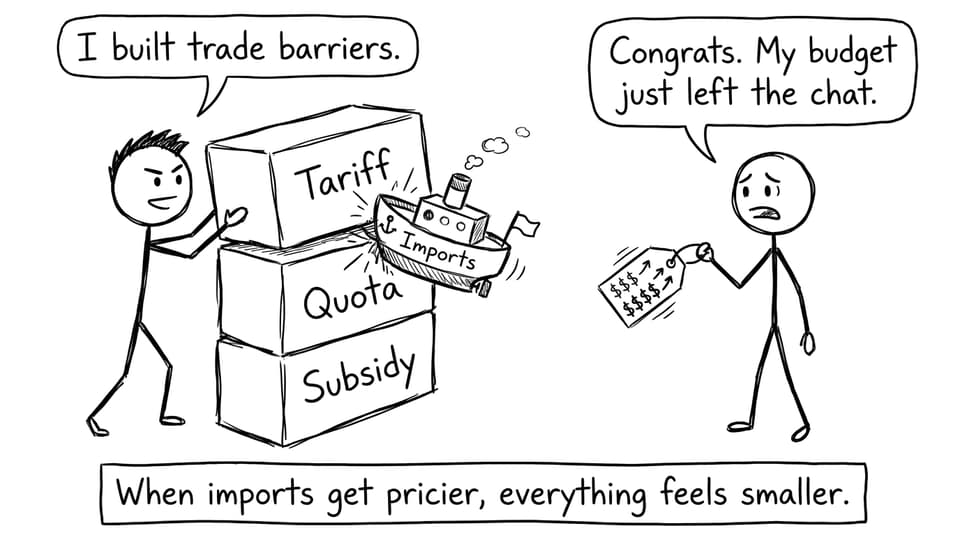
In IB Economics, the first impact to write about is usually the cleanest: tariffs and quotas push up domestic prices.
-
A tariff is a tax on imports, shifting the price consumers pay upward. Consumers lose purchasing power, and consumer surplus falls.
-
A quota limits quantity, creating artificial scarcity and often raising prices even if world supply is cheaper.
That’s why trade protection so often translates to a lower standard of living, especially for low-income households. If you want to anchor this with syllabus-aligned detail, use Notes for 4.2.1 Tariffs and IB 4.2 Types of Trade Protection.
IB Economics view: efficiency losses and misallocation of resources
Trade barriers don’t only change prices. They change incentives.
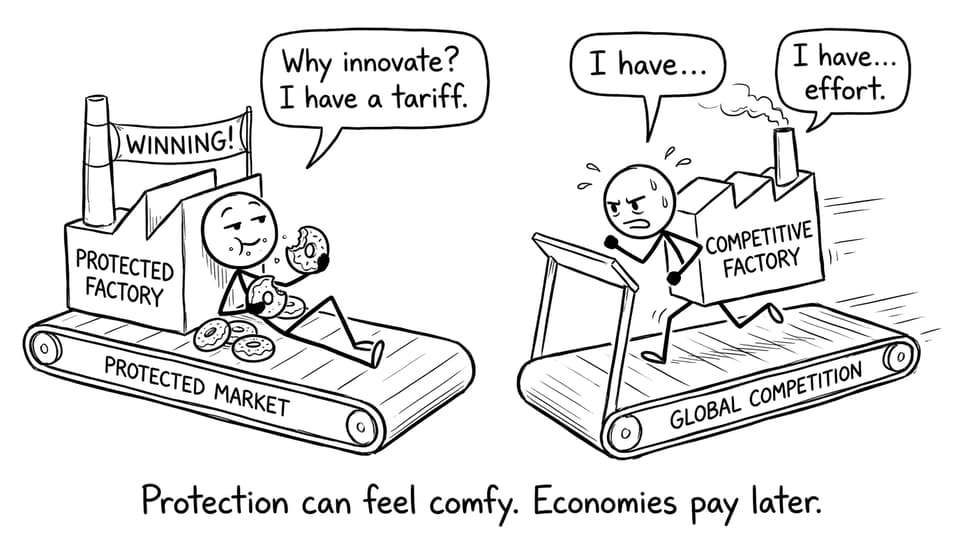
When a country blocks cheaper imports, domestic firms may keep producing goods even if they’re not the lowest-cost producers. That’s a classic IB Economics line: resources shift away from comparative advantage and toward protected industries. Output can fall relative to what’s possible under freer trade, and productivity growth slows.
This is where evaluation sharpens: trade barriers might protect jobs in one sector, but they can also raise input costs for other sectors that rely on imported components. The economy doesn’t just “gain producers”, it reshuffles winners and losers.
To build balanced arguments, RevisionDojo’s Notes for 4.3.3 Free Trade Versus Trade Protection and Notes for 4.3.2 Arguments Against Trade Protection give you ready phrasing for both sides.
Trade barriers and retaliation: the costs grow when partners respond
A single tariff can be written as a domestic policy. A series of tariffs becomes a global problem.
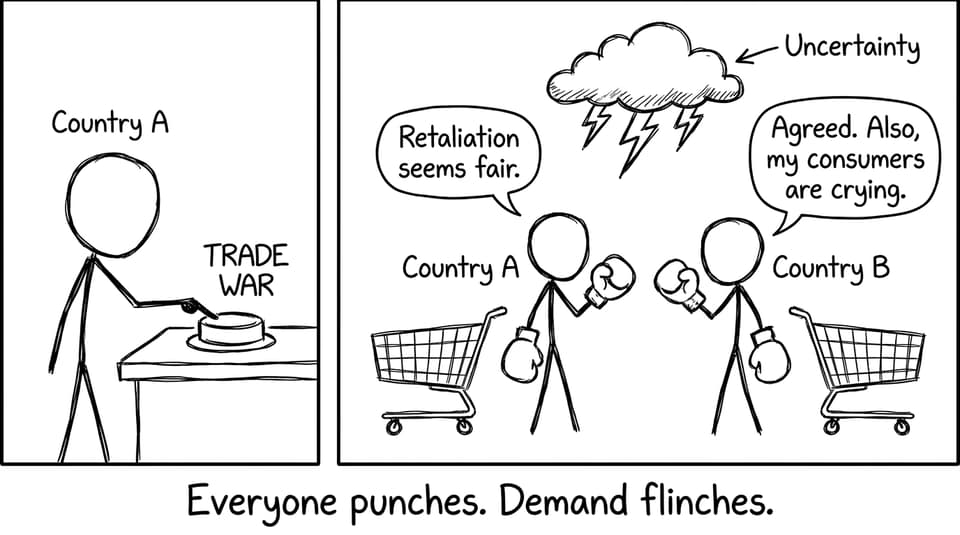
In IB Economics, retaliation matters because it spreads the damage:
-
Export industries lose access to foreign markets
-
Firms face uncertainty, delaying investment
-
Supply chains become more expensive and less reliable
The result can look like a trade war where everyone claims to be defending fairness, while households quietly face higher prices and fewer choices.
How to score higher: trade barriers evaluation that sounds like an examiner
A strong IB Economics paragraph often has this shape:
-
Short run: protection may support employment, infant industries, or strategic sectors
-
Long run: inefficiency, weaker innovation, higher prices, and possible retaliation reduce welfare
To practice writing this under timed conditions, use RevisionDojo’s 4.2 Types of Trade Protection Questionbank and the broader IB Economics Resources. RevisionDojo also supports the habits that actually move grades: Flashcards for key definitions, Study Notes for diagrams and chains of reasoning, AI Chat for instant clarification, and grading tools that tell you what your evaluation is missing.
Bringing it home to RevisionDojo
If you can explain trade barriers as a chain reaction: prices, welfare, efficiency, retaliation, and time-frame evaluation; you’re already writing like a top IB Economics student. Turn that understanding into marks with RevisionDojo: practise with the Questionbank, lock in definitions using Flashcards, refine diagrams with Study Notes, pressure-test your reasoning with AI Chat, and use grading tools plus Mock Exams to spot what an examiner would still want you to add. When trade barriers show up on an exam, you won’t just describe them. You’ll evaluate them.