
When a rival brand quietly changes its price, most consumers barely notice. Businesses do. Because somewhere in the background, demand is shifting like a tide: a little away from one product, a little toward another. In IB Economics, that invisible tug-of-war has a name: cross-price elasticity of demand. And if you can explain why firms care about it, you are already writing like an examiner wants you to.
What cross-price elasticity of demand actually tells a firm
Cross-price elasticity of demand (XED) measures how the quantity demanded of one good changes when the price of another good changes.
Businesses care because XED is basically a relationship detector:
-
Positive XED = the goods are substitutes (they compete)
-
Negative XED = the goods are complements (they move together)
-
XED close to zero = the goods are mostly unrelated
In exam terms, it is a way to connect a price change in Market A to a demand shift in Market B using clear chain reasoning. If you need to refresh elasticity language, the IB Economics hub on Elasticities of demand is a clean starting point.
IB Economics: Why substitute relationships change pricing decisions
If a firm knows its product has strong substitutes, it knows it is vulnerable. A small competitor price cut can pull customers away quickly.
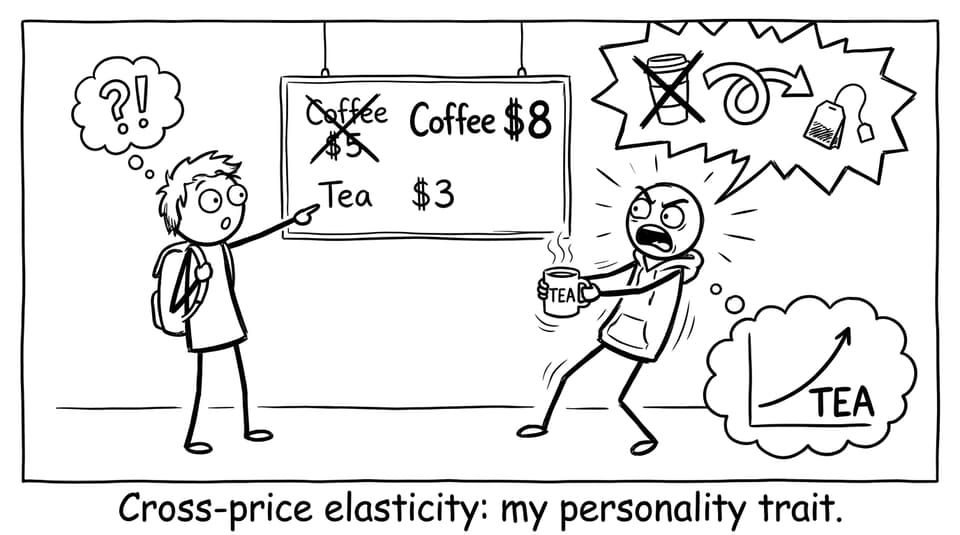
Example: if the price of coffee rises and tea demand rises, coffee and tea show positive XED. For businesses, this is not trivia. It affects:
-
Competitive pricing strategy (Do we match the rival? Differentiate?)
-
Promotion timing (Discounts when a substitute becomes expensive)
-
Market positioning (Branding to reduce substitutability)
This is why firms obsess over what counts as “close.” In IB Economics, you can link this straight to market structure and competition. If you want broader micro context, use IB Economics Microeconomics as your base camp.
IB Economics: Why complement relationships shape bundling and forecasting
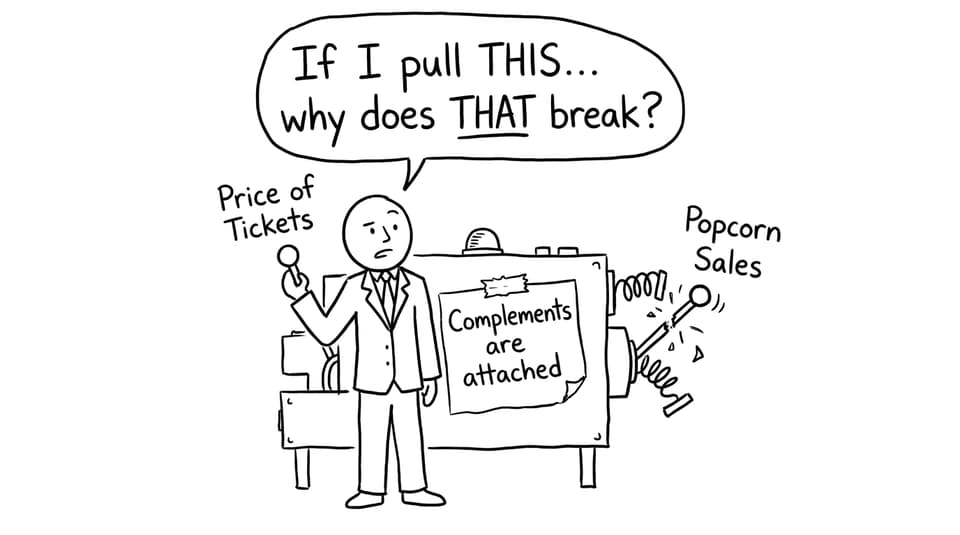
Complements are where businesses learn humility: you can do everything “right” and still lose sales because another market moved.
If XED is negative, the goods are complements. When the price of one rises, demand for the other falls.
Classic example: cinema tickets and popcorn. If tickets become more expensive, fewer people go, and popcorn sales dip too.
Firms use this insight to:
-
Bundle (tickets + snacks, consoles + games)
-
Coordinate pricing across product lines
-
Forecast revenue more accurately when a related market changes
If you are still building your core micro foundations, pair this topic with Define supply and demand and then revisit elasticity.
A quick exam-ready checklist (use this under pressure)
When you see a cross-price elasticity prompt in IB Economics, do this fast:
-
State what XED measures.
-
Use the sign: positive = substitutes, negative = complements.
-
Explain the business implication (pricing, bundling, competition, forecast).
-
Add a real-world example.
-
Evaluate briefly (strength of relationship, time period, other factors).
For structured practice, RevisionDojo’s Microeconomics Questionbank is built for these quick chains of reasoning.
How businesses turn XED into strategy (and how you turn it into marks)
Businesses rarely use XED in isolation. They combine it with market research and with other elasticities to decide what to do next.
In IB Economics exam writing, that becomes evaluation: XED can change by brand loyalty, income levels, availability of alternatives, and the time period.
If you are revising broadly, connect this to technique and structure using Methods for effective IB Economics revision and the bigger picture in Understanding IB Economics.
Conclusion: Learn XED once, use it everywhere
Cross-price elasticity of demand matters because it reveals who you compete with, who you rely on, and how fragile your demand really is. For IB Economics students, it is one of those concepts that turns a diagram into a story businesses actually live.
If you want to practice XED the exam way, RevisionDojo helps you move from definition to confident application using Study Notes, Flashcards, the Questionbank, AI Chat, Mock Exams, Predicted Papers, Grading tools, and even targeted support through the Tutors and Coursework Library. The goal is simple: fewer guesses, more clear chains of reasoning, and higher marks when it counts.