



The first time you write a serious essay in a second language, you notice something odd: you don’t just translate words. You translate thinking. The sentences take longer, yes, but your ideas get sharper. You start spotting nuance earlier. And in the middle of all that effort, a quiet question appears: is the IB Bilingual Diploma actually good for university admissions, or is it just another shiny label?
For most universities, the honest answer is: it’s not magic, but it is meaningful. The IB already signals rigor. The bilingual distinction adds a second signal: you can do that rigor in two languages, under exam pressure, while staying academically precise.
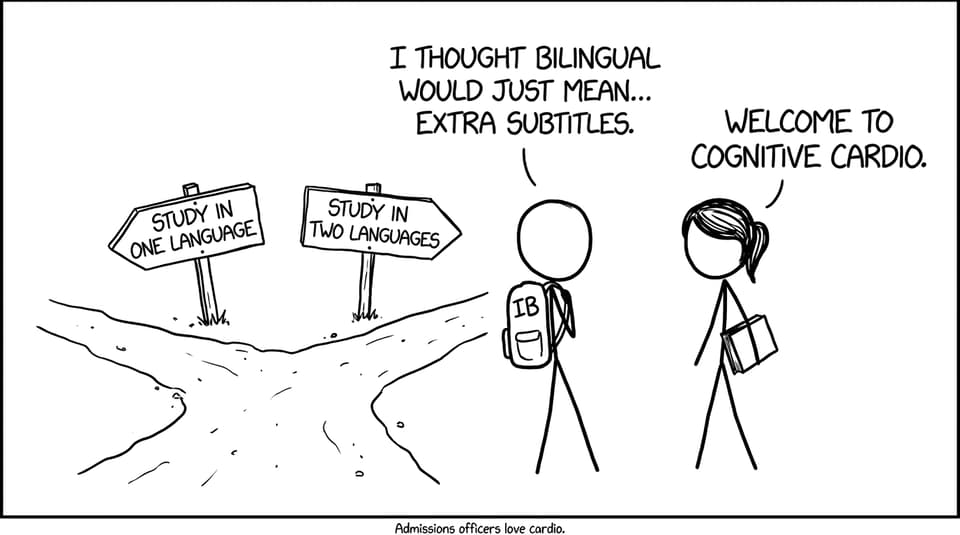
What the IB Bilingual Diploma is (and what it isn’t)
The IB Bilingual Diploma is not a separate diploma you “switch into.” It’s a designation on your final diploma that confirms academic proficiency in two languages through formal IB subjects.
Two official pathways are recognized:
Two Language A subjects
You take two Group 1 Language A courses in different languages (for example, English A and Spanish A). To earn the bilingual designation, you must score 3 or higher in both.
If you want the exact breakdown and examples, see How to Earn a Bilingual IB Diploma.
One Language A + a non-language subject taught in another language
You take one Group 1 Language A, plus a Group 3 or Group 4 subject taught and assessed in a different language. Again, you need 3 or higher in both.
A helpful overview is also in What is an IB Bilingual IB Diploma?.
Quick checklist: when the IB bilingual label helps most
Use this as a fast reality-check before you commit energy during exam season:
-
You’re applying to universities that value global readiness or multilingual study
-
Your intended major connects to languages, culture, policy, business, law, health, or research
-
You can maintain strong IB scores overall (the designation is a bonus, not a rescue)
-
You’ll write about bilingual learning in your personal statement with real evidence
-
You’re ready to practice exam writing consistently in both languages
Why universities tend to like the IB Bilingual Diploma
Universities don’t admit labels. They admit predicted performance. The bilingual designation matters because it’s credible evidence of specific strengths.
The IB bilingual pathway signals academic stamina
Doing the IB well is already demanding. Doing it across two languages adds friction that admissions teams recognize: more complex reading, more careful writing, more cognitive load.
That stamina is especially persuasive when your application also shows strong coursework results, thoughtful activities, and clear academic direction.
It quietly proves cultural competence (without sounding like a slogan)
Plenty of applicants say they are “global-minded.” The bilingual distinction is a harder proof because it comes from sustained academic work.
In practical terms, it tells a university you can participate in seminars, write research, and collaborate across cultures without needing the environment to be simplified for you.
It supports cognitive skills universities care about
Bilingual study often sharpens switching ability: moving between frameworks, adapting tone, and selecting the right wording under time pressure.
Those skills map well onto university life: discussion-based classes, fast feedback cycles, and writing-heavy modules. It’s not that bilingual students are automatically better. It’s that the bilingual IB route trains the exact kind of mental flexibility universities reward.
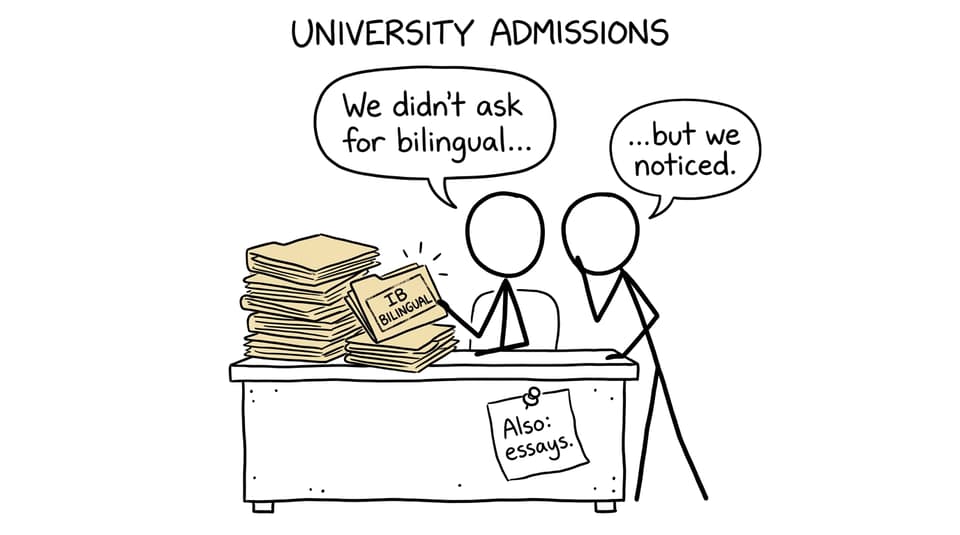
Real university outcomes: admissions, credit, and opportunities
This is where students want certainty, but admissions rarely offers it. Still, there are clear patterns.
Admissions advantage (the realistic version)
At competitive universities, many applicants already have strong grades. What helps is a combination of rigor plus evidence that you can thrive in the university’s environment.
The IB Bilingual Diploma can be one more credible indicator, especially if the university values international cohorts, study abroad participation, or multilingual instruction.
Possible placement, credit, or meeting language requirements
Many universities award credit or advanced placement-like benefits for strong IB scores. The bilingual distinction can also support language requirement fulfillment (depending on the institution).
Always check the policy of each university. The bilingual label won’t automatically translate into credit everywhere, but it strengthens the case that your proficiency is academic, not casual.
Scholarships and programs with an international focus
Some scholarships are designed for multilingual or internationally experienced students. A bilingual IB pathway can make your profile more legible to those committees because it’s standardized and assessed.
How to protect your IB scores while pursuing bilingual
The biggest risk is chasing the designation and letting your overall IB performance slip. If exam prep is your priority, use bilingual study as a system, not a vibe.
Here’s a simple approach that works in busy weeks:
-
Build foundations with RevisionDojo for IB Study Notes, then turn them into active recall using Flashcards
-
Practice exam-style application in the Questionbank (especially for writing-heavy language tasks)
-
Use AI Chat to clarify grammar, tone, and thesis framing quickly, then redo the same task timed
-
Use Grading tools to get feedback on written responses, especially in Language A tasks
-
Simulate pressure with Mock Exams and Predicted Papers so bilingual performance holds under time limits
If you want a full workflow, RevisionDojo App: The Smarter Way to Prep for IB Exams lays it out clearly.

Practical ways to write about bilingual IB in applications
A bilingual designation is most persuasive when you attach it to a story of growth.
Mention a moment where bilingual study forced you to become more precise: a literature argument that only worked once you understood connotation, or a history explanation that demanded exact terminology.
For English A students, this matters even more. Strong writing is evidence. These guides help sharpen it:
-
HL Essay Ideas for IB English A: Literature and Language and Literature
-
Understanding the HL Essay for IB English A: Literature and Language and Literature
Conclusion: Is IB bilingual good for university?
The IB Bilingual Diploma is good for university admissions in the way the best signals usually are: quiet, credible, and earned. It shows you can do difficult academic work in two languages, not just speak them. For admissions teams, that suggests stamina, precision, and adaptability.
If you’re pursuing it while preparing for exams, protect the fundamentals: strong IB scores, clear writing, and repeated exam practice. RevisionDojo is built for that reality, with a Questionbank, Study Notes, Flashcards, AI Chat, Grading tools, Predicted Papers, Mock Exams, a Coursework Library, and Tutors that help you stay steady when the schedule gets loud.
When your results arrive, the bilingual line on the diploma should feel like what it really is: a small sentence that represents a long habit.