



Four weeks before an IB November exam, the problem is rarely a complete lack of time. It is that every unfinished topic suddenly appears equally urgent.
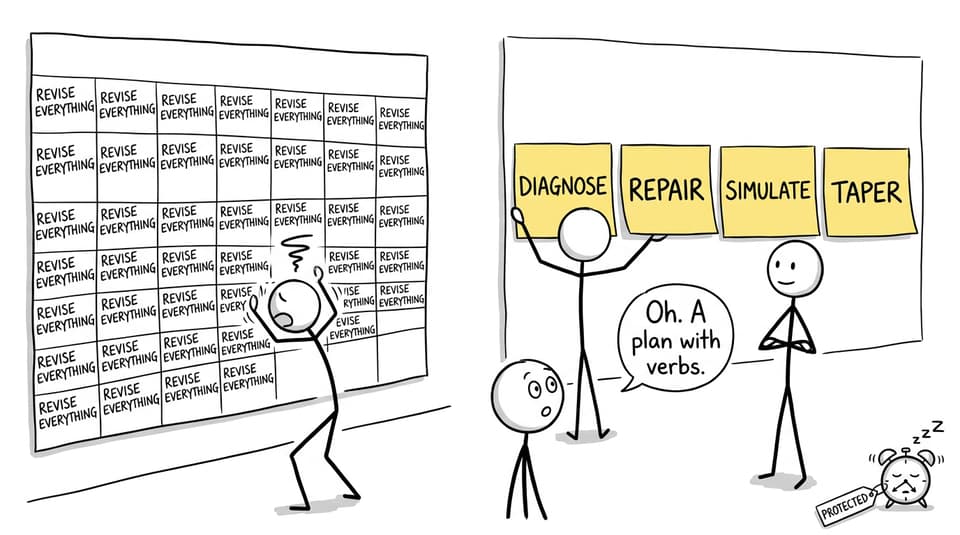
To build a revision timetable for the last four weeks, start with your examination dates, rank each paper by urgency and weakness, and divide the month into four phases: diagnose, repair, simulate, and taper. Give every study block a precise output, reserve time for reviewing mistakes, and leave space for sleep and disruption.
For the November 2026 session, the official examination calendar runs from Friday 23 October to Friday 13 November. Use the personalised timetable confirmed by your school coordinator, including your exam zone and local start times. Revision should follow the order of your papers, not a generic subject rotation.
Your four-week revision checklist
Before filling a calendar, complete this setup:
- Enter every paper separately, with its date, session, level, and duration.
- Mark clusters of consecutive or same-day papers.
- Rate confidence in each paper from 1-5.
- Choose the three weakest, most urgent papers as current priorities.
- Add marking and correction time after every timed attempt.
- Protect one buffer block and one lighter period each week.
The November 2026 IB exam schedule and study plan can help you identify paper sequences and demanding combinations.
Build the timetable backwards from exam day
A calendar becomes useful only when it reflects consequences. A Biology paper in eight days should usually receive attention before a stronger Mathematics paper in three weeks.
Create a simple planning sheet:
| Paper | Exam date | Confidence, 1-5 | Urgency, 1-5 | Next task |
|---|---|---|---|---|
| Biology HL Paper 1 | Your date | 2 | 5 | Timed data questions, then review |
| English A Paper 1 | Your date | 3 | 4 | Annotate and plan one unseen text |
| Mathematics AA Paper 2 | Your date | 4 | 2 | Mixed calculator set |
Your priority is not simply the lowest confidence score. It is the intersection of weakness, proximity, and the amount of practice required. The guide to building an IB exam timetable that works provides a broader framework for mapping those pressures.
If your school calls September through November the fall term, the calendar label changes nothing. Work from your confirmed examination sequence and remaining coursework.
Give each of the four weeks a different purpose
Preparation should change as the examination approaches. Early in the countdown, you can repair knowledge. Near the first paper, performance and recovery matter more.
| Week | Main purpose | Typical work |
|---|---|---|
| Four weeks remaining | Diagnose | Short timed sections, syllabus audit, error classification |
| Three weeks remaining | Repair | Targeted Study Notes, Questionbank sets, written-response practice |
| Two weeks remaining | Simulate | Predicted Papers, Mock Exams, same-day marking |
| Final week | Taper | Error-log review, Flashcards, short drills, sleep and logistics |
Week four: diagnose before studying harder
Attempt a representative section for each priority paper without notes. Record whether lost marks came from missing knowledge, weak method, command-term mistakes, careless execution, or poor timing.
Use RevisionDojo Study Notes and subject resources to repair the smallest identifiable gap, then test it immediately. A diagnosis such as “weak at Biology” is too vague. “Cannot explain how selection changes allele frequency” can become a focused 45-minute block.
Week three: turn weak areas into marks
This is the busiest repair week. A useful session follows a three-part loop:
- Spend 10-15 minutes clarifying one concept with Study Notes or AI Chat.
- Spend 30-45 minutes applying it through the Questionbank.
- Spend 10-15 minutes marking, logging errors, and creating Flashcards.
The IB Questionbank practice guide explains how to move from untimed learning sets to stricter performance sets. For essays and extended responses, use Grading tools to identify weaknesses in structure, evidence, and command-term execution.
Week two: rehearse the real sequence
Now the timetable should resemble the demands ahead. Use Predicted Papers created for IB practice and Mock Exams under realistic timing. Sit at least one session at the time of day when the corresponding examination is scheduled, where practical.
If you face morning and afternoon papers on the same day, rehearse that sequence once. Learn how to eat, reset mentally, and manage recall between sessions. The guide to the hardest November exam-day combinations offers further planning ideas.
Every simulation needs a review block. Mark it, classify the lost marks, repair one important pattern, and schedule a short retest. A long attempt without analysis may reveal a problem, but it does not solve it.
Final week: reduce volume, preserve sharpness
The final week is not the moment to prove how long you can remain awake. Reduce session length while keeping retrieval active. Review Flashcards, redo selected errors, practise short outlines, and complete small Questionbank sets on high-value weaknesses.
Use the final 72 hours before each paper for recall and technique rather than opening an untouched unit. Pack materials, confirm transport and reporting times, and keep sleep consistent. The aim is to arrive able to retrieve what you know.
Turn available hours into realistic blocks
Count only the hours you can genuinely use. School, travel, meals, exercise, sleep, and family responsibilities remain real during the countdown.
If you have 18 usable hours in one week, do not schedule all 18. Reserve time for correction and at least one buffer block. A timetable with no slack usually fails after the first unexpected assignment or tired afternoon.
A practical weekday might contain:
- 15 minutes of Flashcards before school or during a break
- One 50-minute priority-subject block after school
- A 10-minute break
- One 40-minute secondary-subject block
- 15 minutes to mark work and set tomorrow’s first task
Weekends can hold longer simulations and deeper review. The low-stress daily IB study schedule offers adaptable routines for school days.
Write outputs, not intentions
“Revise Chemistry” invites delay because it contains no finish line. “Complete 15 equilibrium questions, mark them, and record three errors” tells you where to begin and when to stop.
Write each block using this formula:
Resource + action + scope + review
For example: Questionbank + answer + 12 genetics questions + correct every error.
RevisionDojo works best as a connected system: Study Notes for clarification, Flashcards for retrieval, the Questionbank for application, AI Chat and Grading tools for feedback, and Predicted Papers or Mock Exams for simulation. Its Coursework Library can support a tightly bounded final coursework check, while Tutors can help when a persistent gap needs human explanation. Every tool should have a defined job.
Review the plan without judging yourself
At the end of each week, compare planned blocks with completed outputs. Move unfinished high-priority work forward, remove tasks that no longer matter, and increase time for error patterns that continue to cost marks.
Do not rebuild the entire system because one Tuesday went badly. A timetable is a decision-making tool, not a contract with your more energetic past self. The strongest plan changes when the evidence changes.
Make the final month feel smaller
Four weeks can look frightening when imagined as one solid block. It becomes manageable when each week has a purpose and each session has a visible finish line.
Start with the confirmed examination sequence. Diagnose honestly, repair narrowly, simulate realistically, and taper deliberately. RevisionDojo brings that process together through its Questionbank, Study Notes, Flashcards, AI Chat, Grading tools, Predicted Papers, Mock Exams, Coursework Library, and Tutors. The value is not simply having more material. It is knowing what to do next, especially when November is close.