
The question behind the question: is a 45 in IB worth it?
A friend once described the IB like a treadmill with a mirror in front of it. You're running, the belt keeps moving, and the reflection is always slightly behind the person you hoped you'd be by now.
Then someone mentions a 45.
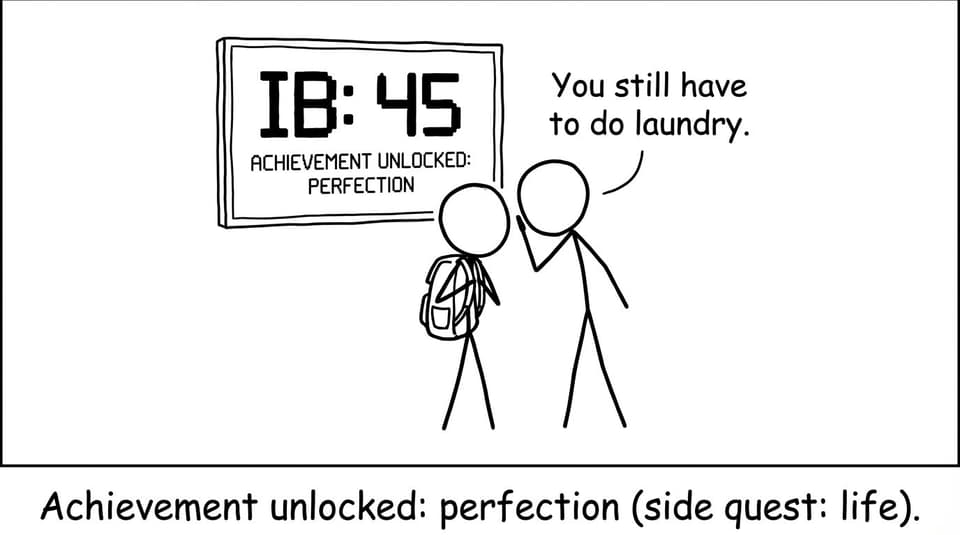
In the IB world, 45 is a myth that walks around in a school uniform. It's a number that can feel like proof: proof you were disciplined, proof you were smart enough, proof you didn't waste these two years.
But the real question isn't "Can I get a 45 in IB?" The real question is: What will it cost, and what will it buy?
This article is a calm, honest look at whether getting a 45 in IB is actually worth it, especially when you're preparing for exams and your time (and energy) is already being traded like currency.
A quick IB decision checklist (use this before you commit)
If you want the short version, run this checklist. It will tell you whether a 45 in IB is a wise goal, or an expensive distraction.
- University reality: Does your target university actually reward a 45 in IB more than, say, a 42 or 43?
- Marginal gain: Are you currently in a score range where extra effort reliably turns into extra points?
- Energy budget: Are you chasing a 45 while sleep-deprived, anxious, or already burnt out?
- Subject ceilings: Are there one or two subjects where you're consistently losing small, fixable marks?
- System vs sacrifice: Do you have a repeatable IB study loop (practice, feedback, retest), or are you relying on panic and long nights?
If you don't have a loop yet, start with the structure in How to Study for IB Exams: Step-by-Step Guide and build from there.
What a 45 in IB actually represents (and what it doesn't)
A 45 in IB is not "perfect knowledge." It's closer to "perfect execution."
IB exams reward students who can do three things at once:
- Recall the right content fast.
- Apply it in the form the question demands.
- Communicate it with markscheme-shaped precision.
That's why two students can both "understand" the topic, but one scores higher. The higher scorer is usually the one who has trained the output.
This is also why the best preparation tools for IB are not the ones that make you feel busy, but the ones that make you confront the truth quickly. RevisionDojo is built around that truth loop: Questionbank practice, Study Notes for fast clarity, Flashcards for daily recall, AI Chat (Jojo AI) to unblock confusion, and Grading tools to turn feedback into actions.
If you want to see how that ecosystem fits together, use RevisionDojo App: The Smarter Way to Prep for IB Exams.
The hidden math: the last few IB points are the most expensive
Early improvements in IB are often cheap.
Going from "I don't get this" to "I can answer standard questions" is mostly about exposure and clarity. A good set of notes, a few focused question sets, and you improve.
But going from 42 to 45 is different. It's not about learning more chapters. It's about removing small leaks:
- dropping fewer method marks
- reading command terms correctly
- writing cleaner evaluations
- not blanking under time pressure
- not making avoidable mistakes when tired
Those leaks are fixable, but they're expensive because they demand high-quality repetitions, not vague effort.
This is where a structured practice engine matters. For example, using Questionbank to drill a single weak subtopic, then switching into timed practice through Mock Exams and Predicted Papers, is usually a better path to extra points than rereading notes.
To make notes work the right way (as a quick patch, not a comfort blanket), skim Digital IB Study Notes: Access Anywhere, Anytime.
When chasing a 45 in IB is worth it
A 45 in IB can be worth it when it's aligned with a real outcome and supported by a sane system.
When a 45 helps your admissions strategy
In some contexts, the IB score is a strong signal. A 45 can strengthen applications, scholarships, or competitive program entry, especially when you're compared against equally strong candidates.
But be honest about the admissions reality. Often, universities have thresholds. Past a certain point, a higher IB score is "nice," not decisive.
If you're aiming for a 45 primarily for external validation, pause. Validation is a shaky fuel source. Systems last longer.
When you're already close, and the fixes are technical
If you're consistently scoring in the low 40s, the difference between your current performance and a 45 is often technique and repetition.
That's the good kind of work: small, specific, and measurable.
A practical approach:
- Use Comprehensive IB Question Bank: Thousands of Practice Questions to find recurring weaknesses.
- Run short, timed sets weekly (not only at the end) using Mock Exams.
- Use AI Chat to ask "why did I lose marks here?" and then retest.
When you can pursue it without trading away your health
The IB doesn't award bonus points for suffering.
If your attempt at a 45 requires chronic sleep loss, skipped meals, constant panic, or isolation, the cost is real. The irony is that those costs often make your marks worse. Fatigue creates sloppy errors, and a 45 is built by avoiding sloppy errors.
If this is your situation, read IB Exams Without Pausing Your Life and rebuild your week around minimum effective dose studying.
When chasing a 45 in IB is not worth it
Here's the quiet truth: sometimes the most mature IB decision is choosing a different target.
When the goal becomes your identity
If "45" starts to feel like a verdict on you as a person, you'll begin studying emotionally.
Emotional studying looks like this:
- rewriting notes for comfort
- avoiding practice because it threatens self-image
- overworking one subject because it feels controllable
- spiraling after one bad timed paper
IB rewards output, not self-esteem management.
If you notice this pattern, switch your goal from "get a 45" to "get my next +1." That framing is powerful because it turns ambition into a process.
When you're sacrificing coursework stability for exam perfection
Many IB students forget that the diploma is an ecosystem.
If you push too hard for exam perfection while your IA, EE, or TOK work becomes chaotic, your total score can suffer.
This is where RevisionDojo's Grading tools and Coursework Library help you keep the other side of IB contained. Your coursework shouldn't be a fog you stare into; it should be a sequence of drafts with feedback.
When your time is better spent on predictable wins
If you're sitting at, say, 35 and dreaming of 45, the honest question is not "Is it possible?" It's "What's the highest return on my next 6 weeks?"
In IB, predictable wins usually come from:
- doing more exam-style questions
- fixing repeated misconceptions
- learning command-term expectations
- building timing skill early
That's exactly what a platform loop is designed for. Start small with Notes + Flashcards + Question Bank (Free), then scale into Mock Exams and Predicted Papers as you stabilize accuracy.
A smarter target: the IB "45 mindset" without the 45 obsession
There's a version of the 45 goal that is healthy: it's not a number, it's a method.
The method is:
- Train with questions, not just content.
- Get feedback quickly.
- Retest the exact weakness within 48 hours.
- Repeat until your mistakes stop repeating.
This is why top scorers don't feel magical. Their work is simply more honest.
If you want a story-driven look at how that preparation actually happens, read How 45-Point IB Students Prepare for Exams.
And if you want to see how a top-scoring routine looks across a whole day, use A Day in the Life of a 45-Point IB Graduate.
A practical weekly plan for ambitious IB students (45 optional)
Here's a simple plan that works whether you're aiming for a 45 or just trying to push your IB score up without burning out.
Daily (30-60 minutes)
- 7-10 minutes: Flashcards (spaced repetition) using Flashcards
- 25-45 minutes: Questionbank practice on one subtopic
- 5 minutes: write 3 "error rules" (what you'll do next time)
Twice per week (60-90 minutes)
- Quick patch with IB Notes: Comprehensive Revision Guides
- Immediately prove it with harder questions (same topic)
- Use AI Chat to explain one confusion you keep postponing
Once per week (timed)
- Run a timed sitting using Mock Exams (or a subject predicted set if available)
- Review longer than you sat
- Turn the most common mistake into a mini flashcard deck
If you need help making timed practice feel real, use IB Test Templates: Pre-Made Exams for Quick Practice.
Closing: choose the IB target that lets you keep your life
A 45 in IB can be worth it. But only when it's a strategy, not a shrine.
If chasing a 45 makes you more consistent, more honest, and more skilled at producing answers under time pressure, it can be a meaningful goal. If chasing a 45 makes you brittle, exhausted, and emotionally attached to every mark, it's probably not worth the price.
The best version of the IB journey is not the one where you prove you can suffer. It's the one where you build a system that compounds.
If you want that system in one place, RevisionDojo is built for IB students who want to aim high without getting lost: Questionbank, Study Notes, Flashcards, AI Chat, Grading tools, Predicted Papers, Mock Exams, Coursework Library, and Tutors.
Start by picking one paper you're training for this week, then run the loop. In IB, that quiet repetition is what makes big numbers possible.