



If you’re an IB student refreshing the results page (or doing mental maths after every mock), a number like 34 can feel strangely ambiguous. Not low enough to panic. Not high enough to brag without checking the room. And yet it matters, because your IB score is one of the few parts of school that looks like a clean number in a messy life.
Here’s the calm truth: 34 in IB is a strong score. It’s above the global average, it signals consistency across demanding subjects, and it’s competitive for a wide range of university pathways. The more useful question isn’t “Is 34 good?” but “What does 34 say about me, and how do I use it?”
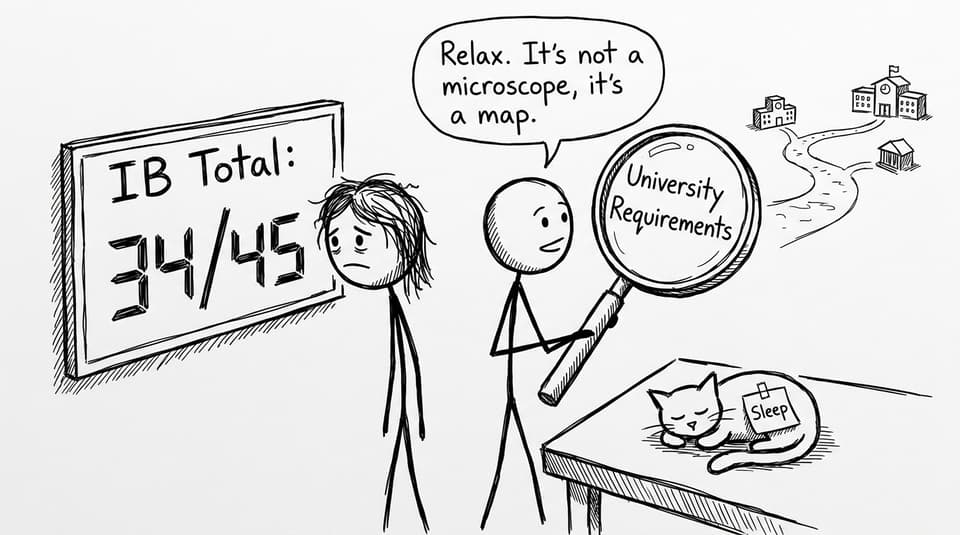
A quick IB checklist: what a 34 usually means
Use this as a fast read on what universities often infer from a IB 34:
-
You performed above the typical global average (often around the low 30s).
-
You likely have stable grades across six subjects, not just one spike.
-
You handled the core (TOK, EE, CAS) without it collapsing your total.
-
You’re probably “admission-ready” for many programs, assuming subject fit.
If you want to sanity-check your breakdown, use the IB Grade Calculator to see how subject marks and core points shape your overall IB outcome.
How 34 compares in IB (and why it feels smaller than it is)
The IB is designed to be hard. That sounds obvious, until you realize how much of your stress comes from treating a tough distribution like it’s supposed to be easy.
Most students cluster in the mid range. That’s why a 34 can feel “normal” even when it’s objectively strong. If you want context for the scoring curve, read Why Most IB Students Score Between 24-34 Points (And Why That’s Completely Normal).
A 34 says: you can sustain performance across workload, deadlines, and exams. In the IB, that steadiness is a skill, not a coincidence.
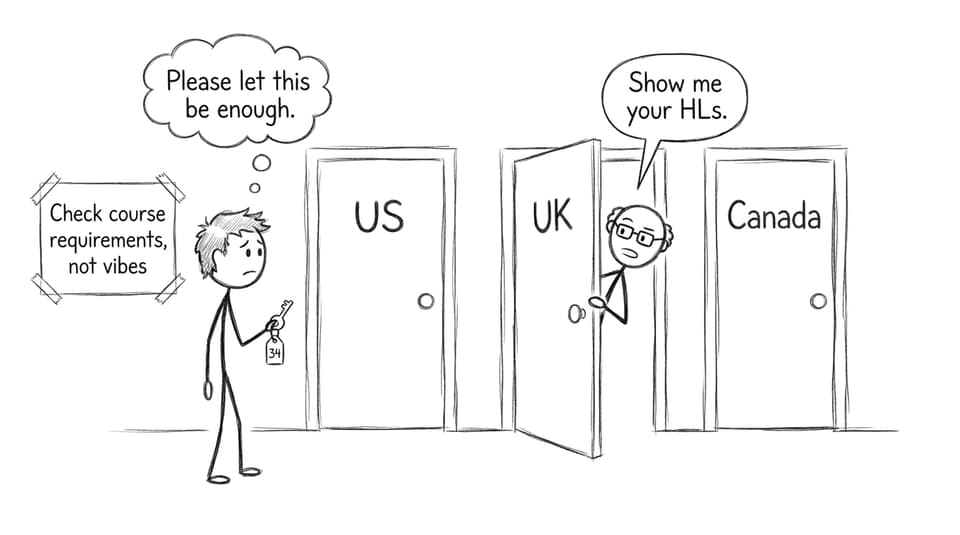
What universities think about a 34 IB score
Universities don’t just “rank” IB totals. They read signals.
United States
A 34 in IB is competitive for many strong public universities and private liberal arts colleges. For the most selective schools, the total alone rarely guarantees anything, but your HL performance and course rigor can matter a lot. Some institutions also award credit for strong HL results.
United Kingdom
Many offers sit in the low-to-mid 30s, so 34 in IB often matches entry requirements for a wide range of courses. Highly competitive programs may ask for higher totals or specific HL grades, but 34 is a respected baseline.
Canada, Europe, and Australia
A 34 IB score is commonly sufficient for direct entry into many programs, especially when your subjects align with your intended major. In these regions, subject relevance can be as important as the total.
For wider benchmarks, see What Is a Good Score in the IB Diploma? (Realistic Benchmarks and Global Averages).
If you want higher than 34 in IB, do this (without burning out)
There’s a quiet trap in the IB: trying harder in ways that don’t translate to marks. The fix is a loop that forces feedback.
A simple plan:
-
Patch weak content fast using Study Notes and articles like Digital IB Study Notes: Access Anywhere, Anytime.
-
Drill exam-style accuracy with RevisionDojo’s RevisionDojo for IB tools (Questionbank + instant feedback).
-
Build timing with IB Predicted Papers and the strategy in IB Predicted vs Specimen Papers: What They Mean.
-
Use AI Chat to diagnose patterns (ask why you lost marks, not just for explanations).
-
When writing is the issue, lean on Grading tools, the Coursework Library, and Tutors for targeted improvement.
If you want the mindset reset too, IB Predicted Grades Don’t Define You (Here’s What Does) is worth keeping open in another tab.
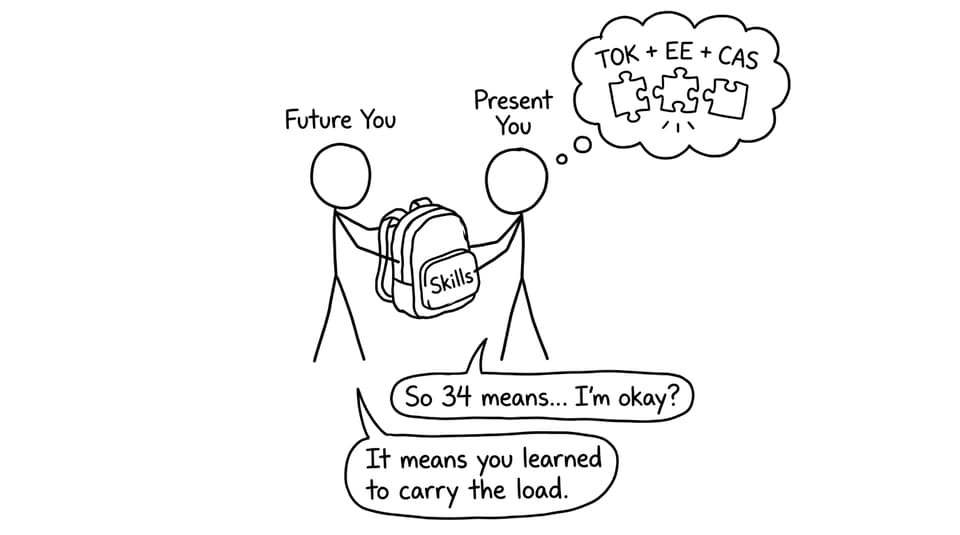
Closing: what a 34 in IB really gives you
A 34 in IB is not a consolation prize. It’s evidence that you can do hard things repeatedly, across months, across subjects, while life keeps happening. If you’re aiming higher, don’t chase motivation; build a system.
RevisionDojo is built for that system: Questionbank, Study Notes, Flashcards, AI Chat, Grading tools, Predicted Papers, Mock Exams, a Coursework Library, and Tutors to turn effort into points. Start by checking your current breakdown, pick one subject to raise by one grade, and run the loop until the exam feels familiar. That’s how IB scores move, quietly, then all at once.