
The email that feels like a verdict
The most dangerous thing about an IB predicted grade isn't the number.
It's the story your brain writes around it.
You open the message and, for a second, it feels like your future has been placed in a small digital box: the university choices you'll make, the way your teachers see you, the way your friends will silently compare. In the IB, the prediction can feel more real than the final exams because it arrives earlier, and because it comes with an implied judgment: "This is what you are."
But a predicted grade is not a definition. It's a snapshot taken in a specific week, under specific constraints, by specific humans, using imperfect information.
The student you are in November isn't the student you can become by May.
A quick overview: what to do when your IB predicted grade stings
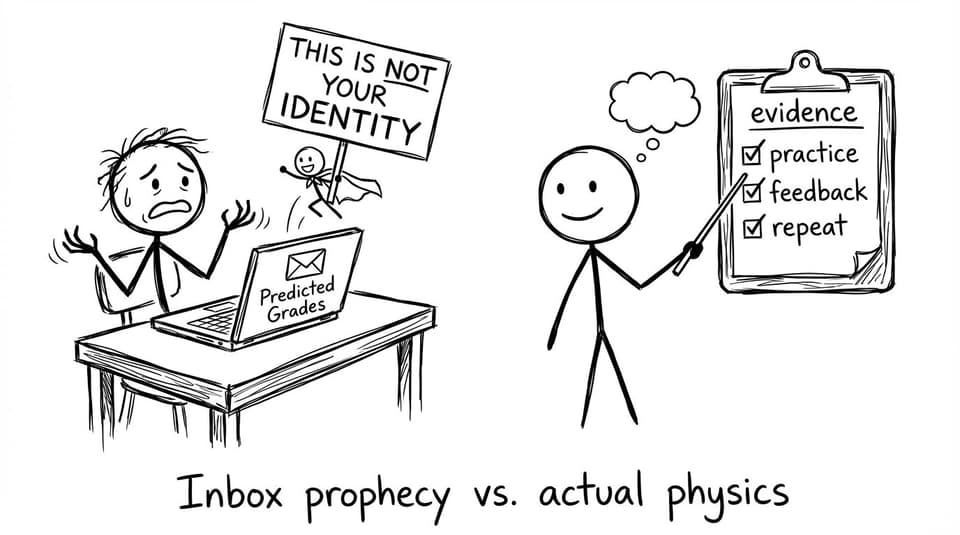
If your IB predicted grades disappointed you, don't negotiate with the feeling. Acknowledge it, then convert it into a plan.
Here's a simple checklist you can follow today:
- Separate identity from data: your predicted grade is information, not a label.
- Find the cause: content gaps, exam technique, timing, or consistency.
- Build an evidence loop: practice, feedback, correction, repeat.
- Protect your week: make your study routine smaller, not more dramatic.
- Simulate the real thing: timed practice beats hopeful revision.
RevisionDojo is designed to make that loop easy to run in one place: Study Notes for clarity, Flashcards for recall, Questionbank for targeted practice, AI Chat for quick help, Mock Exams and Predicted Papers for realism, plus Grading tools, a Coursework Library, and Tutors when you need deeper feedback.
Why IB predicted grades feel personal (even when they aren't)
In the IB, predicted grades are often treated like a passport stamp: they can influence applications, scholarships, and conversations with teachers. So it's normal to attach meaning.
But the meaning you attach is usually bigger than the grade itself.
A predicted grade can reflect things that have nothing to do with your potential:
- a rough term where multiple deadlines collided
- anxiety during timed assessments
- weak exam technique even if you understand content
- inconsistent homework completion (which teachers notice)
- a single unit test landing on your worst topic
Here's the subtle trap: the IB rewards performance under specific constraints. Your predicted grade might be measuring "current exam behavior," not "actual understanding."
That's good news, because behavior is trainable.
If you want a calm, structured system for that training, read: RevisionDojo App: The Smarter Way to Prep for IB Exams.
The difference between a snapshot and a trajectory
A snapshot tells you what happened.
A trajectory tells you what's happening.
Predicted grades are snapshots. They're taken at a moment where your study habits may still be forming. Many IB students only become truly consistent after the first "oh no" moment. It's not because they suddenly become disciplined people. It's because the pain becomes specific.
The students who improve the most in the IB aren't always the ones with the highest predicted grades. They're often the ones who learn to treat the predicted grade as a signal.
Signal of what?
- what content is missing
- which command terms you misunderstand
- where timing breaks your answers
- what question types you avoid
That signal becomes useful when you can turn it into targeted practice. That's exactly what the Questionbank is built for: drill by topic and style, get feedback, then close the gap.
What "turning it around" actually looks like in the IB
Movies make improvement look like motivation.
Real IB improvement looks like boring evidence.
Here's a framework that works across subjects.
Build clarity first, not confidence
Confidence is a lagging indicator. It shows up after you see proof.
Start with clarity:
- Pick one weak topic.
- Review it using Study Notes (short, syllabus-aligned, exam-focused).
- Ask one precise question to Jojo AI Chat (not "explain everything," but "why does X lead to Y in this context?").
If you want a notes system that doesn't turn into endless rewriting, use: Digital IB Study Notes: Access Anywhere, Anytime.
Use flashcards like a daily minimum
The IB is memory plus application. If you keep the memory alive, application becomes easier.
A small daily habit is powerful:
- 7-10 minutes of Flashcards
- star what feels shaky
- revisit tomorrow
RevisionDojo's Flashcards are designed for spaced repetition, so the schedule does the heavy lifting.
Practice in a way the IB actually rewards
Most students "revise" by rereading.
The IB rewards retrieval and precision.
Use a loop:
- Attempt 10-15 questions from the Questionbank on one subtopic.
- Check feedback.
- Write one rule: "Next time, I will…"
- Retake a smaller set 48 hours later.
If you want to get even more targeted, use: IB Question Search Engine: Find Questions by Keyword.
The quiet power move: stop trusting predictions, start collecting data
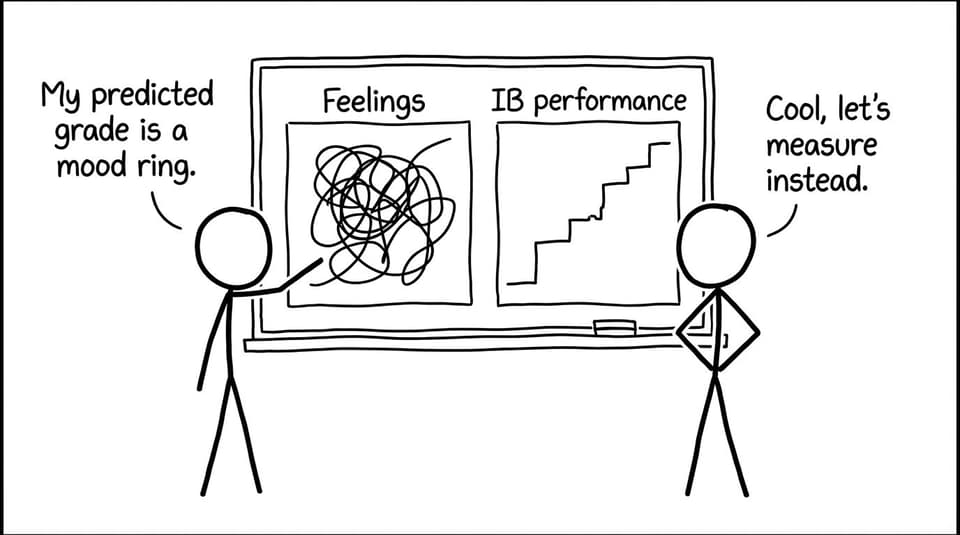
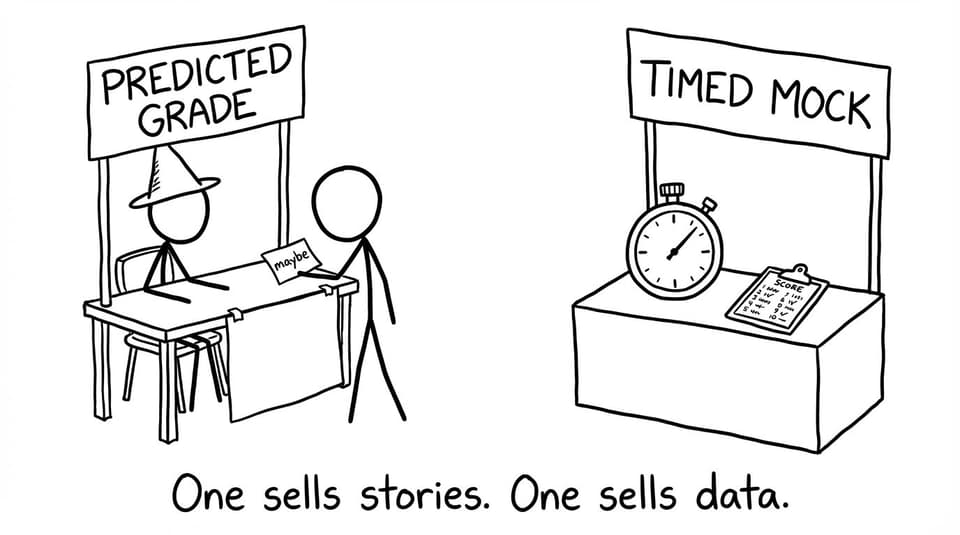
A predicted grade feels like a fortune teller.
But you don't need prophecy. You need measurement.
Timed practice gives you data that's closer to reality than a prediction. It shows you pacing, stamina, and what happens when your brain is under pressure.
That's why Mock Exams and Predicted Papers matter in the IB: they turn anxiety into evidence.
Use one timed block per week:
- a short section (30-45 minutes)
- then review mistakes for patterns
If you want a step-by-step workflow, use: Online IB Mock Exams: Practice Anywhere, Anytime.
And if your subject offers it, explore RevisionDojo's subject-specific Predicted Papers (for example: IB Economics Predicted Papers).
Why your IB predicted grades don't define you (but your habits might)
Predicted grades are often a proxy for three things:
Consistency
The IB is a two-year marathon disguised as a set of exams.
If your predicted grade is low, it might simply reflect inconsistent reps. That's not a character flaw. It's a scheduling problem.
Make the schedule smaller. Make it daily.
If you need a mindset shift around routines, this piece helps: Why Some IB Students Stay Consistent.
Technique
IB marking is not "did you generally understand." It's "did you do the thing the mark scheme rewards."
Technique improves fast when you train it deliberately.
RevisionDojo's Questionbank feedback and Grading tools help you see exactly where marks are won and lost, including for coursework drafts.
Emotional load
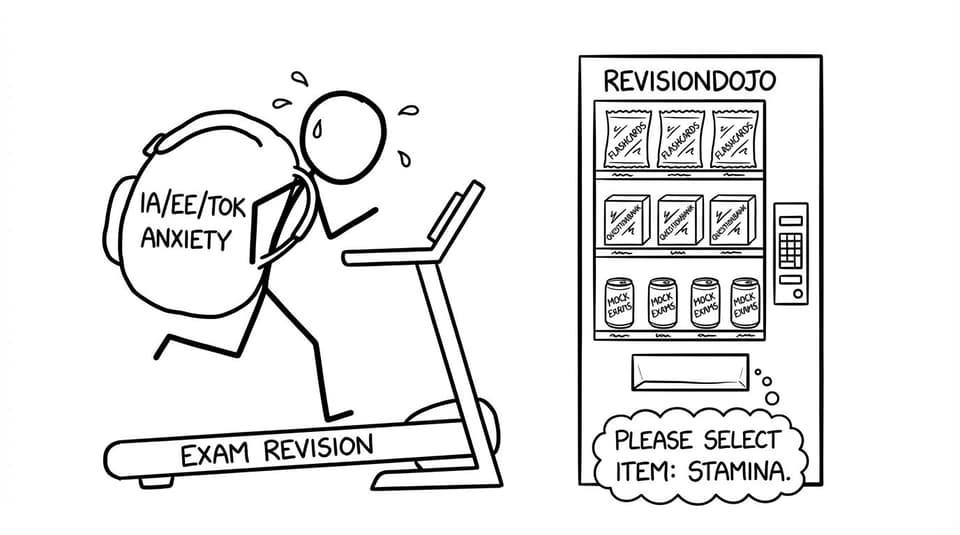
A predicted grade can collide with everything else: IAs, EE, TOK, sports, family stuff, sleep debt.
When your bandwidth is low, your performance drops. That doesn't mean your ceiling is low.
This is one reason RevisionDojo's Coursework Library and Tutors matter: they reduce uncertainty and keep coursework stress from swallowing exam prep.
A simple 2-week reset plan for IB students
If your IB predicted grades shook you, try this reset. Not perfect. Just consistent.
Week 1: accuracy over speed
- Daily: 10 minutes Flashcards
- 4 sessions: Study Notes + 15 Questionbank items (one topic)
- 1 timed block: short Mock Exam section
- 1 review session: write 10 "error rules" (patterns you repeat)
Week 2: add pressure gently
- Daily: Flashcards (keep it)
- 4 sessions: Questionbank mixed difficulty on the same topic
- 1 timed block: longer Mock Exam (or a subject Predicted Paper)
- 1 feedback session: ask Jojo AI Chat to explain your top 3 mistake patterns
For a broader study structure, see: IB: The Last 2 Weeks Before Exams (What Matters).
Closing: you are not your prediction, you are your proof
An IB predicted grade can feel like a name tag you didn't choose.
But the IB is not an identity test. It's a skills test.
And skills respond to training.
If your predicted grades hurt, let them do one useful thing: point you toward a better system. Build your loop: Study Notes for clarity, Flashcards for daily recall, Questionbank for precision, AI Chat when you're stuck, Mock Exams and Predicted Papers for realism, plus Grading tools, Coursework Library, and Tutors when pressure spikes.
Start here and keep it simple: RevisionDojo for IB.
Your predicted grade is a snapshot.
Your IB outcome is a trajectory you can still change.