


In IB Business Management, it’s tempting to treat ethics like a chapter you revise and then move on.
But integrity isn’t a topic. It’s a strategy.
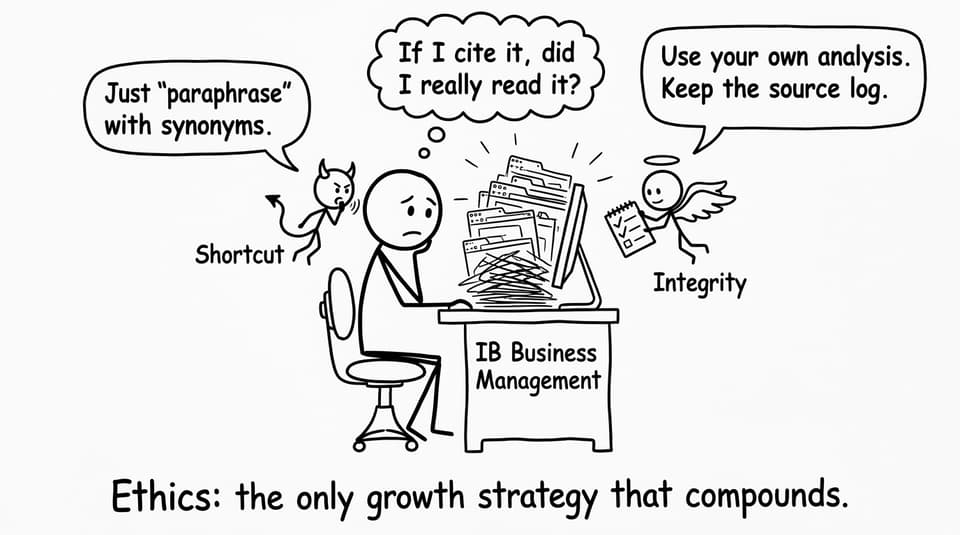
It shows up in the small moments: the data point you couldn’t verify but used anyway, the “perfect” paragraph that sounds unlike you, the SWOT that fits any company on earth. And oddly, those small moments compound. Over time, integrity becomes the difference between analysis that feels alive (and earns marks) and writing that feels borrowed (and collapses under scrutiny).
In this guide, you’ll learn how integrity works in IB Business Management across exams, the IA, and everyday revision. You’ll also get practical routines you can apply immediately using RevisionDojo.
Quick integrity checklist for IB Business Management
Use this as a 60-second scan before you submit coursework or finish a timed response in IB Business Management:
-
Can you explain, out loud, where every key claim came from?
-
Have you cited every borrowed idea, definition, dataset, and visual?
-
Is the analysis clearly yours (judgement, trade-offs, limitations)?
-
Are your business tools applied to this case, not a generic template?
-
If you used AI or classmates, is the help acknowledged and within school rules?
-
Would your work still make sense if the examiner removed all your quotes?
If you want a broader integrity framework across subjects, keep this open: How RevisionDojo Helps You Maintain Academic Integrity While Studying.
What integrity really means in IB Business Management
Integrity in IB Business Management has two layers that students sometimes separate (but examiners don’t):
-
Academic honesty: your work is authentic, properly sourced, and independently written.
-
Ethical reasoning: your decisions and evaluations consider stakeholders, sustainability, and fairness.
The best responses do both at once. They don’t just name ethics or CSR. They show ethical judgement through evidence, balanced evaluation, and transparent limitations.
A simple mental model helps:
-
Authenticity (your thinking)
-
Accuracy (your evidence)
-
Accountability (your ethical impact)
That’s the spine of strong IB Business Management writing.
Ethical research and data use (especially for the IA)
Your IA is where integrity becomes visible. Not because the examiner expects perfection, but because they expect a believable research process.
Ethical research in IB Business Management means:
-
Using data you can justify: company reports, official statistics, credible industry sources, and clearly recorded primary research.
-
Collecting primary research responsibly: informed consent, no pressure on interviewees, and no misrepresentation of responses.
-
Being honest about uncertainty: small samples, biased respondents, missing data, or assumptions in calculations.
-
Protecting confidential information: anonymize where needed and store notes securely.
If you’re building your IA from the ground up, these two guides pair well:
RevisionDojo also supports the integrity side of IA work with Grading tools (to check whether your evaluation is actually evaluation), AI Chat (to clarify concepts without handing you final phrasing), and the Coursework Library (to learn structure while keeping your writing original).
Integrity in business tools: from “template” to analysis
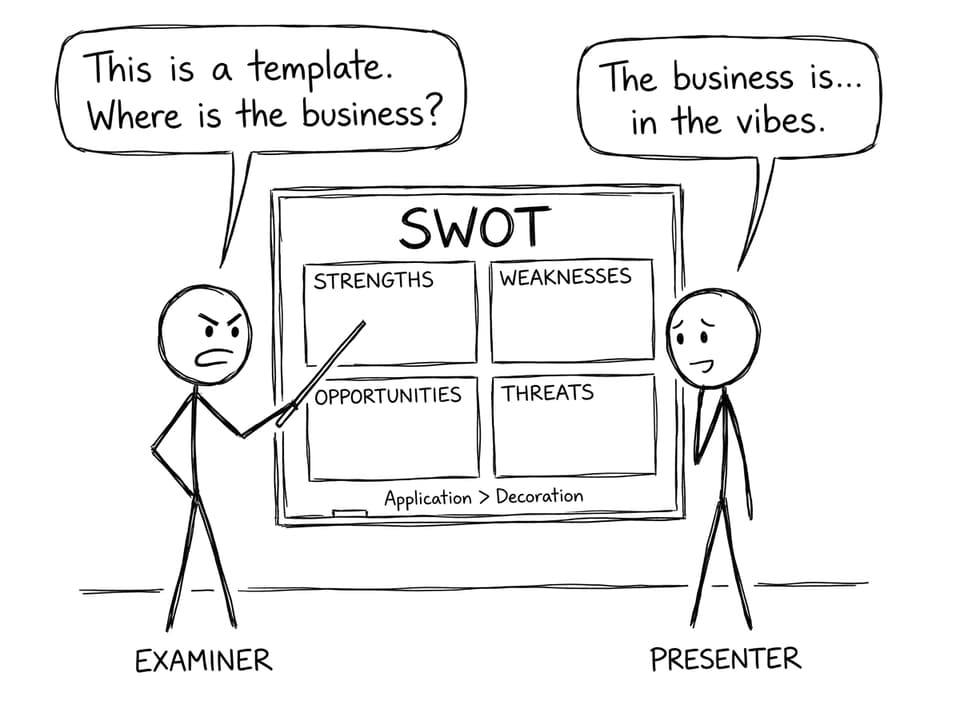
Frameworks are supposed to sharpen thinking. But in IB Business Management, they often become a hiding place: students drop in SWOT, PESTLE, Ansoff, or Porter because it feels safe.
Integrity is asking: Does this tool earn its space?
A tool is ethical and authentic when:
-
It’s relevant to the research question or case decision.
-
It’s applied using case facts and data.
-
It leads to analysis (so what?) and evaluation (is it worth it?).
A tool becomes risky when:
-
It’s filled with generic points that could fit any firm.
-
It’s used to replace judgement rather than support it.
-
It’s copied from an exemplar and lightly edited.
To practice tool application with feedback, use RevisionDojo’s Questionbank inside the subject hub: IB Business Management Resources. You can then reinforce definitions with Flashcards and tighten exam phrasing using AI Chat without outsourcing your thinking.
Avoiding plagiarism, collusion, and “borrowed structure”
Most students don’t plan to cheat. The danger is accidental drift.
In IB Business Management, plagiarism often looks like:
-
Copying lines from model answers or IA samples.
-
Paraphrasing a source by swapping words but keeping the same structure.
-
Using AI to generate “first drafts” that you then lightly edit.
Collusion often looks like:
-
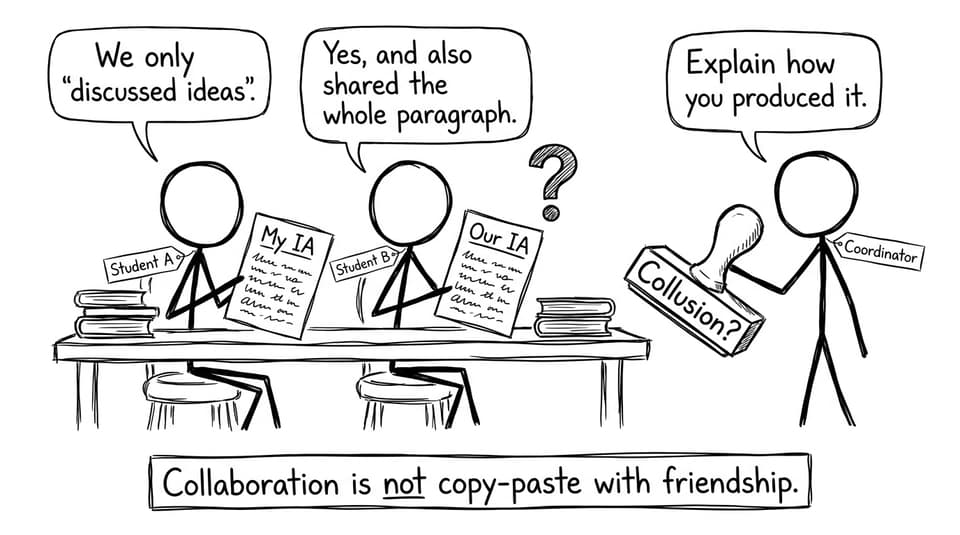
Friends “sharing a paragraph” to help each other get started.
-
Group notes turning into shared submitted writing.
And then there’s the quiet one: borrowed structure. Even if you rewrite every sentence, copying someone else’s chain of reasoning can still erase your authenticity.
If you want a clear, student-friendly explanation of what counts as misconduct, read: IB Academic Misconduct Explained: How to Avoid Plagiarism and Collusion.
Using AI responsibly in IB Business Management
AI can help you learn. It can also quietly steal your marks if it writes for you.
In IB Business Management, responsible AI use means:
-
Asking for explanations, not final paragraphs.
-
Using AI to quiz you on definitions, calculations, and command terms.
-
Using AI to generate practice prompts so you can write your own answers.
-
Checking your own work with a Plagiarism & AI checker where available, then revising in your voice.
RevisionDojo’s ecosystem is built for that boundary: AI Chat supports understanding, the Grading tools support improvement, and the Questionbank forces you to produce your own application and evaluation.
Ethical strategy in exam answers: the “transparent judgement” habit
Ethics in IB Business Management exam responses isn’t about moral speeches. It’s about decision quality.
A high-integrity answer tends to do three things:
-
Names stakeholders explicitly (employees, customers, local community, government, shareholders).
-
Uses evidence from the case or stimulus rather than general claims.
-
Balances trade-offs: short vs long term, profit vs reputation, feasibility vs impact.
If you want targeted topic practice that naturally connects ethics and strategy, try:
These pages work well because you can move from Study Notes to Flashcards to Questionbank practice without losing the integrity thread.
A simple RevisionDojo routine for ethical, high-scoring prep
Here’s a repeatable weekly loop that builds both marks and integrity in IB Business Management:
-
Study Notes (20-30 min): clarify one subtopic you keep describing instead of analyzing.
-
Flashcards (10 min daily): lock definitions so you stop copying textbook phrasing.
-
Questionbank (30-45 min): write short, applied paragraphs. Get feedback. Rewrite once.
-
Mock Exams: simulate pressure so integrity holds when you’re tired.
-
Predicted Papers: build stamina and decision-making in full-paper form.
For full-paper practice, use: Business Management Predicted Papers and the broader hub: IB Predicted Papers by IB Examiners.
When you need a reality-check on score strategy across the course, this is useful: IB Business Management: Maximize Your Exam Score.
FAQ
What counts as academic misconduct in IB Business Management?
Academic misconduct in IB Business Management usually involves plagiarism, collusion, or misrepresenting assistance. Plagiarism includes copying from websites, exemplars, classmates, or AI output without proper acknowledgement. Collusion is different: it’s when collaboration crosses the line into shared submitted work, even if you both “worked together.” Misconduct can also include fabricating data, inventing interview quotes, or editing results to match a conclusion you already wanted. The safest personal test is simple: if someone asked you to reproduce your process step-by-step, could you do it confidently? If you want a clear checklist and examples, use IB Academic Misconduct Explained: How to Avoid Plagiarism and Collusion.
Can I use primary research ethically in my IB Business Management IA?
Yes, and good primary research can make your IB Business Management IA feel real rather than recycled. Ethical use starts with informed consent: the interviewee should know what the data is for and how it may be presented. You should also avoid collecting information that the business considers confidential, or anonymize it when necessary. In your write-up, be transparent about limitations like small sample sizes, leading questions, or potential bias (for example, interviewing only managers). You also need to store your notes responsibly and avoid sharing them publicly. For planning and structure that aligns with examiner expectations, keep the IB Business Management Internal Assessment Guide open while you draft.
How do I cite sources properly without ruining flow in IB Business Management?
In IB Business Management, citations should feel like quiet support, not decoration. The goal is to show what you borrowed while keeping the spotlight on your analysis and evaluation. A practical method is to cite at the point of use: the moment you introduce a statistic, definition, or external claim, attach the reference immediately. Keep quotations short and rare, because examiners generally reward your judgement more than your ability to copy a strong sentence. Use one citation style consistently and make sure your in-text citations match your bibliography exactly. Also remember visuals count: if you include a chart, table, or image that isn’t entirely yours, it needs a citation too. For a clean checklist you can reuse, read 10 Best Practices for Citing Sources Properly in IB EE and IA.
Conclusion: in IB Business Management, trust is a competitive advantage
A business can buy attention. It can even buy growth.
But it can’t buy trust for long.
That’s why integrity matters in IB Business Management: it trains you to think like someone whose decisions have consequences, whose evidence can be checked, and whose recommendations are built on real reasoning.
If you want to prepare with the same mindset, build your routine inside RevisionDojo: use Study Notes to understand, Flashcards to retain, Questionbank to apply, AI Chat to clarify, Grading tools to improve, and Predicted Papers plus Mock Exams to rehearse under pressure. Start at the hub: IB Business Management Resources.