
Choosing between the IB Diploma and A Levels can feel like choosing between two maps of the same country. Both can lead to excellent universities. Both reward serious academic work. But they organise the journey differently.
For families comparing IB vs A Levels, parents should focus less on which qualification sounds more prestigious and more on how their child learns. The IB suits students who want breadth, can manage several parallel deadlines and are willing to keep languages, mathematics, writing and other disciplines in their timetable. A Levels usually suit students who are ready to specialise in fewer subjects and want more time to explore those subjects deeply.
Neither route is universally harder or better. The right question is whether its structure fits the student, the school and any likely university prerequisites.
IB vs A Levels at a glance
| Area | IB Diploma | A Levels |
|---|---|---|
| Typical structure | Six subjects plus a compulsory core | Usually three or more subjects |
| Specialisation | Broad, with three or four subjects at Higher Level | Earlier concentration in selected subjects |
| Additional requirements | Theory of Knowledge, Extended Essay and Creativity, Activity, Service | No single shared core across all subjects |
| Assessment | A mixture of final examinations and internally completed work | Usually centred on examinations, although this varies by subject and awarding body |
| Grading | Each subject is graded 1-7, with up to three additional core points | Individual subjects are commonly graded A*-E |
| Maximum overall result | 45 points | No single combined score across all subjects |
| Best suited to | Organised students who value breadth and international portability | Students with clear subject strengths who prefer earlier specialisation |
| Main parent concern | Coordinating overlapping subjects, coursework and core deadlines | Making suitable subject choices and managing high-stakes final assessment |
This comparison describes the standard IB Diploma and the typical UK A Level route. A Level structures can differ across England, Wales, Northern Ireland and international examination boards, so always confirm the details with the school.
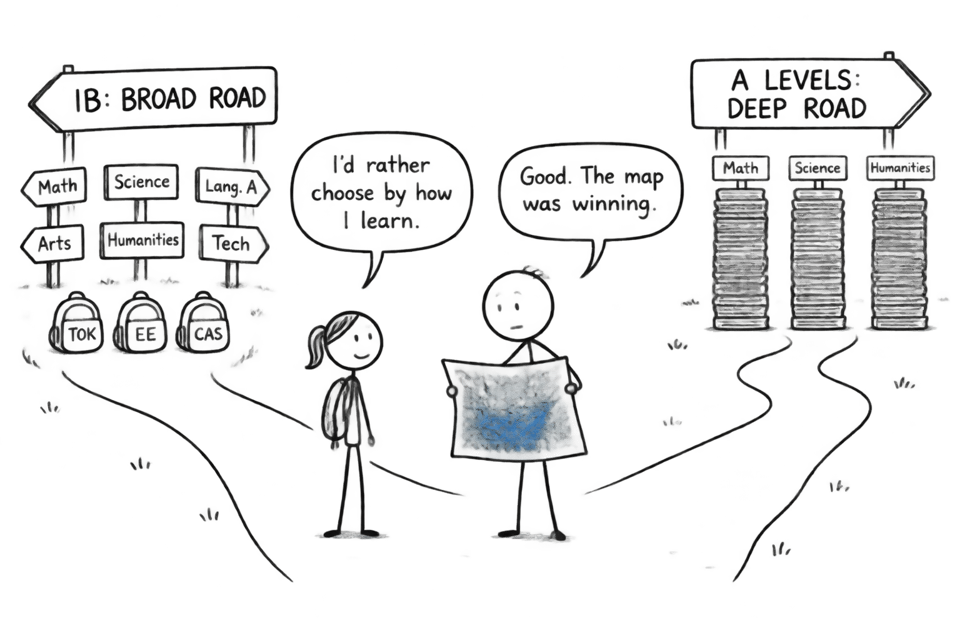
The central difference is breadth versus concentration
The IB Diploma requires six subjects drawn from a broad curriculum. Students normally take three subjects at Higher Level, sometimes four, with the rest at Standard Level. Higher Level means more teaching time and greater depth. It does not simply mean receiving more difficult homework.
Students also complete the Diploma core:
- Theory of Knowledge, usually shortened to TOK, explores how knowledge is created, tested and challenged.
- The Extended Essay, or EE, is an independent research project presented as a formal essay.
- Creativity, Activity, Service, known as CAS, involves experiences beyond ordinary academic lessons.
If those abbreviations already feel unfamiliar, the complete parent guide to the IB Diploma explains the system without assuming previous IB knowledge.
A Levels take a different approach. Students usually study three or more subjects over two years. A learner interested in engineering might choose mathematics, further mathematics and physics. An aspiring historian might combine history, politics and English literature. There is more room for concentration, but choosing subjects early can close certain university pathways if prerequisites are overlooked.
That distinction shapes family life. An A Level student may have fewer academic compartments, each studied deeply. An IB student has more moving parts. Supporting the latter is often less about explaining content and more about helping the student see the whole calendar.
Workload is not just a question of hours
Parents often hear that the IB is more work. That statement is incomplete.
The IB can feel heavier because six subjects, the core and internally completed assessments remain active at the same time. A student might revise chemistry, prepare a language oral, refine an essay question and record a CAS reflection during the same week. The challenge is coordination as much as intellectual difficulty.
A Levels concentrate effort into fewer subjects. That does not make them easy. The depth can be considerable, and examination performance may carry substantial weight. A student who dislikes one chosen subject has fewer alternatives balancing the timetable.
For a new IB student, the first term is therefore an adjustment period rather than a reliable forecast of the next two years. Early grades may be lower while the student learns unfamiliar command words, marking criteria and time management. RevisionDojo's guide to your child's first IB term helps parents distinguish ordinary adjustment from a problem requiring intervention.
Assessment feels different in each system
The IB combines external and internal assessment. External assessment includes final examinations and other work marked by IB examiners. Internal assessment refers to subject work marked initially by the student's teacher and moderated by the IB. The exact balance varies by subject.
Each IB subject receives a grade from 1-7. The six subjects can contribute 42 points, while TOK and the Extended Essay can contribute up to three additional points. Although 24 points is an important diploma threshold, earning the Diploma also depends on satisfying additional conditions. Parents should therefore avoid treating the total as the only measure that matters.
A Levels are graded separately by subject, commonly from A* to E. In England, reformed A Levels are generally linear, meaning assessment is concentrated at the end of the course. Other systems and international boards may use different arrangements, and some subjects include practical or non-examination components.
The practical lesson is simple: ask the school for an assessment calendar, not merely an examination calendar. In the IB, a deadline completed during the course can matter to the final result.
University admission depends on subjects as well as grades
Both qualifications are widely used for university entry. Universities make their own offers, however, and there is no universal conversion that makes every IB score directly equivalent to a particular set of A Level grades.
An offer may specify an overall IB score, particular Higher Level grades and required subjects. An A Level offer may name three grades and one or more compulsory subjects. Competitive courses such as medicine, engineering or economics may care deeply about the precise mathematics or science combination.
Before choosing, look at several plausible university courses, including options in more than one country if international mobility matters. Record the required subjects, levels and grades. Do not rely on a broad claim that one qualification is “accepted everywhere.” Recognition and admission are related, but they are not identical.
The IB parent timeline from school to university can help families anticipate when subject decisions, predicted grades and applications begin to matter.
Which is right for your child?
The IB may be the stronger fit when your child:
- enjoys several subject areas and is reluctant to narrow down early;
- values languages, writing and interdisciplinary thinking;
- can build routines around multiple smaller deadlines;
- may apply across different national university systems;
- accepts that independent research is part of the programme.
A Levels may be the stronger fit when your child:
- already has a clear academic direction;
- wants to stop studying subjects that feel less relevant;
- prefers sustained depth in a smaller number of areas;
- performs well in examination-focused courses;
- has checked that the chosen combination meets likely university requirements.
School quality can outweigh theoretical differences between the qualifications. An excellent coordinator, realistic deadline calendar and strong subject teaching can make the IB manageable. Weak guidance can make any programme unnecessarily difficult. Ask about class sizes, subject availability, university counselling, deadline coordination and support when students fall behind.
If your child has already started the IB, comparison should not become a running family debate. Use it to understand the structure, then help the student work successfully within it.
Practical ways parents can support a new IB student
Hold one short weekly planning conversation
Ask three questions: What matters most this week? Where are you stuck? What help would be useful? Ten calm minutes usually reveal more than nightly questions about homework.
Let the student own the calendar. Parents can help identify collisions and protect time, but constant monitoring can turn organisation into dependence. These IB time-management strategies provide a practical starting structure.
Learn the milestones without taking over
You do not need to understand every assessment criterion. You should know when major internal work, TOK tasks and Extended Essay stages are approaching. The parent guide to the Extended Essay explains how to encourage progress without directing the research or rewriting the student's work.
Respond to evidence, not atmosphere
A tired evening does not prove the programme is failing. Look for patterns: repeated missed deadlines, declining attendance, persistent sleep loss, avoidance of one subject or feedback that is never acted upon. If one subject becomes a recurring problem, use this guide to supporting IB subject struggles before assuming the only answer is more study time.
Make useful resources easy to reach
RevisionDojo brings the main parts of IB preparation into one connected system. A student can clarify a topic through Study Notes, test memory with Flashcards and apply it in the Questionbank. AI Chat can explain a difficult step, while Grading tools help students interpret assessment criteria rather than guess what improvement means.
Later, Predicted Papers and Mock Exams can develop timing and stamina. The Coursework Library offers examples for comparison, while Tutors can provide human support when independent study is no longer enough. Parents do not need to supervise each tool. The aim is to give the student a reliable place to work, such as RevisionDojo's complete collection of IB resources, and then discuss what the evidence shows.
A calmer way to view the decision
The IB is broad by design. A Levels are concentrated by design. Each structure creates opportunities and trade-offs, and neither removes the need for capable teaching, sensible routines and appropriate subject choices.
For parents of a new IB student, the most helpful shift is from asking, “Would A Levels have been easier?” to asking, “What system will make this week manageable?” That question produces actions rather than anxiety.
RevisionDojo is built to make those actions visible, from first-term Study Notes and Questionbank practice to coursework feedback, Mock Exams and specialist Tutors. For a simple overview without another dashboard to inspect, sign up for RevisionDojo and choose the parent weekly-summary email. It is a useful way to prepare for one informed weekly conversation while leaving the daily work where it belongs, with the student.