


A student can look calm at breakfast while mentally carrying six subjects, a research essay, an epistemology course, extracurricular commitments, and an approaching examination session. Parents often see the tiredness before they understand the machinery behind it.
The reassuring answer is that the International Baccalaureate Diploma Programme is demanding, but it is not mysterious. It is a two-year programme for students aged 16 to 19, built around six academic subjects and three core components: Theory of Knowledge, the Extended Essay, and Creativity, Activity, Service. Students are assessed through a combination of examinations and coursework, earning a final score out of 45.
This parent guide to the IB Diploma explains what your child is studying, how the scoring works, where pressure tends to build, and how to support progress without taking ownership away from the student.
Accuracy note: Programme structure and diploma award conditions were checked against current guidance published by the International Baccalaureate. Schools may set additional internal deadlines and policies, so your school's IB coordinator remains the best source for local details.
The IB Diploma at a glance
If you remember only one page of this guide, remember this checklist:
- The Diploma Programme normally lasts two academic years.
- Students study six subjects, usually three at Higher Level and three at Standard Level.
- They also complete Theory of Knowledge, the Extended Essay, and Creativity, Activity, Service.
- Each subject receives a grade from 1 to 7.
- The six subjects contribute up to 42 points.
- Theory of Knowledge and the Extended Essay can contribute up to three additional points.
- The maximum score is 45, while 24 is the minimum total required for the diploma.
- Reaching 24 is not enough by itself; students must satisfy the other award conditions.
- Universities set their own course, subject, level, and score requirements.
For a shorter programme-level introduction, read How the IB Diploma Works. This broader guide focuses on what parents need to notice throughout the entire journey.
What is the IB Diploma?
The IB Diploma Programme is an internationally recognized pre-university curriculum. Its distinguishing feature is balance. A student may develop considerable depth in mathematics or history, but cannot abandon languages, broader academic study, or reflective work entirely.
Students generally select courses across studies in language and literature, language acquisition, individuals and societies, sciences, mathematics, and the arts. An additional language, science, or individuals and societies subject can usually replace the arts choice. Availability depends on the school.
At least three and no more than four subjects are taken at Higher Level. The remaining subjects are taken at Standard Level. The IB recommends 240 teaching hours for an HL course and 150 for an SL course, reflecting the greater scope expected at HL. Both levels are still graded from 1 to 7, however, and a 7 at SL contributes the same number of diploma points as a 7 at HL.
Subject selection therefore matters for two reasons. It shapes the student's weekly workload, and it may affect university eligibility. A prospective engineering, medicine, or economics applicant should check specific university requirements before finalizing subjects rather than assuming that a strong overall score will compensate for a missing prerequisite.
Understanding the three core components
The word “core” can sound like an extra layer added around the real subjects. In practice, it represents much of what makes the Diploma Programme distinctive.
Theory of Knowledge
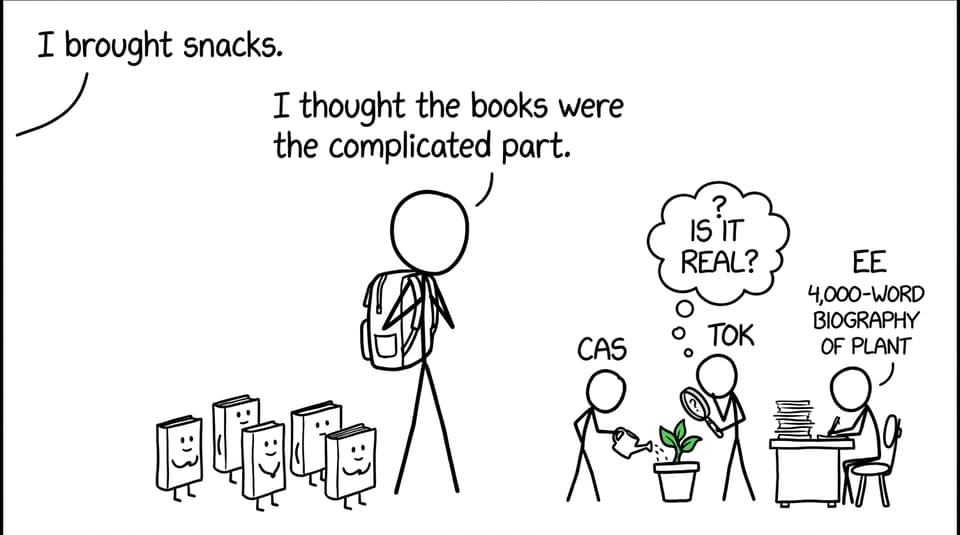
Theory of Knowledge, usually called TOK, asks students to examine how knowledge is created, supported, challenged, and communicated. Students complete an exhibition and a 1,600-word essay. The course is less about collecting facts than learning to evaluate claims, perspectives, methods, and evidence.
Parents can help by discussing ideas without trying to supply the “correct” conclusion. Questions such as “What evidence would change your view?” are often more useful than proposing another paragraph. Students needing a clearer assessment overview can consult the TOK requirements guide.
The Extended Essay
The Extended Essay is an independent research project culminating in a formal paper of up to 4,000 words. A supervisor provides guidance, but the student is responsible for developing the research question, selecting appropriate methods, evaluating evidence, and managing the process.
The hardest stage is often not writing. It is narrowing an interesting theme into a question that can be answered within the available evidence and word limit. RevisionDojo's Extended Essay guides help students understand subject-specific structure and assessment expectations without replacing the role of their school supervisor.
Creativity, Activity, Service
CAS involves sustained experiences across creativity, physical activity, and service. It does not add points to the diploma total, but satisfactory completion is compulsory. Schools evaluate completion rather than awarding a numerical or letter grade.
This is important because CAS should not become a last-minute collection of disconnected activities. Students need to follow their school's expectations, preserve suitable evidence, and reflect meaningfully on their learning. The guide to how CAS is evaluated explains why participation and reflection matter even though CAS carries no points.
How IB Diploma scoring works
The scoring system is simpler than it first appears, although the award conditions require attention.
| Component | Maximum contribution |
|---|---|
| Six subjects graded from 1 to 7 | 42 points |
| Combined TOK and Extended Essay result | 3 points |
| Maximum diploma total | 45 points |
TOK and the Extended Essay are each graded from A to E. Their combination determines whether the student receives zero, one, two, or three core points. CAS is recorded separately as a completion requirement.
The diploma requires at least 24 total points, but the IB also applies minimum conditions across the programme. Under current published criteria, students must complete CAS, receive grades in all six subjects and the assessed core, avoid a grade 1 in any subject, meet limits concerning grades of 2 and 3, and earn the required totals across HL and SL subjects. An E in either TOK or the Extended Essay is a failing condition.
This is why a parent should resist interpreting 24 as an ordinary pass mark. The diploma recognizes a balanced pattern of achievement, not merely a total produced by a few strong subjects. The IB grading system explanation provides a fuller breakdown, while the IB grade calculator can help students explore possible score combinations.
How assessment and examinations fit together
IB assessment usually combines work completed during the course with final written examinations. The precise components and weightings differ by subject. School-based work may be marked by teachers and externally moderated, while some components are sent directly for external assessment.
This creates an important psychological reality: one difficult examination does not necessarily define an entire subject result. Equally, strong coursework does not make final preparation optional. Students need to understand the weighting of every component in each subject rather than relying on general impressions.
Grade boundaries convert weighted marks into final grades from 1 to 7. They are not one universal percentage scale, and they can vary by subject, level, and examination session. Historical boundaries can support planning, but they should be treated as reference points rather than promises.
A useful parent question is not “What grade will you get?” but “What does your latest marked work suggest you should practise next?” That turns anxiety about outcomes into evidence about action.
What the workload feels like
IB pressure is rarely caused by one enormous task. It usually comes from several reasonable tasks arriving close together: an internal deadline, an oral assessment, an Extended Essay meeting, CAS evidence, and ordinary subject revision.
The most useful household system is a visible calendar containing school deadlines, examination dates, university tasks, and recovery time. Ask your child to explain the next two weeks rather than demanding a detailed account of the entire year. Short planning horizons make overload easier to detect.
During examination preparation, encourage a cycle of learning, retrieval, application, and review. Students might clarify a topic with Study Notes, test memory with Flashcards, answer targeted Questionbank problems, and then record why errors occurred. The step-by-step IB exam study guide turns that cycle into a practical routine.
Timed work should be introduced gradually. Short sections build accuracy and confidence before full Mock Exams test pacing and stamina. Predicted Papers are best used as realistic rehearsal, not as forecasts of exact questions.
How parents can provide useful support
The paradox of helping an IB student is that the best support often looks less active than expected. The student needs structure, perspective, and care, but also ownership.
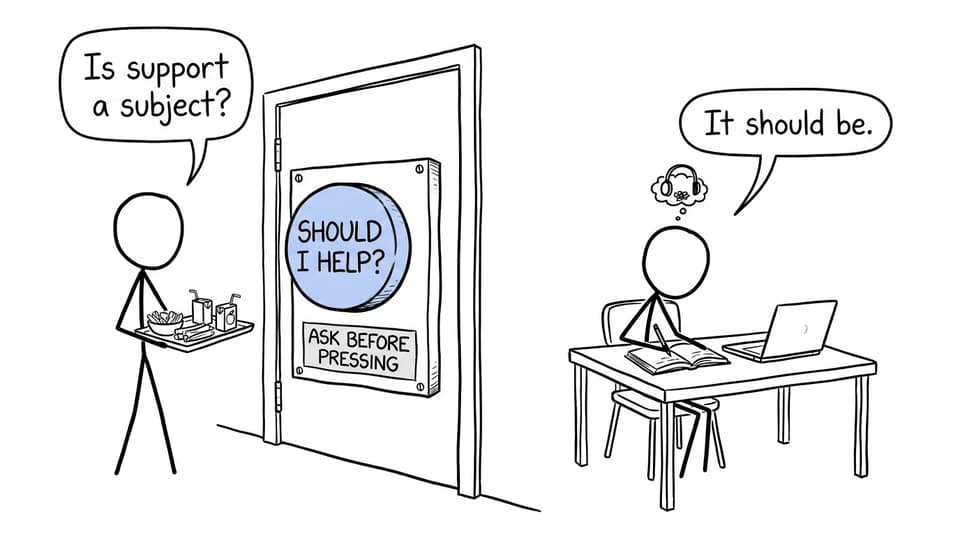
Ask before solving
Try: “Would you like me to listen, help you plan, or leave you space?” These options distinguish emotional support from practical intervention. Unrequested solutions can make a capable student feel managed precisely when the programme expects independence.
Watch patterns, not isolated bad days
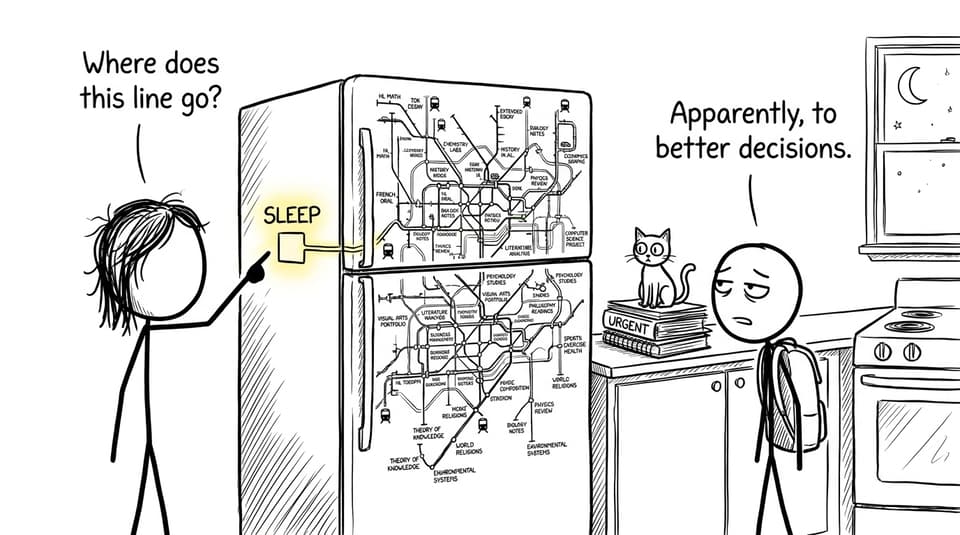
One late night before a deadline may be recoverable. Repeated sleep loss, persistent withdrawal, skipped meals, panic, or an inability to begin ordinary tasks deserves attention. Start with a calm conversation and involve the appropriate school or health professional when concerns persist or feel serious.
Make rest practical
Protecting sleep is not lowering standards. Fatigue affects concentration, memory, judgement, and emotional regulation. A quiet workspace, predictable meals, transport help, and fewer unnecessary interruptions may contribute more than another hour of anxious revision.
Keep communication specific
Replace “Are you on track?” with questions that can be answered:
- Which deadline comes first?
- What feedback did you receive?
- Which topic is costing the most marks?
- What will you do differently in the next timed attempt?
- Is there anything the school coordinator needs to clarify?
Specific questions reduce defensiveness because they focus on decisions rather than character.
The IB Diploma and university applications
The Diploma Programme is recognized by universities around the world, but recognition does not mean identical admission rules. Institutions may specify a total points score, grades in particular HL subjects, language requirements, or additional national conditions. Some make offers using the full diploma score, while others evaluate individual components or use their own equivalency system.
Families should always check the official admissions page for each intended course and application year. Do not rely solely on informal comparison charts or assume that every institution using a points tariff evaluates the diploma in the same way.
Predicted grades may play a role in applications, depending on the destination and admissions system. Treat them as informed estimates, not guaranteed final results. If an application goal appears inconsistent with current evidence, the constructive response is to identify the score gap, prerequisite, and next academic action early.
How RevisionDojo fits into this picture
Parents do not need to become subject teachers. They need to help students find a dependable process.
RevisionDojo brings that process together: Study Notes for rebuilding understanding, Flashcards for retrieval, a Questionbank for targeted application, and AI Chat for focused explanations. Grading tools help students interpret performance, while Predicted Papers and Mock Exams make timed conditions familiar. The Coursework Library offers examples and guidance for understanding expectations, and Tutors provide human support when a student needs more individual direction.
The value is not simply having more material. It is shortening the distance between “I am worried about this subject” and “I know what to do next.” Students can learn a concept, practise it, receive feedback, identify a pattern, and try again. The RevisionDojo IB exam preparation overview shows how those tools work as one revision loop.
The IB Diploma asks young people to become independent before they always feel independent. A parent's role is not to remove every difficult moment. It is to make sure difficulty remains manageable, support remains available, and progress is measured with evidence rather than fear.
Start with one calm conversation about the next deadline. Then let RevisionDojo help turn the answer into a plan.