
The biggest adjustment for most new IB Theatre students is not performing in front of people. It is learning that a polished performance is only one part of the work. The course also expects you to research, experiment, collaborate, document decisions, and evaluate whether your choices affected an audience as intended.
That distinction explains many IB Theatre first term struggles. A student can be expressive on stage and still feel lost when asked why a choice was made or what evidence informed it. Equally, someone without extensive performance experience can thrive by becoming observant, experimental, and reflective.
The solution is not to arrive with every answer. It is to develop a repeatable process for finding answers through practice.
The first-term adjustment in one checklist
During your first term, focus on five habits:
- Enter rehearsals with a specific question or intention.
- Test ideas physically instead of discussing them indefinitely.
- Record your contribution while details remain fresh.
- Connect choices to research, feedback, and audience impact.
- Treat unsuccessful experiments as evidence, not wasted time.
These habits reflect the structure explained in the IB Theatre syllabus overview. The course develops students as creators, designers, directors, and performers, so it demands more than acting ability.
Why adjusting to IB Theatre feels uncomfortable
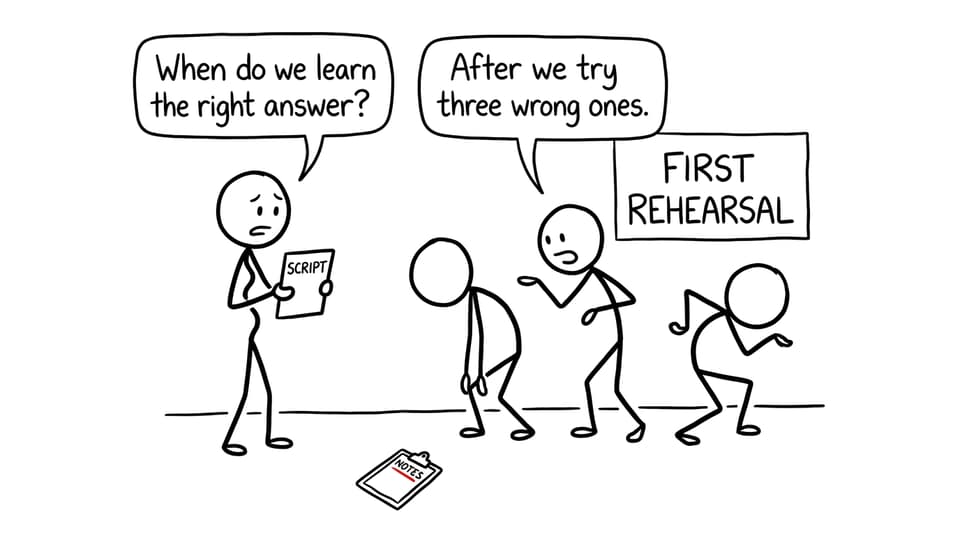
Many subjects create a familiar bargain: learn the material, practise applying it, and produce the correct response. Theatre behaves differently. Two staging choices may both be defensible, but only if the theatre-maker can explain the intention, practical exploration, and effect behind each choice.
This can feel like uncertainty. In reality, it is disciplined decision-making.
The current IB Theatre course emphasizes inquiry, development, presentation, and evaluation. Students investigate theatre in context, develop intentions, explore performance and production elements, present work, and reflect on feedback. At both SL and HL, assessed tasks include a production proposal, research presentation, and collaborative project. HL students also complete a solo theatre piece.
The collaborative project makes the adjustment especially visible. Students create and perform an original 7-10 minute piece, but the performance is not the whole story. Each student submits an individual report explaining the collaborative process, evaluating the completed work, and examining specific contributions.
The lesson arrives early: the result matters, but so does your ability to reconstruct how and why it developed.
The real source of IB Theatre first term struggles
The central struggle is moving from doing theatre to thinking like a theatre-maker while doing it.
Imagine that an ensemble tries a scene using slow movement and silence. It feels flat, so the group adds overlapping speech and sharper changes of level. The second version creates more tension.
A conventional rehearsal mindset remembers only that the second version was better. An IB Theatre mindset asks:
- What was the original intention?
- Why was the first approach ineffective?
- How did vocal overlap and spatial levels change audience focus?
- What observation or feedback supports that conclusion?
- What should the ensemble test next?
Reflection can initially feel as though it interrupts creativity. With practice, it improves creativity. The journal becomes a rehearsal instrument rather than an administrative burden.
Build an evidence habit before deadlines appear
Spend 5-10 minutes documenting each practical session. Do not record everything. Capture the decisions that changed your understanding or redirected the work.
Use this six-part rehearsal record:
- Intention: What were you trying to communicate or discover?
- Experiment: What did you test through body, voice, space, design, or structure?
- Contribution: What did you personally propose, perform, direct, create, or refine?
- Observation: What happened when the idea was tested?
- Evaluation: Why was the choice effective, limited, or unsuitable?
- Next step: What precise variable will you change next?
Add evidence where permitted, such as an annotated script, blocking sketch, design draft, photograph, or feedback summary. A visual without explanation is decoration. Caption it by identifying the choice and explaining its significance.
The guide to documenting the collaborative process offers a manageable structure. The collaborative project reflection checklist can then help you move beyond a simple rehearsal diary.
Replace description with analysis
A weak entry might say:
We rehearsed the opening and changed the positions. It worked better.
A stronger entry explains that a compressed diagonal directed attention toward an isolated performer, clarified the power imbalance, but concealed an important gesture. It then identifies the next experiment: retaining the diagonal while adjusting spacing and sightlines.
The stronger version makes intention, choice, effect, limitation, and next action visible. RevisionDojo's guide to critically reflecting on the IB Theatre process can help you practise this distinction.
Learn to collaborate without disappearing
Collaboration does not mean surrendering individual responsibility. You must support the ensemble while remaining able to identify and evaluate your artistic contribution.
At the start of a project, agree how the group will make decisions, which responsibilities each person will lead, and how changes will be recorded. When disagreement appears, test both proposals under the same conditions. Ask which version better fulfils the ensemble's intention and what an audience is likely to perceive. The stage can settle questions that conversation cannot.
The guide to succeeding in the collaborative project provides strategies for roles, rehearsal rituals, evidence, and creative conflict. Generosity and individual accountability can coexist.
Connect research to something you can stage
New students sometimes treat research as background information to summarize before practical work begins. IB Theatre asks for a closer relationship between knowledge and action.
When investigating a practitioner or world theatre tradition, select a manageable convention and test it. Observe how it influences movement, voice, space, design, structure, or performer-audience relationships. Ask what the convention demands, what meaning it held in context, and what changed when you attempted it. This encourages informed exploration rather than copying an aesthetic surface.
The guide to organizing research for the IB Theatre research presentation separates notes into context, conventions, application, and reflection.
A realistic first-term weekly routine
You do not need an elaborate productivity system. A calm weekly rhythm is enough:
- Review one concept using RevisionDojo Study Notes.
- Turn essential terminology into Flashcards.
- Use the Questionbank to test whether you can explain ideas independently.
- Complete one focused practical experiment.
- Write one analytical reflection immediately afterward.
- Ask AI Chat to question your reasoning, not author assessed work.
- Use Grading tools to locate unclear evidence or evaluation.
The IB Theatre study strategies guide shows how research, rehearsal, and micro-reflection can fit into a sustainable schedule. RevisionDojo's Coursework Library and Tutors offer additional guidance when you need an informed outside perspective. Its Predicted Papers and Mock Exams can support your other IB subjects, preserving deliberate time for Theatre.
Your goal is not early certainty
Students who adjust well are not necessarily the strongest performers. They are often those who can test an idea, notice what happened, and change course without treating the first attempt as failure.
By the end of your first term, aim for a reliable process rather than a perfect artistic identity. Keep evidence, ask better questions, make your contribution visible, and explain choices through intentions and audience impact.
RevisionDojo brings Study Notes, Flashcards, the Questionbank, AI Chat, Grading tools, the Coursework Library, and Tutors into one ultimate IB resource. With the right system, creative uncertainty stops feeling like confusion. It becomes the way you learn to make theatre.