


IB Oral Presentation Tips: AI-Powered Improvement Strategies
The night before an IB oral, most students don’t fear the content; they fear the moment their mind goes blank and their “perfect” plan dissolves into filler words. The good news is that IB oral performance isn’t magic. It’s a repeatable loop: plan, rehearse, get feedback, adjust, repeat. With AI, that loop becomes faster, calmer, and more measurable.
RevisionDojo makes that loop practical by combining AI feedback with exam-style expectations, so your IB oral sounds less like a memorized script and more like controlled analysis.
Quick checklist (save this before you rehearse)
-
Choose one clear global issue (Language A IO) or one focused knowledge question (TOK)
-
Build a simple structure: intro, 2-3 analytical moves, conclusion
-
Record one timed run (don’t stop)
-
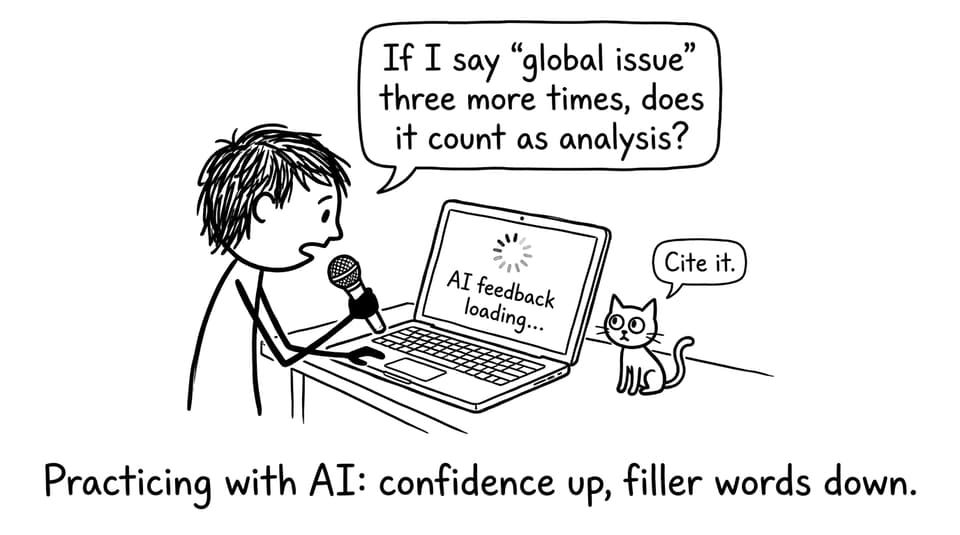
Use AI to spot pacing, clarity, and weak links
-
Fix one thing per rehearsal, not everything at once
If you’re working on Language A, keep the full IO requirements nearby: Comprehensive Guide to the IB Individual Oral (IO) and Cracking the Individual Oral: The Ultimate Guide for IB Students.
Start with a global issue you can actually prove (IB IO)
A common IB mistake is picking a global issue that sounds impressive but can’t be sustained with specific authorial choices. AI helps here because it forces you to test your claim: can you connect it to both extracts in concrete language?
Use RevisionDojo’s support pages to anchor your choice and examples, then pressure-test your wording with AI:
A strong IB global issue is narrow enough to argue, but big enough to matter. “Power” is too wide. “How institutions normalize surveillance through everyday language” is something you can demonstrate.
Use pacing as a scoring strategy, not a personality trait
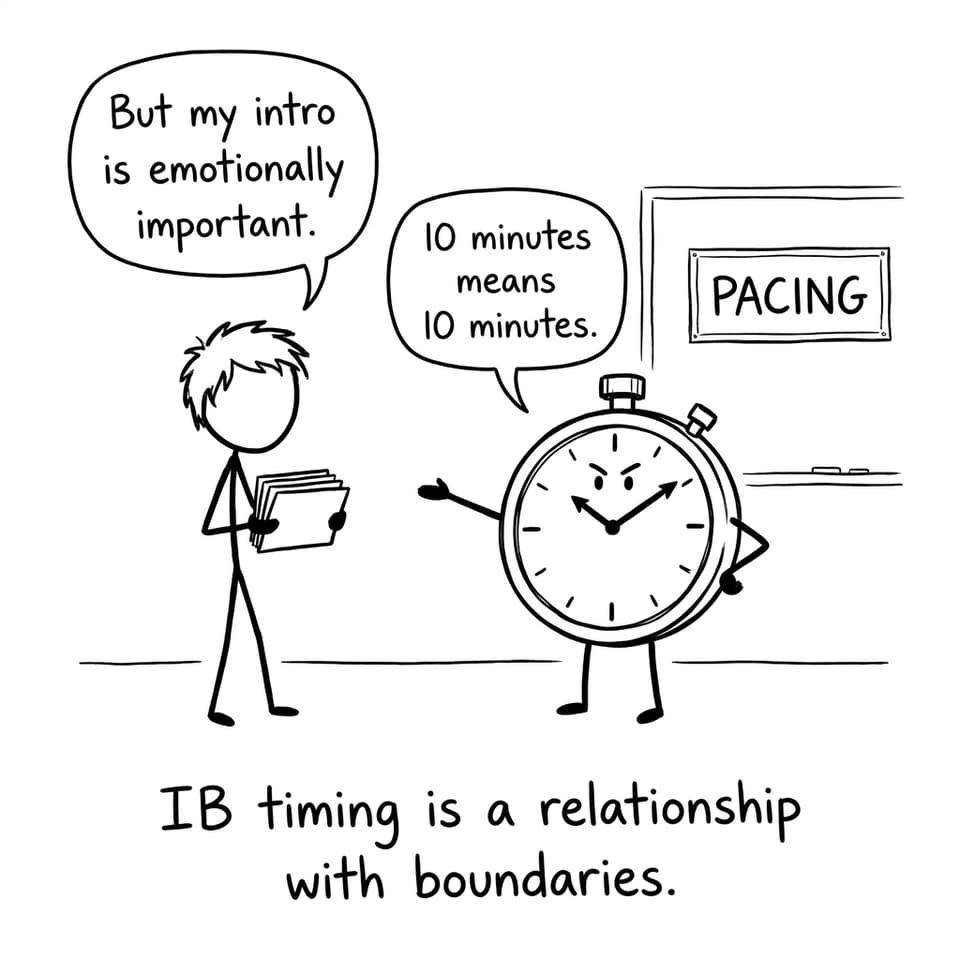
In an IB oral, time pressure creates bad habits: rushed analysis, bloated introductions, and conclusions that vanish. Treat pacing like a skill you train.
A practical structure:
A clean 10-minute flow
-
Intro (about 1 minute): texts + global issue/KQ + your line of inquiry
-
Body (about 7-8 minutes): 2-3 focused analytical moves with evidence
-
Conclusion (about 1 minute): what your analysis adds, not what it repeats
Then rehearse in a way that creates data. The easiest path is recording and reviewing with tools designed for IB.
To make rehearsals feel like real assessment conditions, use Record and Grade IB Oral Presentations: All-in-One Platform and pair it with a transcript pass from IB Oral Transcript Generator: See Your Speech in Writing. Seeing your spoken IB habits on the page makes weak transitions and repeated phrasing impossible to ignore.
The AI-powered improvement loop (what to do after you record)
AI is most useful when you ask it to be specific. After one recording, run this loop:
Diagnose
Ask: Where did I summarize instead of analyze? Where did I lose the global issue/KQ? Where did my academic vocabulary flatten?
Edit
Fix one category only (for example: transitions). This is where RevisionDojo’s AI Chat shines: paste a paragraph of transcript and ask for two tighter transition options that keep your claim intact.
Re-run
Record again and compare. RevisionDojo’s ecosystem (Study Notes, Flashcards, and the Coursework Library) helps you fill gaps quickly, while the Questionbank and Mock Exams keep your broader IB exam skills moving.
If you’re also preparing TOK, use Comprehensive Guide to IB ToK Presentation Tips and sharpen example-linking with The Art of Linking Examples to Knowledge Questions.
Common IB oral mistakes AI can spot fast
-
Sounding memorized: AI often flags unnatural pacing and repeated sentence shapes
-
Vague claims: AI feedback makes it obvious when your “global issue” is only a theme label
-
Device-dropping: naming “tone” or “symbolism” without explaining effect on meaning
A useful calibration step is reading an IB exemplar set, then checking your own draft against it: IB Language A: Individual Oral Examples.
FAQ
Can AI replace my teacher for IB oral feedback?
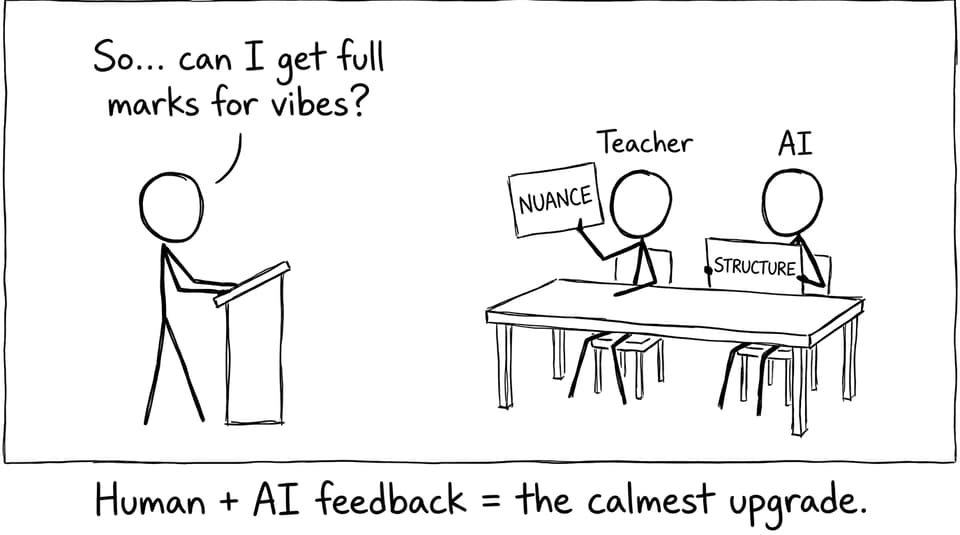
AI can’t replace a teacher, but it can remove the waiting and guesswork that slows IB progress. A teacher is best for nuance: whether your interpretation is convincing, whether your tone fits the task, and whether your emphasis sounds natural. AI is best for repetition and clarity: it can spot structural drift, pacing problems, and unclear phrasing across multiple rehearsals. Used together, you get both accuracy and speed. That’s why RevisionDojo works well: you can practice with AI as often as you want, then bring a cleaner version to your teacher. In IB, that combination is usually where the biggest jumps happen.
How early should I start preparing my IB oral?
For most students, 6-10 weeks is a realistic runway for a high-quality IB oral. The first phase is choosing your global issue or KQ and gathering evidence, which is slower than it looks. The second phase is building a structure that stays stable under pressure. The third phase is rehearsal: recording, reviewing, and tightening language. AI makes the third phase far more efficient, but it can’t help if the first two phases are rushed. Start earlier than you think, but improve in small steps so you don’t burn out.
What should I do if I keep going over time in my IB oral?
First, don’t cut analysis to save time, cut summary. Most IB timing problems come from over-explaining the plot, context, or content of the non-literary text. Use a transcript to highlight sentences that merely describe, then compress them into one line of context. Next, set “time gates” for yourself (for example: global issue stated by 0:40, first extract analysis by 1:30). Finally, rehearse with a timer until your body learns the pace. AI feedback helps because it shows you where your pace spikes and where you wander.
Conclusion: make your IB oral predictable
The best IB orals don’t sound dramatic. They sound inevitable: a clear global issue, evidence that actually earns marks, and pacing that stays calm. Use AI to shorten the gap between practice and improvement, then use RevisionDojo to keep everything in one place: IO tools, AI Chat, Study Notes, Flashcards, the Coursework Library, Grading tools, Predicted Papers, Mock Exams, and Tutors when you need a human push.
If you want the simplest next step, record one rehearsal today and run one feedback loop on RevisionDojo. Your IB oral improves fastest when you stop “preparing” and start iterating.