



When your IB Individual Oral feels bigger than 10 minutes
The strangest part of the IB Individual Oral (IO) isn’t the stopwatch. It’s the silence afterward: Was my global issue clear? Did I analyse, or just describe? Did I actually earn those marks? In class, feedback can be brilliant, but it’s also slow (and sometimes vague). And when the IO is close, waiting a week for comments can feel like watching your confidence leak out one day at a time.
That’s why an IB Individual Oral Grader powered by AI is such a game-changer for Language A. It turns practice into a tight loop: perform, get assessed, improve, repeat.
Quick IO reality check (save this)
Use this checklist before every IB rehearsal:
-
Global issue: defined in one sentence, not a single word
-
Two texts: both clearly connected to that issue (not “kind of related”)
-
Evidence: short references to the extract and the wider work/body of work
-
Methods: authorial choices linked to meaning (what, how, so what)
-
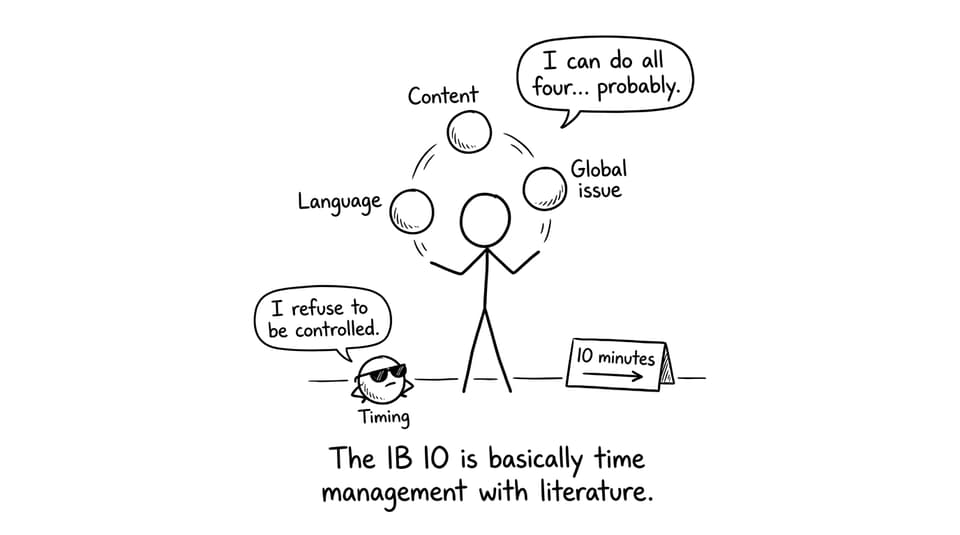
Timing: stable structure you can deliver calmly in 10 minutes
For a bigger map of the task, keep this open while you plan: IB Oral (IO) Guide: Language & Lit and Literature.
What an IB Individual Oral Grader actually does
RevisionDojo’s approach is simple: make IB practice feel real, then make feedback immediate.
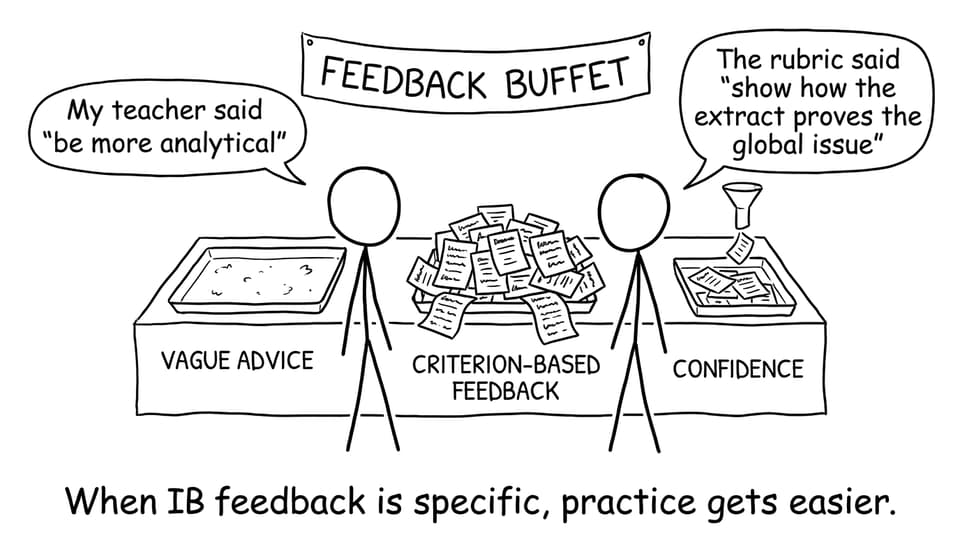
With the IB Language A: Individual Oral Grader, you can rehearse by recording (or drafting your delivery), then receive structured, criterion-aware feedback that mirrors how the IB rubric “thinks.” Instead of “be more analytical,” you get specific prompts about focus, structure, language control, and the strength of your global-issue line.
If you want the bigger picture of how to build your IO from the ground up, pair it with: How to Approach the IB English Individual Oral (IO) Presentation.
Why AI assessment helps IB students (without replacing your teacher)
Consistency you can practise against
In the IB, marks come from repeatable behaviours: defining a global issue precisely, selecting evidence efficiently, and linking technique to meaning under time pressure. AI assessment shines because it applies the same lens every time you practise, so improvement is measurable rather than emotional.
For context on why alignment matters, see: Why AI Tools Should Align With IB Curriculum.
Faster feedback loops (the real secret)
Most students don’t need more practice. They need better practice. When you can rehearse at 11 pm and still get immediate, rubric-aware guidance, you stop repeating the same habits.
This is the same philosophy behind RevisionDojo’s broader system: Meet Jojo AI: Your Personal IB Study Assistant.
Clearer speaking through transcripts and pacing
A surprising IO hack: seeing your speech as text. RevisionDojo supports this workflow in tools like its oral transcript features: IB Oral Transcript Generator: See Your Speech in Writing.
A practical IB workflow: from “practice” to marks
Try this three-session cycle:
-
Session 1 (Plan): sharpen your global issue using the IB English A Fields of Inquiry guide.
-
Session 2 (Perform): record a full run with the IB Individual Oral Grader.
-
Session 3 (Fix): turn recurring problems into drills: build knowledge with IB English A Lang & Lit Resources, then apply using the IB English A Lang & Lit Questionbank.
That’s also where RevisionDojo’s wider toolkit supports you naturally: Study Notes for quick clarity, Flashcards for recall, AI Chat for explanations, Grading tools for coursework feedback, Mock Exams and Predicted Papers for exam readiness, plus a Coursework Library and Tutors when you need human nuance.
FAQ
Is the Individual Oral really that important in IB Language A?
Yes, because the IO is one of the few moments in IB Language A where your thinking has to be immediate, structured, and defensible out loud. It typically counts as a meaningful portion of your final grade (often up to 20%, depending on course structure and session). More importantly, the IO trains the same skills you’ll reuse elsewhere: precision, interpretation, and method-to-meaning analysis. Students who treat it as a skill tend to become calmer writers too, because they learn to hold a clear line of argument. If you want to understand what the rubric rewards, start with Language A Internal Assessment (IA) Rubric. Once the criteria feel predictable, preparation becomes less emotional and more tactical.
Can an IB Individual Oral Grader replace my teacher’s feedback?
It shouldn’t, and that’s actually the point. In IB, teacher feedback can catch tone, classroom context, and text-specific nuance in ways AI may not fully replicate. But AI assessment is unbeatable for speed, repetition, and consistency: you can practise five times in a week and still get structured guidance every time. The best results usually come from combining both: use AI to fix structure, clarity, timing, and global issue control, then ask your teacher for the final “human polish.” This approach also reduces the pressure you put on one single feedback conversation. Think of the AI grader as your daily training partner, not your judge.
How do I use AI ethically for IB oral practice?
Use AI to improve your thinking, not to manufacture it. In an IB context, that means you can ask for feedback on your structure, clarity, and links to the global issue, but your interpretations, evidence selection, and phrasing should remain yours. Keep your planning notes and drafts so you can show ownership of the process. If AI suggests a better sentence, rewrite it in your own voice and make sure you understand why it’s better. When in doubt, follow a simple rule: AI can coach, question, and critique, but it shouldn’t perform. For a clear integrity framework, read: IB-Approved AI Study Resources: What’s Actually Safe?.
The calm advantage: practise like the IB is listening
The IB IO rewards students who can make their analysis repeatable under pressure. An IB Individual Oral Grader helps you get there faster: clearer global issues, tighter structure, better timing, and feedback you can act on today.
If you want one place to build the whole loop (learn, practise, get assessed, improve), make RevisionDojo your home base and start with the IB Language A: Individual Oral Grader.