
A university score requirement can look like a verdict. To a parent, 38 points may seem to divide a future neatly into possible and impossible. Admissions rarely work that neatly.
The clearest answer is this: there is no universal IB score required for university. Some institutions publish a basic eligibility threshold around 24 to 30 points, while selective courses may require 34 to 38. Highly selective UK courses can ask for 38 to 42 points, usually alongside specific Higher Level grades. In the United States, many universities use holistic admissions and publish no fixed IB cutoff at all.
More importantly, the requirement normally belongs to the course, not simply the university. A student may meet the total score for one degree but remain ineligible for another because of an HL subject, mathematics pathway, admissions test, English requirement, or portfolio.
This guide provides a current planning overview for IB diploma parents and students. Requirements were checked against official admissions information available in August 2026, but universities can revise them by entry year. Always confirm the exact course page before applying.
IB score requirements at a glance
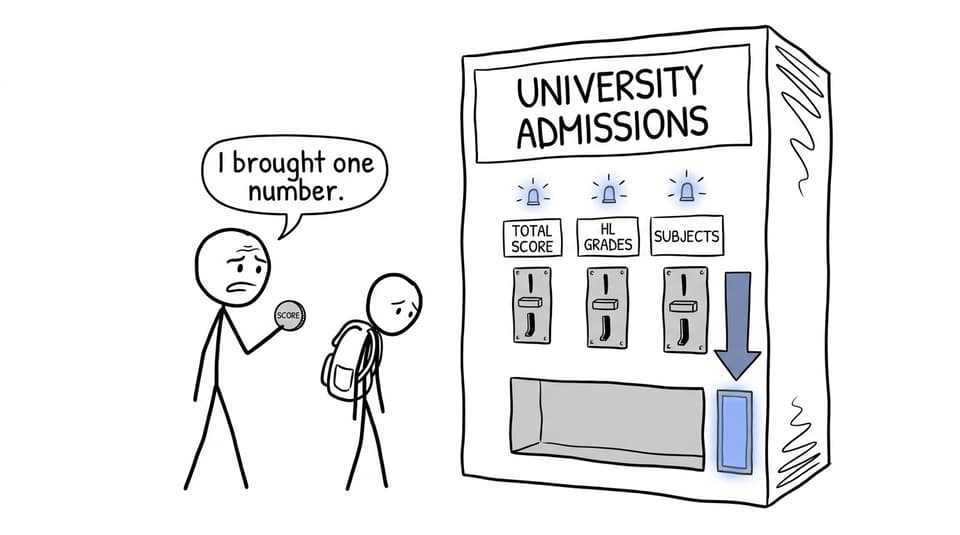
Before comparing universities, use this five-part checklist:
- Overall IB score: The required total, including core points unless stated otherwise.
- Higher Level profile: A condition such as 7, 6, 6 or a combined HL total.
- Required subjects: For example, HL Chemistry for some medicine courses or HL Mathematics for engineering.
- Additional selection: Tests, interviews, portfolios, auditions, essays, or supplementary forms.
- Offer type: Whether the figure is an eligibility minimum, a competitive benchmark, or a conditional offer.
A useful planning range is:
| IB score | Broad planning interpretation |
|---|---|
| 24-29 | Meets the formal threshold at some universities, but many courses require more |
| 30-33 | Opens options at a range of institutions, subject to course prerequisites |
| 34-37 | Competitive for many strong courses internationally |
| 38-40 | Relevant to highly selective universities and programmes |
| 41-45 | Within the academic range requested by some of the most selective courses |
These are orientation bands, not guarantees. A 36 with the right HL subjects may be eligible where a 39 with the wrong subjects is not. RevisionDojo's global guide to minimum IB university scores offers additional regional context.
IB minimum score by university: current examples
The table below is deliberately selective rather than exhaustive. It shows how differently institutions express IB university requirements and why a single global ranking of minimum scores would be misleading.
| University or course | Published IB position | What parents should notice |
|---|---|---|
| University of Oxford | 38, 39, or 40 depending on the course | Core points are included, while relevant HL subjects generally require 6s and 7s |
| Cambridge Natural Sciences | 41-42 with 7, 7, 6 at HL | Required science and mathematics combinations apply; many successful students exceed the minimum offer level |
| London School of Economics | 37-39 overall, depending on programme | Published requirements combine the total with HL profiles ranging from 6, 6, 6 to 7, 6, 6 |
| University College London | 34-40 across its qualification equivalencies | UCL assesses both the overall total and combined HL points; each course sets its level |
| King's College London | Course-dependent, using published IB equivalencies | Its guide runs from 29 to 40, but competitive degrees and required HL subjects determine the real target |
| University of British Columbia | 24 is the formal university minimum | UBC states that most programmes require a higher score because places are limited |
| Australian National University | 30 is the lowest indicative IB threshold | Individual degrees can require substantially higher converted admission ranks |
A published minimum means the application can be considered under that academic rule. It does not necessarily describe the score of a typical admitted student, guarantee an offer, or override limited capacity.
That distinction matters at UBC, where 24 is a formal minimum but most programmes require more. It also matters at Cambridge, where meeting the stated offer level does not remove competition from the process. Families should therefore record three separate figures whenever possible: the formal minimum, the standard offer, and any recent competitive guidance published by the institution.
Why the course matters more than the university name
Parents often begin with a university list. Admissions teams begin with a degree programme.
At Oxford, requirements differ by course within the 38-40 range. At UCL, the published IB equivalencies span 34-40 because its degrees carry different academic conditions. At King's, an overall total may be paired with a required grade in an HL humanities, science, or mathematics subject.
This is why searching only for a university's general IB page can produce false confidence. The reliable sequence is:
- Open the undergraduate course page for the correct entry year.
- Select International Baccalaureate or international qualifications.
- Record the overall score and whether core points count.
- Record each named HL subject and minimum grade.
- Check mathematics pathway, English, test, and portfolio rules.
- Save the page and note the date checked.
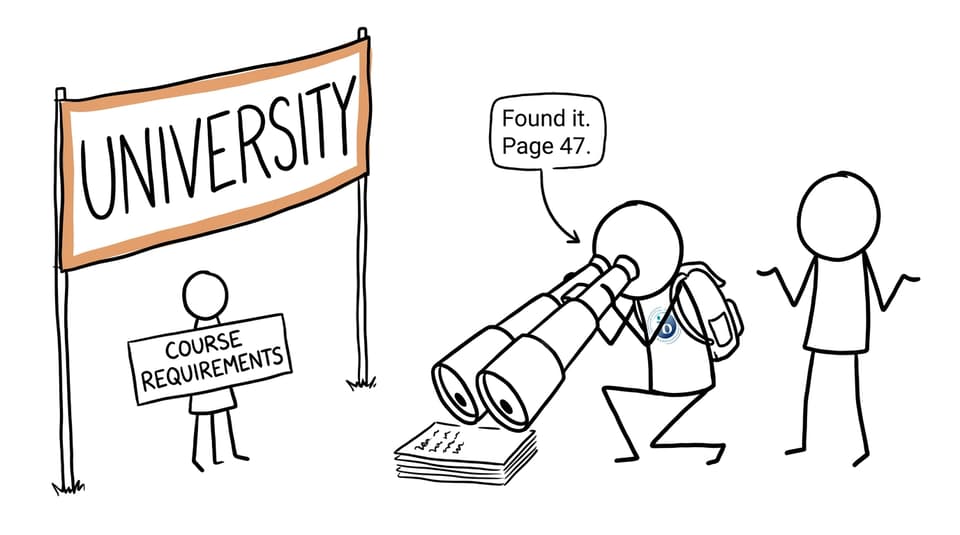
This process is especially important for medicine, engineering, economics, computer science, architecture, and law. A university may accept the Diploma broadly while a particular programme imposes non-negotiable subject or selection requirements.
How requirements differ by country
United Kingdom
UK offers are frequently expressed as a total Diploma score plus an HL profile. A conditional offer might require 36 overall with a 6 in a named HL subject. Predicted grades help the university decide whether to make the offer; final results determine whether its conditions have been met.
Parents can read more about how predicted grades influence university admissions and how IB conditional offers work. Contextual admissions may produce a lower offer for eligible applicants, but the policy and reduction vary by institution.
United States
Many US universities do not publish a minimum Diploma total. They consider course rigour, school transcripts, essays, recommendations, activities, and other required or optional evidence alongside IB performance.
That does not mean scores are unimportant. It means a parent should avoid treating an unofficial online score range as a formal cutoff. Check the university's first-year admissions policy separately from its IB credit policy: the score needed to receive university credit after enrolment is not necessarily an admission requirement.
Canada
Canadian universities commonly combine general admission rules with faculty-specific prerequisites and competitive selection ranges. UBC illustrates the difference between a formal minimum and practical competitiveness. McGill publishes recent lowest grades used for admission by programme and explicitly warns that meeting them does not guarantee admission.
Mathematics choice can also matter. Some science, business, and engineering routes do not accept Mathematics: Applications and Interpretation SL as a prerequisite. Families should inspect the programme's accepted mathematics list rather than assuming every IB Mathematics course is interchangeable.
Australia
Australian institutions generally convert IB results into an ATAR-comparable admission rank. The conversion may depend on where and when the Diploma was completed, and programme thresholds still apply after conversion. ANU, for example, publishes an indicative conversion beginning at 30, while degrees with higher admission ranks require higher IB results.
The lesson across all four systems is simple: the same score can be interpreted differently because the admissions machinery is different.
Turn a predicted score into a balanced university list
A predicted grade should guide the list, not define the student. Start by checking how the school produces predictions; this guide to the IB predicted-grade process explains the evidence teachers may consider.
Then build three groups:
- Ambitious choices: The student's prediction meets the published requirement, but competition is intense.
- Realistic choices: The prediction clears both the total and relevant HL conditions with some margin.
- More secure choices: The student is comfortably above the published academic conditions and meets every prerequisite.
Avoid calling the final group “easy.” Selectivity, capacity, language rules, and applicant volume can change. No legitimate choice is completely risk-free.
It is also worth modelling the score subject by subject. The RevisionDojo IB grade calculator can help students translate current practice performance into a provisional Diploma total. The result is an estimate, not an official prediction or admission decision, but it can reveal whether the real pressure point is the overall total or one required HL grade.
What parents can do without increasing pressure
The most helpful parental role is usually administrative and emotional rather than instructional. Keep a shared admissions sheet, verify dates, and ask calm questions such as, “Does this course require a particular HL grade?” That is more useful than repeatedly asking whether the total score has risen.
RevisionDojo's guide to supporting a child's university planning frames this well: provide structure without taking ownership away from the student. Its discussion of whether the IB offers a university advantage also helps separate the value of the programme from anxiety about one number.
From university target to exam plan
Once the requirements are verified, translate them into a narrow academic plan. If a course needs 38 overall with a 6 in HL Mathematics, the student needs both a total-score strategy and a mathematics strategy. Raising an unrelated SL subject may help the total while leaving the decisive condition exposed.
Near exams, RevisionDojo can provide a light structure around that work. Students can use Study Notes and Flashcards to rebuild knowledge, the Questionbank and Mock Exams to identify weak areas, and Predicted Papers to practise unfamiliar questions. AI Chat and grading tools can support feedback, while the Coursework Library and Tutors are available when more focused help is needed. The purpose is not to chase points blindly, but to direct effort toward the conditions that actually affect the offer. The exam preparation habits used by high-scoring IB students provide a practical starting framework.
A score is a planning tool, not a prophecy
The search for an IB minimum score by university begins with a number, but good planning ends with a complete set of conditions. Check the course, entry year, total points, HL profile, prerequisite subjects, and additional selection steps. Then build a balanced list with more than one credible route.
For parents, reassurance does not mean pretending every outcome is guaranteed. It means replacing a vague fear with verified information and a next action. Review the target courses together, record the exact conditions, and let the student return to the work that can still move the result. If results eventually differ from the plan, RevisionDojo's parent guide to IB results day can help the family respond calmly and practically.