


Mathematics has an odd habit: it looks clean on the page, then messy in your life.
A question in a textbook politely tells you what to find. A real situation doesn’t. It gives you noise, missing information, competing goals, and a time limit that feels personal.
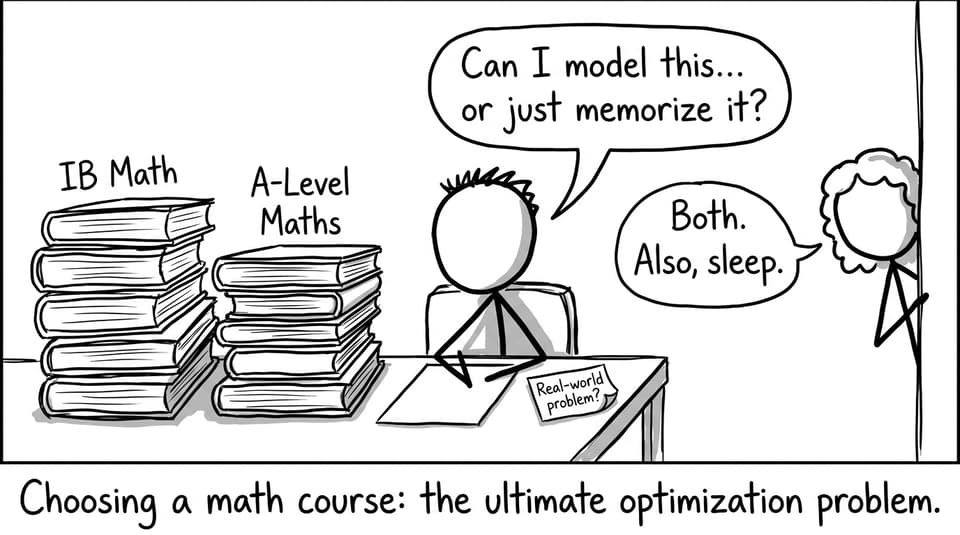
That is why choosing between IB Math and A-Level Maths is not just about “which is harder.” It is about what kind of thinking you want to train. If you are an IB student preparing for exams, you are also preparing for the next stage of problem solving: university assignments, data-heavy decisions, and unfamiliar questions that do not come with a neat method label.
This guide compares IB Math and A-Level Maths through one lens: which path strengthens real-world problem solving, and what that means for your revision strategy.
Quick comparison checklist (use this before you choose)
If you only have two minutes, use this.
-
If you want real-world modelling and interpretation, IB Math (especially AI) trains it constantly.
-
If you want procedural fluency and exam efficiency, A-Level Maths leans hard into method mastery.
-
If you learn best through projects and written reasoning, IB Math rewards that through the Internal Assessment.
-
If you prefer a fully exam-based score, A-Level Maths keeps the assessment structure simpler.
To orient your IB revision fast, start from the RevisionDojo course hubs: IB Mathematics Analysis and Approaches Resources and IB Mathematics Applications & Interpretation Resources.
What “real-world problem solving” actually means in maths
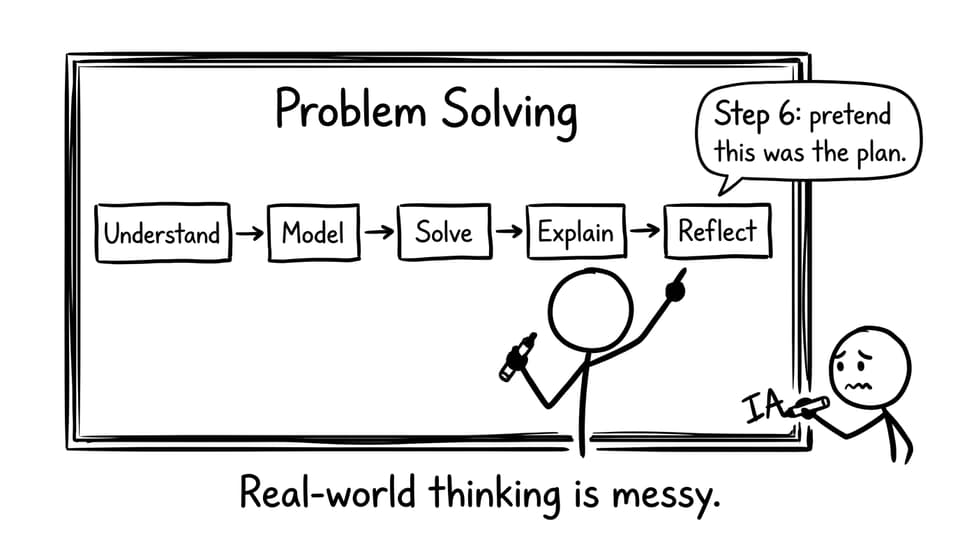
Real-world problem solving is not one skill. It is a stack of smaller skills.
-
Framing: turning a messy scenario into a mathematical question.
-
Modelling: choosing assumptions, variables, and a structure (equation, graph, simulation, statistics).
-
Solving: doing the mathematics accurately.
-
Interpreting: explaining what the answer means, including units, reasonableness, and limitations.
-
Reflecting: noticing how your model could fail, and what you would change.
A-Level Maths is exceptional at the “solving” layer. IB Math spends more time training the whole stack, especially modelling, interpretation, and reflection.
IB Math pathways: AA vs AI (and why that matters)
A common misunderstanding is that IB Math is one course. It isn’t.
IB Math AA: the craft of structure and proof-like thinking
IB Math AA (Analysis and Approaches) is closer to traditional pure mathematics. You spend time with algebraic technique, functions, calculus, and reasoning that rewards structure.
The real-world benefit is subtle but powerful: AA trains you to build an argument. Not just compute, but justify. When a university problem asks you to show, explain, or derive, the AA habit of “what is the logic of this step?” becomes a genuine advantage.
If you want to see how RevisionDojo breaks this down by topic, explore IB Math AA Calculus and drill with the Math AA Calculus Questionbank.
IB Math AI: the habit of modelling and interpreting
IB Math AI (Applications and Interpretation) leans into statistics, technology, modelling, and data interpretation. In real life, that is most of what “math” becomes: making decisions with imperfect data.
AI students practice translating context into mathematics: regression choices, interpreting parameters, reading outputs critically, and communicating what a model can and cannot claim.
If you are revising AI, it helps to pair notes with immediate practice: How to Use RevisionDojo Notes to Simplify IB Math AI Concepts plus targeted drills from a section like the Number and Algebra Questionbank (Math AI).
A-Level Maths: why it creates fast, reliable solvers
A-Level Maths is designed around depth and fluency within a defined structure: pure maths (and typically mechanics and statistics). The questions often signal the method more clearly. Your job is to execute accurately, under time.
That may sound less “real world,” but it builds something real: reliability.
In many STEM degrees, early-year success depends on whether you can manipulate algebra, differentiate, integrate, and transform expressions without hesitation. A-Level Maths often produces students who can do that at speed.
So if your definition of real-world problem solving is “I can solve technical problems quickly and correctly,” A-Level Maths has a strong case.
Assessment: the quiet reason IB Math feels different
The assessment design shapes the thinking you practice.
IB Math assessment trains explanation and adaptability
IB Math combines external exams with an Internal Assessment (the Mathematical Exploration). That exploration forces you to do what real problems require: choose a direction, justify methods, interpret results, and admit limitations.
If you want a rubric-aligned guide to doing that well, RevisionDojo’s IA resources are a strong anchor: IB Math IA 2025 Guide: Write a Top-Scoring Exploration, IB Math IA Structure: A Logical, High-Scoring Flow, and the Maths AA IA Exemplars.
A-Level assessment trains performance under pressure
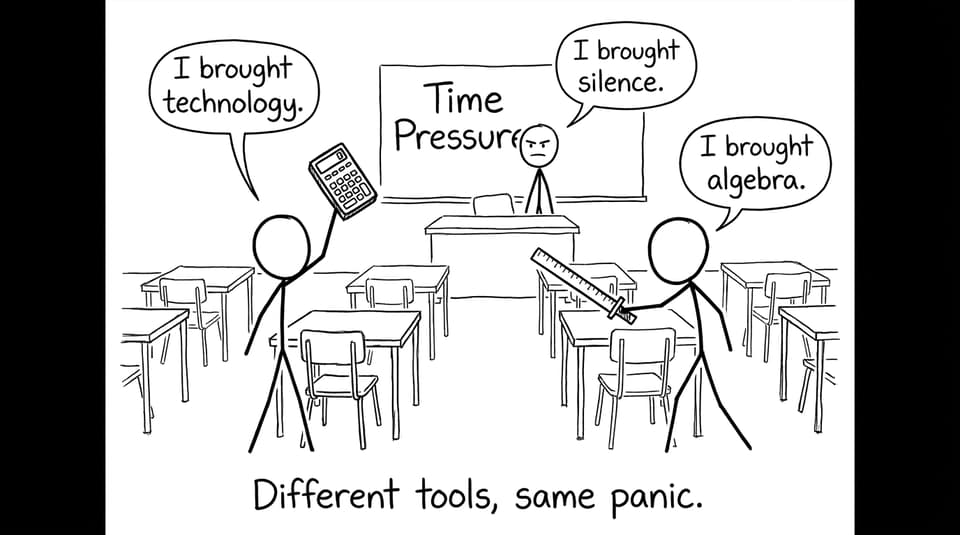
A-Level Maths is typically 100% exam-based. That structure rewards consistent method selection, clean working, and pacing. In other words, it trains you to perform.
If you are the kind of student who improves through repetition and feedback loops, you can absolutely simulate this in IB Math revision too. The trick is to practice like an exam athlete, not like a note collector.
So which strengthens real-world problem solving?
Here is the honest answer: both do, but in different ways.
IB Math strengthens real-world problem solving through modelling
IB Math is built to make you ask:
-
What does this situation become as a function, a distribution, or a system?
-
What assumptions am I making, and are they reasonable?
-
What does the output mean in context?
-
How do I communicate the reasoning clearly?
That is the exact mental motion you use in economics, biology, computer science, psychology, business, and any field where data and uncertainty are normal.
A-Level Maths strengthens real-world problem solving through fluency
A-Level Maths makes you fast and dependable with core tools. That matters in engineering and physics, and it also matters whenever problems become too complex for slow algebra.
In real life, you often need both: the modelling instincts and the technical fluency.
How to turn IB Math into a “real-world thinking” advantage (exam edition)
Knowing that IB Math is good for problem solving is not enough. Exams reward what you can do under time.
The 20-minute IB Math loop (simple, repeatable)
-
Learn one micro-skill using Study Notes (not a whole chapter).
-
Drill 10-15 questions in the Questionbank with immediate feedback.
-
Convert mistakes into 3-5 Flashcards (definitions, steps, traps).
-
Explain one solution out loud or in writing (train communication marks).
-
Finish timed: a short set under pressure.
RevisionDojo is designed around this loop: Questionbank, Study Notes, Flashcards, AI Chat, Grading tools, Predicted Papers, Mock Exams, Coursework Library, and Tutors all work together so you do not have to build a revision system from scratch.
To make your practice more targeted, use: IB Math: Targeted Revision Using the Questionbank and the platform page for the Questionbank feature.
Train stamina and decisions, not just content
Many IB students preparing for exams know the content but lose marks on choices: which method, which representation, how much working, when to stop.
That is why timed simulation matters. Use RevisionDojo’s mock workflows: How to Use RevisionDojo to Prepare for IB Math Mock Exams and IB Math Mock Exams: Use RevisionDojo's Mock Exam Builder.
When you are later in revision, add high-quality exam rehearsal with IB Predicted Papers by IB Examiners and specifically Mathematics Analysis and Approaches Predicted Papers.
FAQ
Do universities prefer IB Math or A-Level Maths?
Universities usually respect both, but they read them differently. A-Level Maths is extremely familiar in the UK and signals strong algebraic and calculus fluency, especially when paired with Further Maths. IB Math signals breadth, mathematical communication, and (through the IA) experience handling an extended piece of reasoning. Internationally, IB Math is often valued because it sits inside a globally standardized diploma and trains interdisciplinary thinking. The best choice still depends on the degree: some programs specify a particular level or strand (for example, AA HL) rather than “IB Math” generally. If you are unsure, treat university requirements as a constraint and then choose the course that best fits your learning style.
Is IB Math harder than A-Level Maths for most students?
“Harder” depends on what you find difficult. IB Math can feel tougher because you are asked to explain, interpret, and connect ideas across topics, not just apply a method. The Internal Assessment adds a project-style demand that some students find stressful, even if the mathematics is manageable. A-Level Maths can feel tougher because the exams demand fast, accurate execution across long sequences of algebra and calculus under strict timing. Many students experience A-Level as narrower but deeper in its procedural expectations, while IB Math is broader and more mixed in skill types. If you struggle with open-ended tasks, the IA may be the hardest part of IB Math; if you struggle with speed and fluency, A-Level can be the harder environment.
Which IB Math course is better for real-world problem solving: AA or AI?
Both can build real-world problem solving, but they train different versions of it. IB Math AI is the more direct route for modelling, statistics, technology use, and interpreting data in context, which matches many modern “real-world” problems. IB Math AA is often better if your real-world problems will be highly technical: engineering-style modelling, physics derivations, or mathematically rigorous university courses. The key is not just the strand but how you revise: if you use real contexts, write explanations, and reflect on limitations, you can make either AA or AI feel “real.” RevisionDojo supports both pathways with strand-specific hubs, targeted Questionbank practice, and IA support through the Coursework Library.
How do I revise IB Math to improve problem solving, not just memorization?
First, build a habit of translating questions into a plan before you calculate: write what is given, what is asked, and what topic tools might apply. Second, practice mixed-topic questions so you stop relying on obvious signals and start recognizing structures, which is central to IB Math exams. Third, review mistakes by type (setup error, algebra slip, interpretation, communication) instead of only by topic, because real-world problem solving fails in patterns. Fourth, use feedback quickly: RevisionDojo’s AI Chat can unblock a stuck step, while Grading tools help you see what the markscheme logic rewards. Finally, simulate pressure weekly using Mock Exams and then return to targeted drills in the Questionbank so your next attempt is measurably better. This is how IB Math becomes a skill, not a subject.
Closing: pick the path, then train the skill
Choosing between IB Math and A-Level Maths is a little like choosing between two gyms.
One is built for broad athleticism: modelling, interpreting, explaining, reflecting. That is IB Math, and it is a genuine advantage for real-world problem solving when you lean into the full skill stack.
The other is built for strength and speed on core techniques: reliable algebra, calculus fluency, and exam performance. That is A-Level Maths, and it produces solvers you can trust under pressure.
If you are an IB student preparing for exams, the practical move is simple: commit to IB Math, then revise in a way that matches what it is trying to teach you. Use RevisionDojo as your home base: learn with Study Notes, drill with the Questionbank, retain with Flashcards, get unstuck with AI Chat, rehearse with Mock Exams and Predicted Papers, level up coursework through the Coursework Library, and call in Tutors when you need a human explanation.
When your exam questions start to look like decisions instead of puzzles, you will feel the point of IB Math in your hands.