


The quiet mistake that costs marks
The night before an IB Math exam, most students worry about the big things: calculus, proofs, statistics, that one topic that never felt fully stable.
But exam day has a sneaky way of stealing marks with small chaos. A dead calculator battery. A “helpful” watch that turns into a rule breach. A label on a water bottle that suddenly matters. IB Math is already demanding enough; the goal is to make the logistics boring so your thinking can be sharp.
IB Math exam day checklist (pack this the night before)
Here’s the simple truth: the best exam morning feels almost dull. You know what you’re bringing, you know what you’re not bringing, and you’ve already rehearsed your routine.
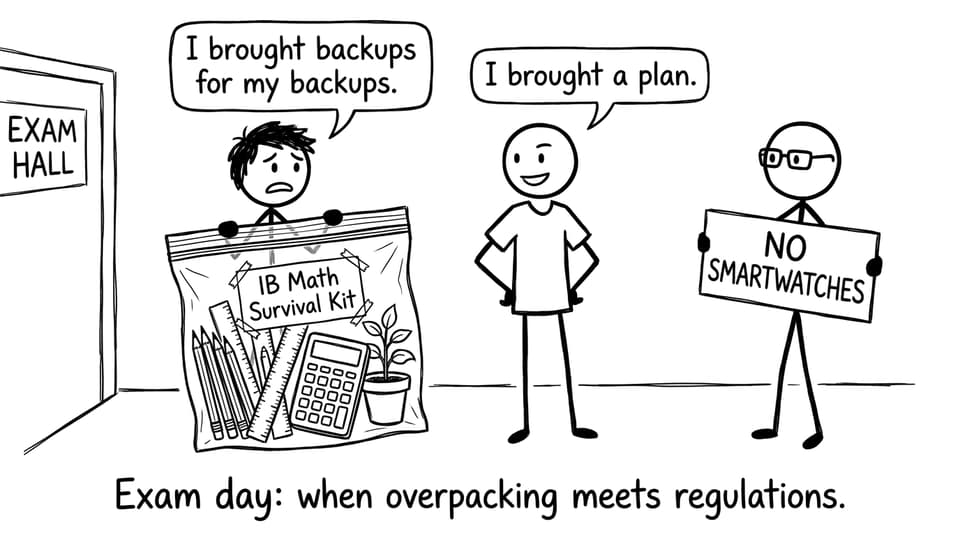
What to bring
-
Two black or blue pens (plus a spare)
-
Two sharpened pencils (for diagrams, graphs, and tidy working)
-
Eraser and ruler (small, simple, reliable)
-
Approved calculator (for calculator-allowed papers)
-
Clear water bottle (no label)
-
Candidate ID details as your school requires
-
Layers (exam rooms love unpredictable temperatures)
If you want to double-check your course pathway and paper structure (AA vs AI, SL vs HL), start at the main hubs: IB Math AA resources and IB Math AI papers.
Pro tip: use a “clear pouch system”
Many centres dislike bulky pencil cases. A clear pouch forces discipline: only what’s allowed, nothing suspicious, nothing extra to worry about.
Calculator rules that trip up IB Math students
In IB Math, calculator compliance is a common exam-day stress trigger because it’s partly math and partly administration.
What to do with your calculator
-
Use an IB-approved model (your school will confirm acceptable devices).
-
Expect memory checks and clearing procedures.
-
Don’t rely on last-minute switching between calculator models.
-
Know your settings (degrees vs radians) before the paper starts.
A strong move is to train with the same calculator you’ll use on the day, under timed conditions. If you want a practical guide, use How to Use Graphing Calculators During IB Math Exams.
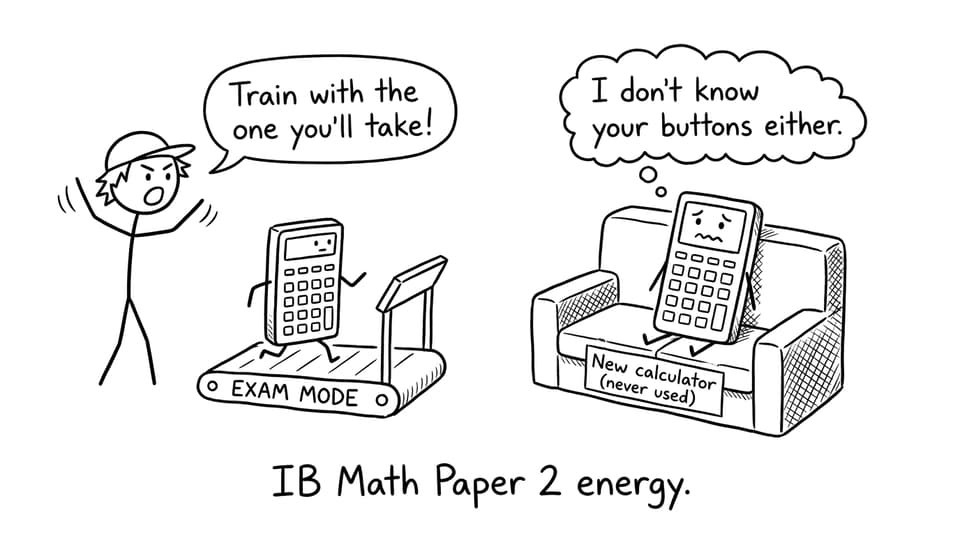
And if Paper 2 still feels like “calculator chaos,” this walkthrough helps you turn button-pressing into marks: IB Math Paper 2 Prep: Calculator Strategy That Scores.
What to avoid bringing (and why it matters)
IB Math exams run on strict rules for fairness. The fastest way to lose calm is to bring something you then have to surrender, explain, or worry about.
Leave these out completely
-
Phones (even switched off)
-
Smartwatches and watches of any kind (don’t try to argue “it’s not smart”)
-
Earbuds/headphones
-
Notes, books, or your own formula sheets
-
Correction fluid/tape
-
Gel pens (smudge risk and often not permitted)
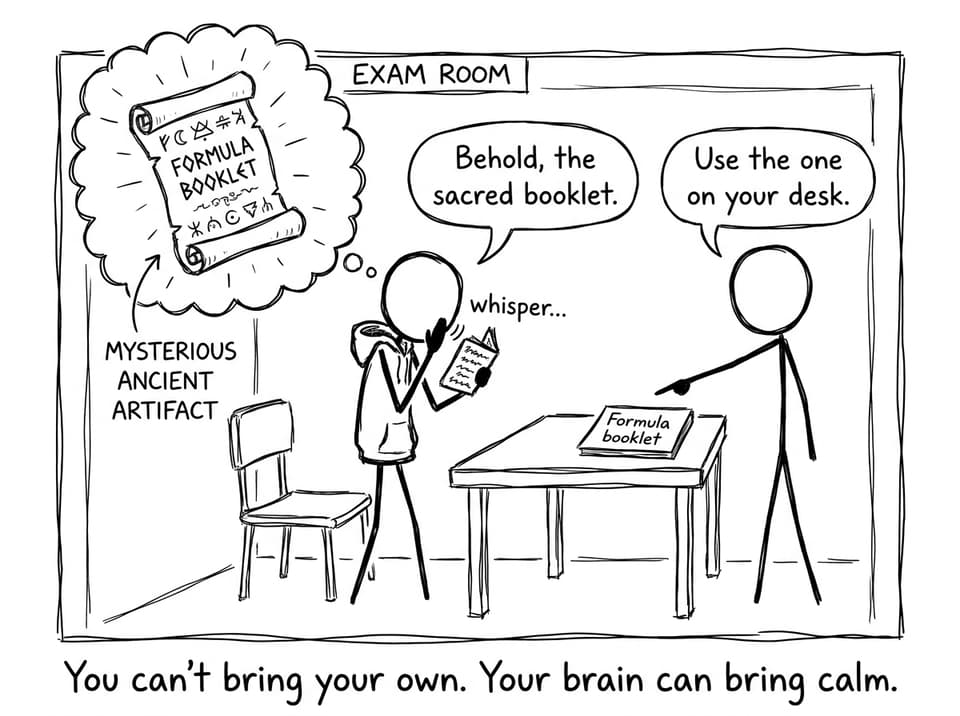
Your centre will supply what’s official, including the formula booklet when relevant. Build your confidence around using the official materials calmly.
Know the IB Math paper structure before you sit down
Exam day gets easier when you stop thinking of IB Math as “one exam” and start treating it as separate performances.
-
SL typically sits Paper 1 (no calculator) and Paper 2 (calculator allowed).
-
HL sits Paper 1, Paper 2, plus Paper 3 (extended problem solving, calculator allowed).
To reduce format shock, it helps to explicitly balance the way you revise across papers. This guide makes that practical: IB Math: Balance Paper 1 and Paper 2 Revision.
You can also clarify what really changes between the two main papers here: IB Math AA Paper 1 vs Paper 2: What Actually Changes?.
Pro tips that actually raise your IB Math score
Scan first, then commit
Spend the first few minutes scanning. In IB Math, the goal is to spot:
-
questions you can bank quickly
-
questions that need careful setup
-
questions that look time-expensive for their marks
Time by marks (not by panic)
A calm rule: allocate time roughly proportional to marks. If a 6-mark question is eating 18 minutes, it’s not bravery anymore; it’s leakage.
Protect method marks
Write like you want credit for thinking. Even if your final answer slips, clear method can still earn marks.
Save 5 minutes for “boring checks”
At the end, check what you can actually control:
-
sign errors
-
rounding (exact vs decimal)
-
units and interpretation statements
If you want a revision system that trains these habits, build a loop around RevisionDojo’s Study Notes, Questionbank, and Flashcards, then pressure-test with Mock Exams, Predicted Papers, and Grading tools. When you get stuck, AI Chat helps you fix a hole fast instead of spiraling. And if you need a human eye on your weaknesses, the Tutors feature gives structure without guesswork.
For a focused practice workflow, use IB Math: Targeted Revision Using the Questionbank and How to Revise IB Math AA and AI Effectively.
FAQ
Can I bring more than one calculator to an IB Math exam?
In many schools, you can bring a spare calculator, but you still have to follow your exam centre’s rules and the calculator must meet all requirements. The deeper issue is not “how many,” it’s whether both devices are compliant and familiar. In IB Math, unfamiliar calculators slow you down when a question already feels tight on time. If your centre clears memory or requires exam settings, your spare needs the same preparation. Practically, a spare is only useful if you’ve tested it under timed conditions. If you’re unsure, ask your IB coordinator early and then stick to one primary device you trust.
Are coloured pens or highlighters allowed in IB Math?
Policies vary by centre, but the safest approach is to use black or blue ink for all final working in IB Math. Highlighters can be risky because scanning and moderation processes may not capture them cleanly, and they can make pages harder to read. Coloured ink might look neat to you but can create ambiguity in how your work is interpreted. If you want to structure your solution clearly, use spacing, underlining with the same pen, and clean labelling instead. Remember that examiners reward clarity of method, not aesthetic formatting. When in doubt, make your work easy to scan and impossible to misread.
How do I stay calm right before the IB Math paper starts?
Calm is rarely a feeling you can summon on command; it’s usually a routine you repeat. On exam day, aim for a short, consistent sequence: sit down, set out your allowed tools, check calculator settings if relevant, and take slow breaths for 20 seconds. In IB Math, the first question often sets your emotional tone, so choose to start with the most approachable item rather than the one that looks impressive. If your mind is racing, write one line at the top of the page: “Marks come from method.” That single reminder nudges you back into process. And if you’ve trained with timed practice (especially through RevisionDojo’s Mock Exams and Questionbank), your brain recognizes the situation as familiar, not threatening.
Walk in like a mathematician, not a tourist
Your IB Math score won’t be decided by a heroic all-nighter. It will be decided by small decisions that stay steady under pressure: packing correctly, following rules, using your calculator fluently, and writing method that earns marks.
Make the logistics boring. Then use RevisionDojo to make the practice smart: tighten concepts with Study Notes, drill weak spots in the Questionbank, lock in recall with Flashcards, and rehearse the real thing with Predicted Papers and Mock Exams. When exam day arrives, you’re not hoping to perform well in IB Math; you’re repeating what you’ve already trained.