If you have ever finished an IB Math question, written a bold final sentence, and still lost “interpretation” marks, it can feel unfair. You did the calculations. You got a sensible value. So why does the marking sometimes punish confidence?
Because in IB Math, a conclusion is not a victory speech. It is a claim about reality. And reality, especially when you are working with models, estimates, sampling, rounding, and technology output, almost never deserves absolute language.
What “cautious language” really means in IB Math
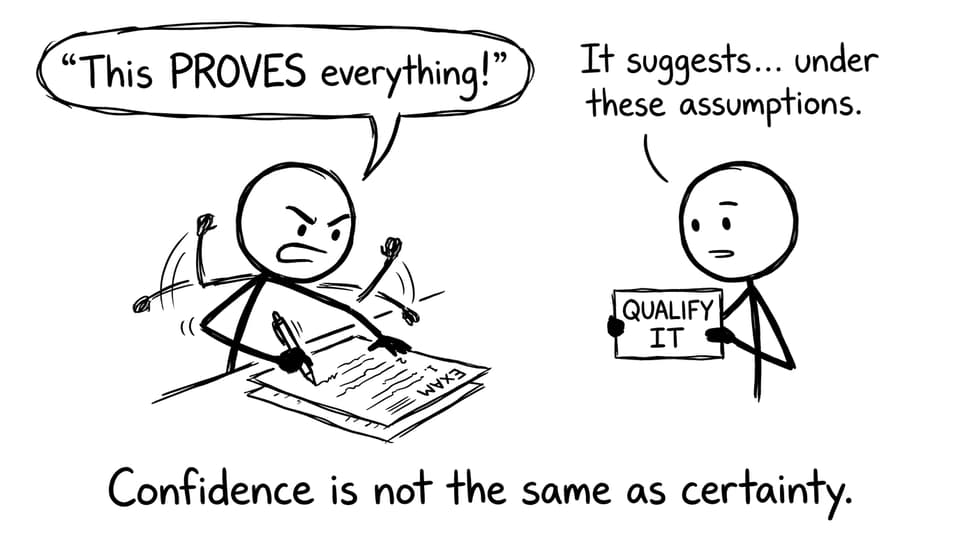
Cautious language in IB Math is qualified, conditional writing that matches what your mathematics can actually support. It is not “being unsure.” It is being accurate.
In Applications and Interpretation, many tasks involve regression, probability, inference, and real data. Those areas are built on uncertainty. When you write “this proves” or “this guarantees,” you accidentally claim a level of certainty your method did not earn.
A good mental model is: your algebra may be exact, but your situation rarely is.
If you want a broader view of what AI rewards beyond calculation, this reflection helps: Why AI Maths Is Less About Maths and More About Thinking.
A quick checklist for cautious conclusions (save this)
Use this mini-checklist at the end of any IB Math response:
-
State the result clearly (with units and context).
-
Add a qualifier: “approximately,” “likely,” “suggests,” “within this model.”
-
Name the condition: assumptions, sample, rounding, or model choice.
-
If predicting, mention reliability limits (especially extrapolation).
This style aligns naturally with clear mathematical communication. For structure practice, use: How to Explain Calculations Clearly Without Losing Depth.
Why IB Math rewards cautious language (and where you lose marks)
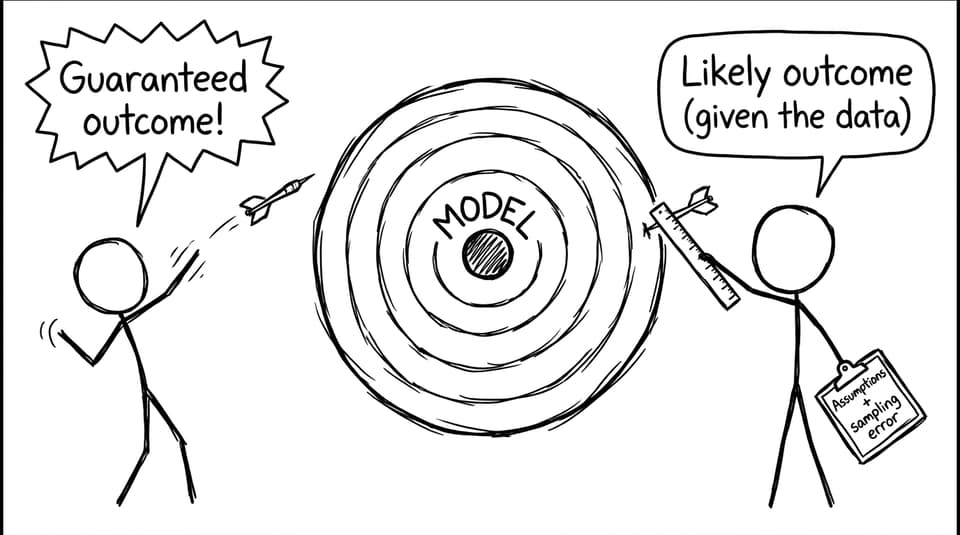
Most IB Math conclusions are based on models, not truth
In IB Math, you often build a model from incomplete information: a scatterplot, a sample, a simplified assumption, or a calculator regression line. That model can be useful and still be imperfect.
So the examiner is watching for something deeper than “answer found.” They are watching for judgement.
If you are revising stats and probability, keep your content solid here: Statistics and Probability Notes and Questions.
Cautious phrasing shows you understand limitations
Examiners reward students who signal limitations without panicking.
Compare these two endings:
-
Overconfident: “This proves study time causes higher scores.”
-
IB-ready: “The data suggests a positive association, although causation cannot be concluded from this sample.”
That single shift is often the difference between partial and full interpretation marks in IB Math.
If you want to tighten your language across longer responses (especially IA writing), these help:
Real data analysis avoids absolute claims
The IB often mirrors how analysts, scientists, and economists write: careful conclusions that respect uncertainty. That is why probability can feel “less certain” than other topics, and why the language matters so much in IB Math: Why Probability Feels Less Certain Than Other Areas of Maths.
Approximation and rounding should appear in your final line
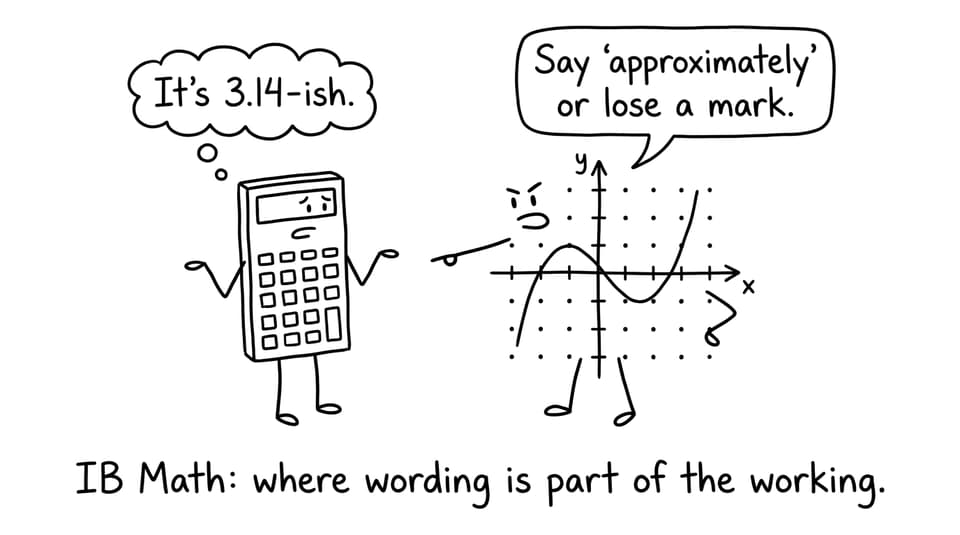
If your method uses interpolation, estimation, or calculator rounding, your final sentence should reflect that. A simple “approximately” can protect accuracy marks when your value is slightly different than expected but your reasoning is correct.
Phrases that help (and phrases to avoid) in IB Math
Helpful IB Math conclusion starters:
-
“This suggests that… within the limits of the model.”
-
“It is reasonable to conclude that… assuming…”
-
“The result is consistent with… although…”
-
“Approximately… due to rounding and sampling variability.”
Phrases to avoid unless certainty is truly justified:
-
“This proves…”
-
“This guarantees…”
-
“This will happen…”
If you want to match your tone to what the question is asking, train command terms deliberately: How to Decode IB Math Command Terms.
Bring this skill into exam practice with RevisionDojo
The easiest way to improve cautious conclusions is to practice them repeatedly, with feedback, until they feel automatic. RevisionDojo helps you do that with the Questionbank (targeted interpretation practice), Study Notes (clear phrasing models), Flashcards (language you can reuse), AI Chat (quick feedback on your conclusion wording), and Grading tools to spot where marks leak.
If you are building exam stamina, use Mock Exams and Predicted Papers for full-paper rhythm, then review your conclusions like they are part of the mathematics. In IB Math, they are.
For more support across topics, browse: All IB Math Posts.



