

A quick story IB Math students recognise
You can almost hear it in the exam hall: someone sees “n = 2000” and relaxes.
In IB Math, that instinct is understandable. A bigger number feels safer. It feels scientific. But the IB quietly tests something deeper: whether you understand that how data is collected can matter more than how much data you collected.
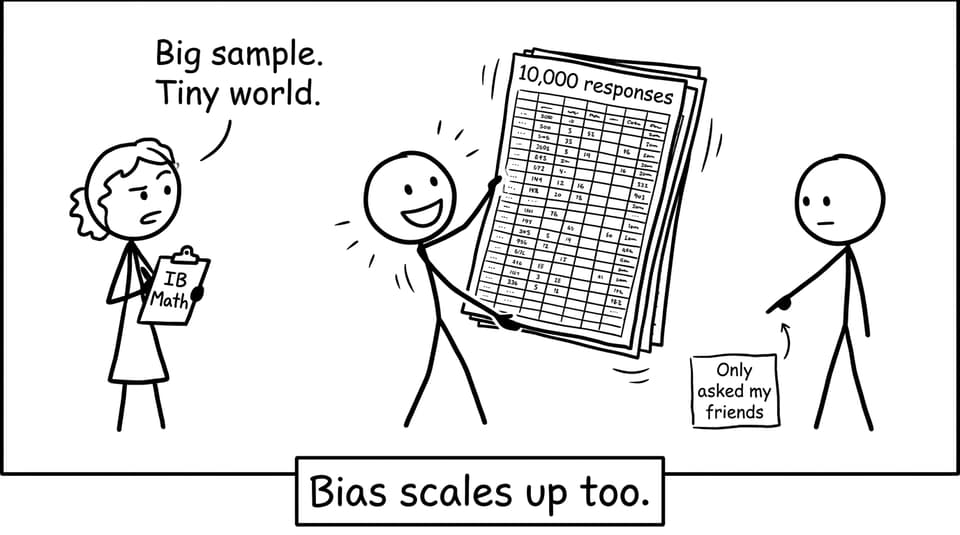
A huge sample taken the wrong way doesn’t become reliable. It becomes confidently misleading. And in IB Math, that’s exactly the trap hiding inside many statistics questions.
Sampling method vs sample size: a fast checklist
When you’re reading an IB Math question (or writing your IA), run this mental checklist:
-
What is the population? Who are we trying to talk about?
-
What is the sampling frame? Who could realistically be picked?
-
What method was used? Random, stratified, convenience, voluntary response?
-
Where can bias creep in? Undercoverage, self-selection, leading questions?
-
Only then: Is the sample size large enough to reduce random variation?
If you want a clean refresher on sampling language, keep the IB Math AI stats notes open while you practice: SL 4.1 Introduction to Statistics (AI).
Why sampling method matters more than sample size in IB Math
Bias is the core idea.
In IB Math, bias means your sampling method systematically favours certain outcomes. That’s different from random error. Random error shrinks with bigger samples. Bias does not.
Imagine surveying “study hours” by asking only the students who stay late in the library. You can collect 5 responses or 5,000. Either way, your method has already nudged the data upward.
This is why examiners reward explanations like:
-
“The sample may not be representative of the population.”
-
“The method excludes students who do not attend the library.”
-
“A larger sample would not fix undercoverage bias.”
For a broader view of what IB wants you to say, this is worth reading: Why Does Sampling Matter So Much in IB Statistics?.
The most common sampling traps (and how to write them)
Convenience and voluntary response: big samples, big problems
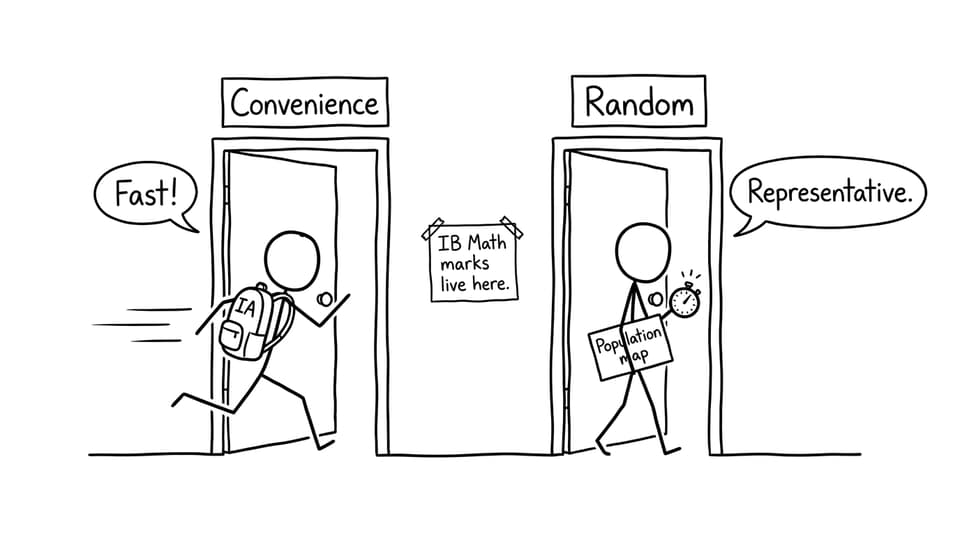
Convenience sampling (asking whoever is nearby) and voluntary response (people opt in) often create samples that are large but skewed.
In IB Math, you don’t just label the method. You explain the consequence: who is overrepresented, who is missing, and what direction that might push results.
If this “limitations” language is where you lose marks, pair this article with: Why IB Questions Emphasise Sampling Limitations.
“Random” is not magic if the frame is broken
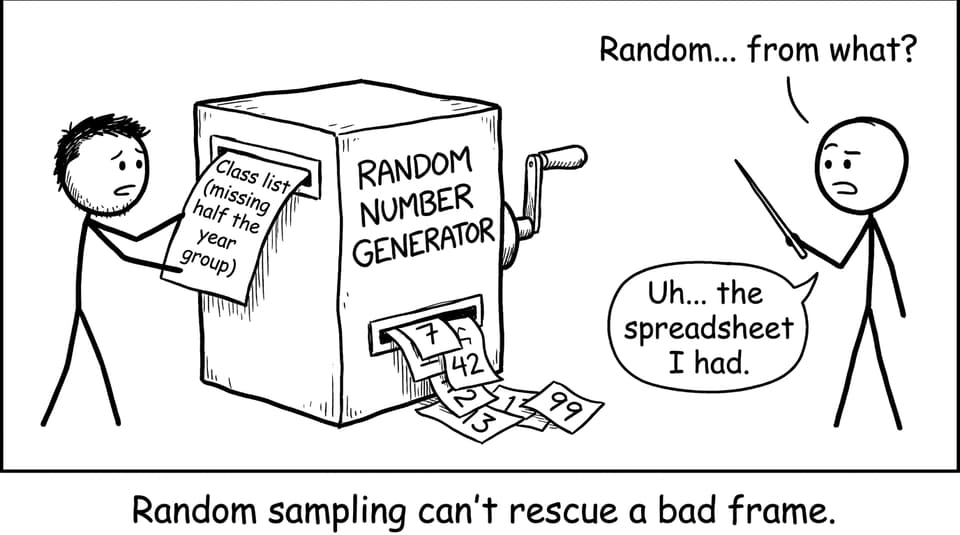
Students sometimes write “random sample” and think the argument is finished.
But IB Math expects you to notice what the randomness was applied to. If your list excludes half the population (wrong sampling frame), randomness only randomises the mistake.
To build this skill quickly, practice with targeted questions where the method description is the whole point: Statistics and Probability Questionbank (Math AI).
How to study this efficiently with RevisionDojo
Sampling questions feel “wordy” until you see the pattern: IB is marking your judgement.
RevisionDojo helps you train that judgement in a practical way:
-
Use the Study Notes for definitions and examples: SL 4.1 Concepts, reliability and sampling techniques (AA) and SL 4.1 Concepts, reliability and sampling techniques (AA Notes).
-
Drill exam-style interpretation with the Questionbank and get faster at spotting bias.
-
Turn recurring phrases (“not representative,” “self-selection,” “undercoverage”) into Flashcards.
-
Use AI Chat to rewrite your explanation in examiner-ready language.
-
Build stamina with Mock Exams and Predicted Papers, then review with Grading tools.
If you want a home base for the whole course, start here: IB Math AI hub.
Closing: the IB Math mindset shift
In IB Math, “bigger is better” is only true after “representative is better.”
If you train yourself to judge sampling method first, you’ll spot bias faster, write clearer evaluations, and pick up the interpretation marks other students leave behind.
To practise this the smart way, use RevisionDojo’s Questionbank, Study Notes, Flashcards, and AI Chat to turn sampling into a repeatable exam skill, then consolidate with Mock Exams and Predicted Papers inside your IB Math revision plan.