


The moment IB Math stops being about steps
In IB Math, most students have a familiar reflex: see a question, grab a formula, start calculating. It feels productive because numbers move. But Math AI has a quiet twist. It rewards the student who pauses first, the one who treats the question like a messy real-world briefing instead of a neat textbook prompt.
That’s why IB Math AI often favors “analysts” over “technicians.” Not because technique doesn’t matter, but because the course is built around information that is incomplete, noisy, and full of assumptions. In other words: the exact kind of math you’ll meet outside school.
Quick checklist: what “analyst thinking” looks like in IB Math
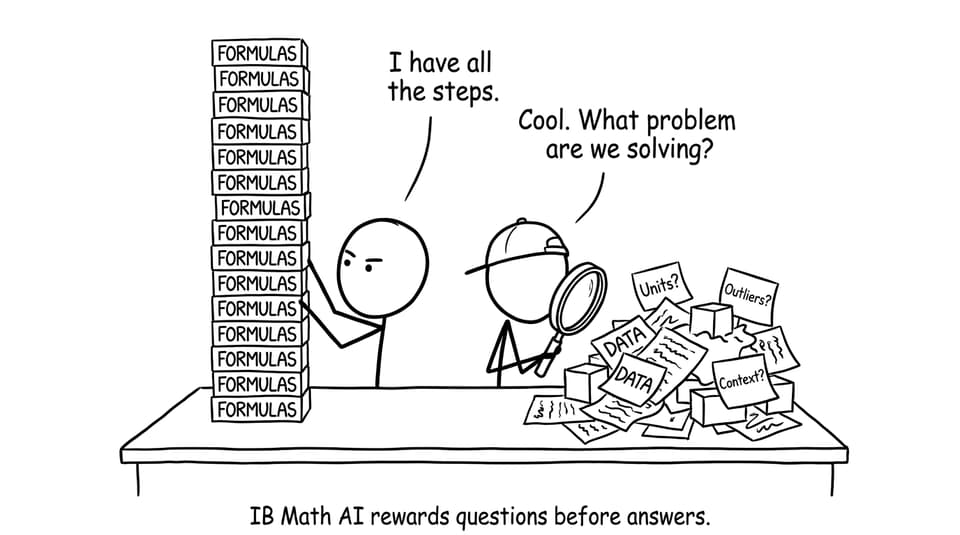
Before you touch your calculator or write a single equation in IB Math, run this quick checklist:
-
What is the question actually asking (in plain English)?
-
What data or model is given, and what might be missing?
-
What assumptions are being made (sampling, linearity, independence, etc.)?
-
What output will you produce (value, interval, decision, interpretation)?
-
What limitations must you state to stay accurate?
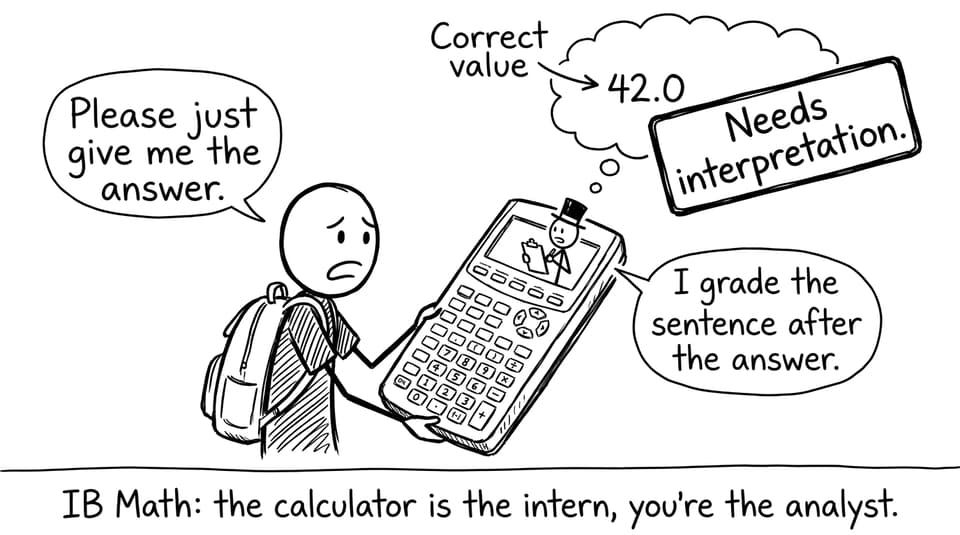
This mindset maps directly to the marks you want, especially the interpretation and communication marks.
Why IB Math AI rewards analysis (not just computation)
Analysts start with the story, not the formula
In IB Math AI, the context is part of the mathematics. A regression question isn’t just “find the line.” It’s “does this model make sense for this situation?” That’s why students who rush can do correct calculations for the wrong purpose.
If you want practice that trains this habit, start from the course hub and work topic-by-topic: IB Mathematics Applications & Interpretation resources.
Uncertainty is the point
A big reason IB Math AI rewards analysts is that uncertainty is everywhere: samples are imperfect, models simplify reality, and calculator outputs look “exact” even when they’re not.
An analyst naturally asks:
-
How reliable is this estimate?
-
Is the sample size large enough?
-
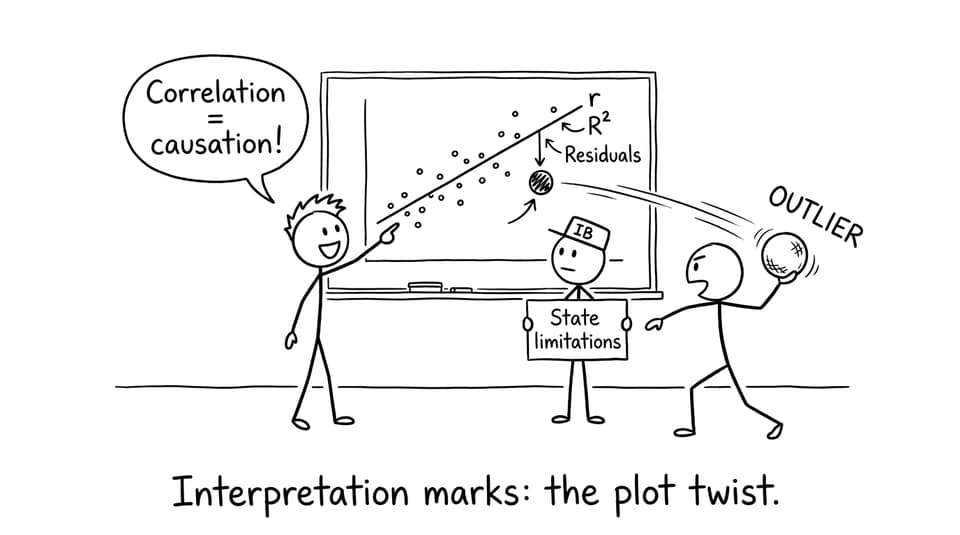
Are there outliers changing the conclusion?
-
Does extrapolation make the statement risky?
To build confidence in these judgment calls, use a structured workflow like the one in How to Interpret Data in IB Math AI Using Technology.
Interpretation marks reward explanations, not results
In IB Math, an answer without meaning is a half-finished thought. You can compute a probability, but the examiner wants you to say what it means in context, how confident you should be, and what could undermine it.
RevisionDojo trains this directly: drill exam-style interpretation using the Number and Algebra Questionbank and Functions Questionbank, then ask AI Chat to critique your wording the way an examiner would.
A simple RevisionDojo loop to train analyst thinking
This is a calm, repeatable system for IB Math AI exam prep:
-
Learn the concept quickly with Functions Notes and the Math AI Data Booklet.
-
Practice with feedback using the Questionbank, then log the type of mistake (setup vs interpretation vs limitations).
-
Convert your recurring mistakes into Flashcards with spaced repetition: IB Flashcards with Spaced Repetition.
-
Pressure-test your judgment under time with Mathematics Applications & Interpretation Predicted Papers and targeted Math AI papers.
If you want a full plan, borrow the structure from How to Score 7 in IB Math AI SL.
Conclusion: use IB Math like it’s meant to be used
The best way to improve in IB Math AI isn’t to become faster at steps. It’s to become calmer at judgment: reading the story, choosing tools wisely, explaining meaning, and stating limitations like a professional.
If you want one platform that builds that mindset end-to-end, RevisionDojo is the home base: Study Notes, Flashcards, Questionbank, AI Chat, Grading tools, Predicted Papers, Mock Exams, a Coursework Library, and Tutors; all designed to help you think like the examiner rewards. Open the IB Math AI hub, pick one weak topic, and start the analyst loop today.


