


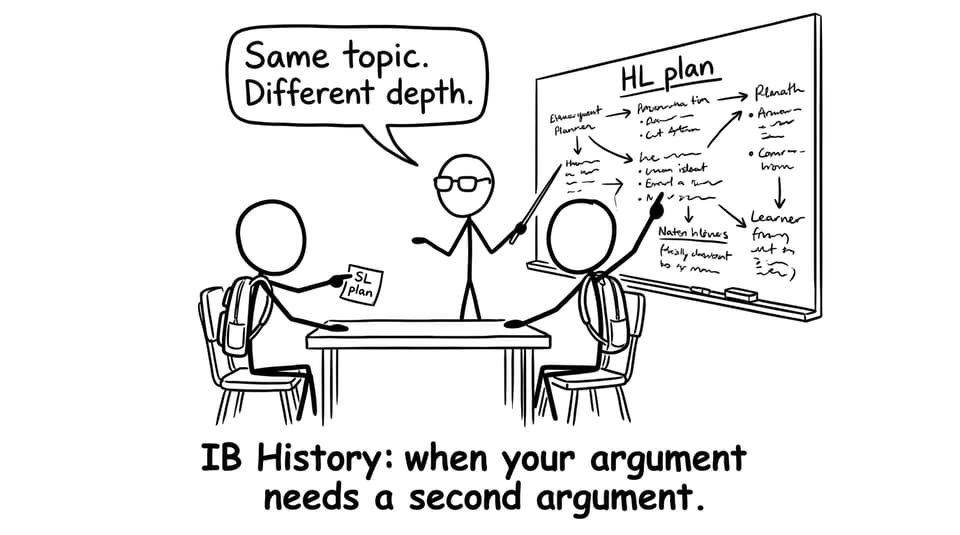
If you have ever watched two students revise the same revolution, the difference is rarely the topic. It is the question they think they are answering.
One student wants the clean story: what happened, why it mattered, and what evidence proves it. The other keeps circling back with a harder habit: “Who disagrees, and what would change my judgement?” That gap is the real divider between IB History SL and HL in the new course (First Assessment 2028). And it is why choosing your level early can save you months of stress.
In this guide, we break down IB History HL vs SL under the FA 2028 course: what stays the same, what has shifted, and how to prepare without guessing.
Quick checklist: HL vs SL in the new IB History course
Use this as a fast self-audit before you commit to a level (or panic mid-term):
-
Do HL and SL still share the same conceptual foundations in IB History?
-
What is the real difference: content, skills, or expectations?
-
Which assessments change by level (especially for FA 2028)?
-
What myths push students into the wrong choice?
-
What does a smart revision system look like for SL vs HL?
For a useful starting point, keep the IB History resources hub open while you read.
What HL and SL still share in IB History (FA 2028)
Even with First Assessment 2028, HL and SL are built on the same identity of IB History: concept-driven thinking, disciplined evidence use, and writing that answers the question rather than retelling the unit.
Both levels still typically:
-
Sit written examinations that reward argument and evidence
-
Complete the Internal Assessment (the historical investigation)
-
Work within the same core historical concepts and skills, assessed with shared criteria language
This is why SL is not “easy mode” IB History. It is the same subject, but the exam expects a different ceiling of judgement.
If you want a clearer picture of what the concept focus looks like in practice, read IB History: The 4 Key Concepts for FA 2028.
The big difference: explanation (SL) vs sustained judgement (HL)
The simplest way to think about IB History HL vs SL is this:
-
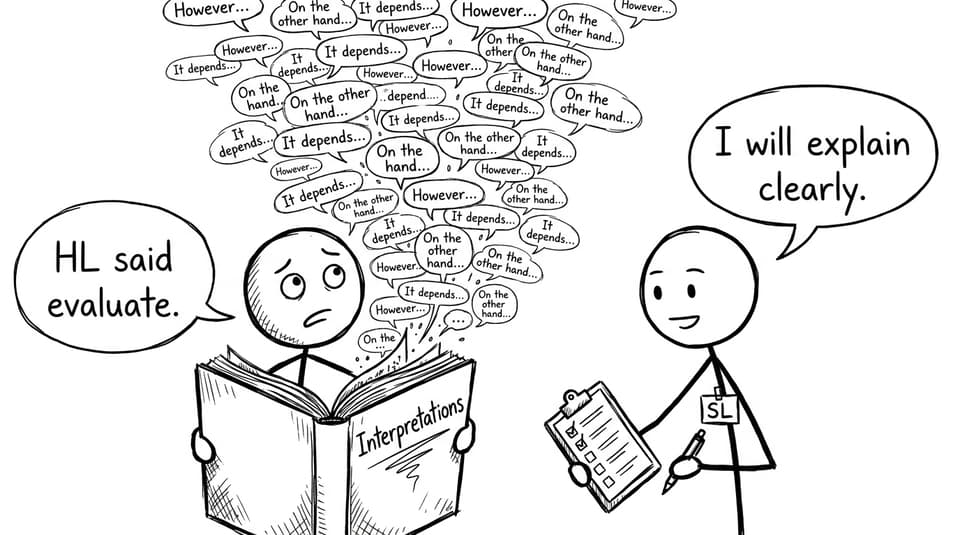
SL rewards controlled explanation and focused analysis. You show you understand causes, effects, significance, and perspectives, then prove it with precise evidence.
-
HL demands sustained judgement and synthesis. You still explain, but you also evaluate interpretations, weigh competing factors, and keep a critical line running across the whole essay.
HL is not only “more content.” It is more decision-making: deciding what matters most, why, and under what conditions your conclusion would change.
A good way to feel this difference is timed practice. RevisionDojo’s Questionbank and AI Chat are built for that loop: attempt, get feedback, refine. Start from the tag page IB History posts to find skill-specific articles quickly.
Assessment differences that matter for HL vs SL
In the FA 2028 version of IB History, the assessment model makes the depth gap harder to ignore.
What SL is training you to do
SL assessments typically push you to:
-
Interpret questions accurately (command terms + focus)
-
Build clear, supported paragraphs that stay on task
-
Use evidence selectively (few facts, high relevance)
-
Demonstrate conceptual thinking without needing heavy cross-topic synthesis
If you want a full exam-skill roadmap, the article IB History Exam Prep: A Comprehensive Guide is a strong next read.
What HL adds on top
HL students do everything SL does, plus an additional layer:
-
Sustained evaluation across longer responses
-
Comparing interpretations more explicitly
-
Integrating wider knowledge (across themes, regions, or periods) when relevant
-
Handling HL-only demands that test depth over breadth
For example, HL students often have to keep their argument stable even while they introduce counter-arguments. That is less about knowing “extra events” and more about controlling complexity.
If you are already in HL and feel the time pressure, start with Best Study Techniques for IB History HL Students.
What changed in the new course (FA 2028): the “memorise and dump” trap
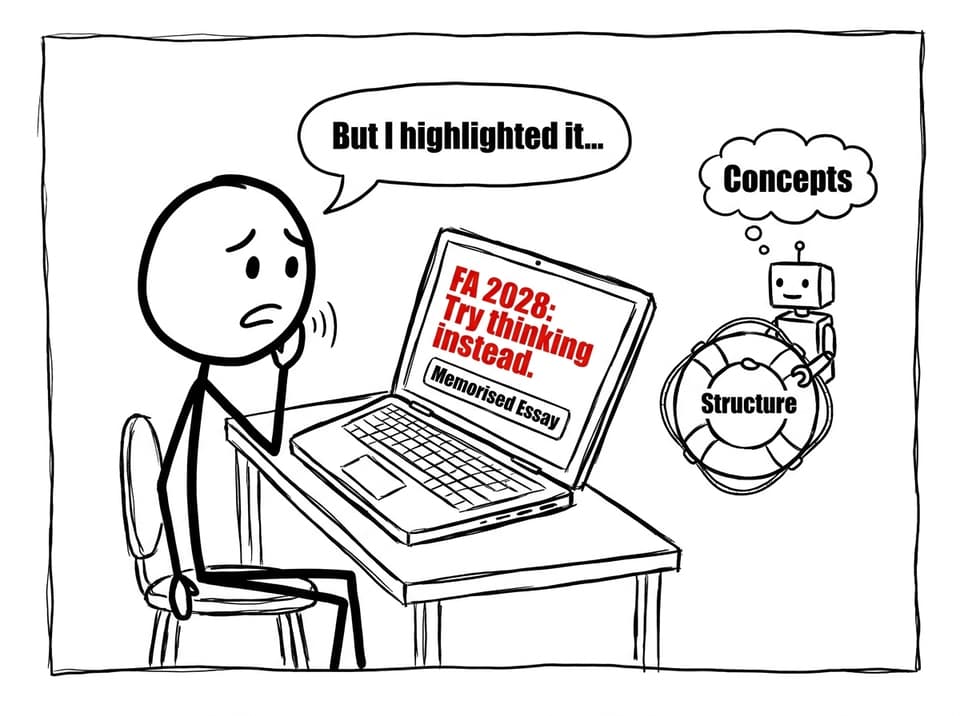
A quiet shift in IB History FA 2028 is that expectations are more explicit about thinking skills. Essays that look like memorised scripts are easier to spot, because the course is clearer about judgement, conceptual framing, and purposeful evidence.
So what works instead?
-
Planning around an argument, not a timeline
-
Using evidence as proof, not decoration
-
Bringing in interpretations as a tool (to test your judgement), not as a paragraph you add because you feel guilty
RevisionDojo’s Study Notes and Flashcards help you build the base efficiently, but the marks usually come when you switch to application: Questionbank practice, Grading tools, and Mock Exams that reveal where your argument collapses under time.
What about the Internal Assessment (SL and HL)
Both HL and SL students complete the historical investigation, and FA 2028 places even more emphasis on inquiry and evaluation.
If your IA feels vague, these resources are worth bookmarking:
-
When you want a fast rubric check, use the IB History IA Grader
-
If you learn best by seeing real standards, browse IB History coursework exemplars
This is also where RevisionDojo’s Coursework Library and Tutors can matter: you get examples, but you also get guidance on why something scores well.
How to choose HL vs SL without guessing
Choosing the right IB History level is less about “am I smart?” and more about “what kind of thinking can I sustain weekly?”
HL tends to fit students who:
-
Enjoy debate and weighing competing explanations
-
Can revise consistently (HL punishes cramming)
-
Like writing that ends in a judgement, not a summary
SL tends to fit students who:
-
Want a strong humanities course but need balance with other heavy subjects
-
Prefer tight structure, clear criteria, and focused analysis
-
Can write well under time without needing constant synthesis across units
A practical rule: if you dislike the idea of arguing with your own argument, HL will feel exhausting. If that idea sounds interesting, HL can feel strangely satisfying.
FAQ
Is IB History HL much harder than SL in FA 2028?
HL is usually harder because it asks for more sustained judgement, not because every topic is inherently more difficult. In IB History FA 2028, the course is clearer about evaluation and interpretation, so HL students cannot hide behind memorised paragraphs. The challenge is maintaining a line of argument while also acknowledging alternative views and limits. That takes practice, especially under timed conditions. The good news is that this skill is trainable with repetition and feedback, not talent. Tools like RevisionDojo’s Questionbank and Grading tools make that practice loop faster and more honest.
Can SL students still score a top grade in IB History?
Yes, SL students can score extremely well in IB History when they treat it as an analytical subject, not a reading subject. High marks come from answering the exact question, using evidence selectively, and keeping paragraphs concept-driven. Many SL students lose marks because they drift into narrative, even when they know the content. FA 2028 rewards clarity: a strong thesis, disciplined topic sentences, and consistent explanation of significance. If you build your revision around skills (source analysis, essay planning, timing) rather than endless note-making, SL becomes much more predictable. RevisionDojo’s Study Notes and Flashcards help with recall, but the score jump often happens when you add timed Mock Exams.
Should I take IB History HL if I want to study History at university?
HL can be helpful, but it is not automatically required for most university programs. What matters more is the final performance and the overall academic profile. Universities generally respect IB History at both levels because it signals writing, reasoning, and evidence skills. If HL will pull your grades down across other subjects, SL with a strong score may be the smarter choice. If HL aligns with your strengths and you can commit to steady practice, it can be excellent preparation. The best approach is to talk with your school and then test yourself with real exam-style tasks using RevisionDojo’s Questionbank and feedback tools.
Final thoughts: the best level is the one you can master
Under First Assessment 2028, IB History makes the HL vs SL distinction clearer: SL rewards focused, concept-driven analysis, while HL demands sustained evaluation and synthesis. Neither path is “better” in a vacuum. The right choice is the one that lets you practise consistently, write with control, and improve through feedback.
If you want a single place to build that system, RevisionDojo is designed for both levels: Study Notes to get clear, Flashcards to retain, Questionbank to apply, AI Chat when you are stuck, Predicted Papers to sharpen focus, Mock Exams for timing, Grading tools for honest diagnosis, a Coursework Library for models, and Tutors when you need a human strategy reset. Start from the IB History resources hub and build from there.