

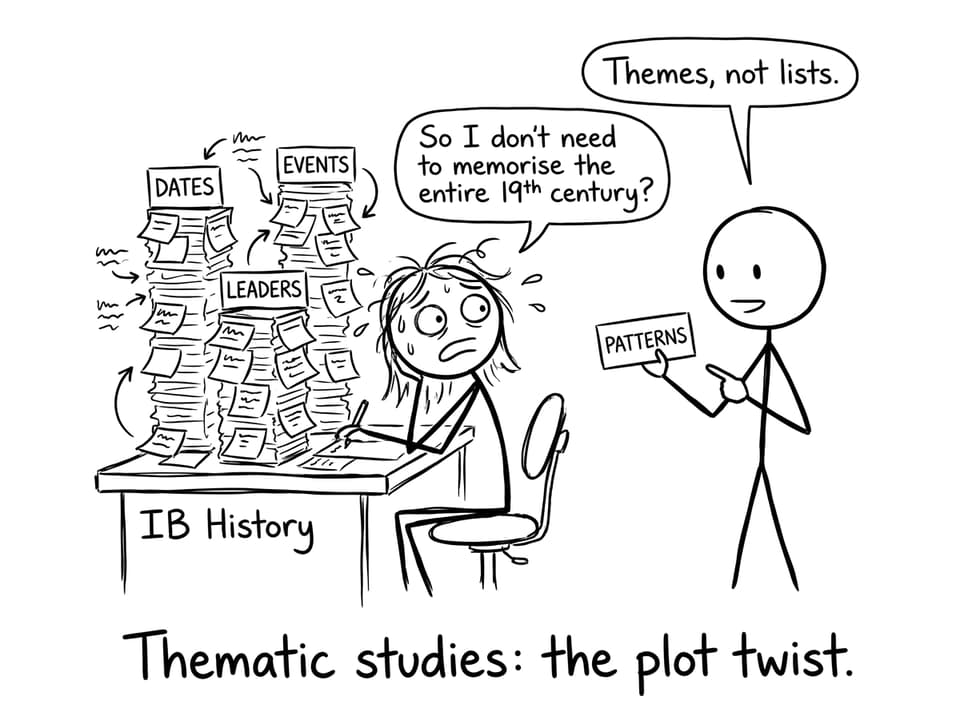
When students first hear “thematic studies,” they often do the most reasonable thing: open a notebook and start making a list. Dates. Leaders. Treaties. Turning points.
And then the list grows until it feels less like IB History and more like trying to archive the entire human experience before Thursday.
But thematic studies in IB History (first assessment 2028) are not a memory contest. They’re a thinking contest. The exam is essentially asking: Can you notice the recurring shapes of history--and explain why they look different in different places?
Quick checklist: how to approach IB History thematic studies
Use this before you revise any theme in IB History:
-
Define the theme in one sentence (so you know what counts, and what doesn’t)
-
Choose 2--3 case studies you can compare confidently
-
Organise notes by concepts (cause, consequence, continuity and change, perspectives, significance)
-
Practise comparison in paragraphs (not “mini-essays” glued together)
-
Train with timed plans and examiner-style questions
If you want a single home base for your course, keep the IB History Resources hub open while you study.
What are Thematic Studies in IB History?
Thematic studies are long-view investigations: you track a major historical theme across multiple places and extended time periods. Instead of asking “what happened in one country,” the syllabus pushes you to ask “what tends to happen when this kind of historical pressure appears?”
In practical terms, IB History thematic studies require you to:
-
Identify patterns that repeat across contexts
-
Compare how different societies respond to similar challenges
-
Explain change over time (and what stays stubbornly the same)
-
Use evidence selectively--as proof, not as decoration
This is why thematic studies feel hard at first. They’re not vertical (deep into one event). They’re horizontal (across cases).
For a broader look at how the course is structured, the IB History Exam Prep guide is a helpful map.
Why IB History thematic studies matter more under first assessment 2028
Under first assessment 2028, the direction of travel is clear: IB History rewards conceptual, comparative thinking more explicitly.
That shift changes what “good revision” looks like.
You don’t win by knowing more. You win by knowing what matters, and being able to move it around. Thematic studies are built for that. They train you to take a concept (say, the causes of conflict) and test it against different realities.
If you want to anchor your understanding of what the exam is really looking for, read Why IB History essays are different under the new specification (FA 2028).
Thematic Studies vs Focused Studies (and why students mix them up)
Here’s the simplest distinction:
-
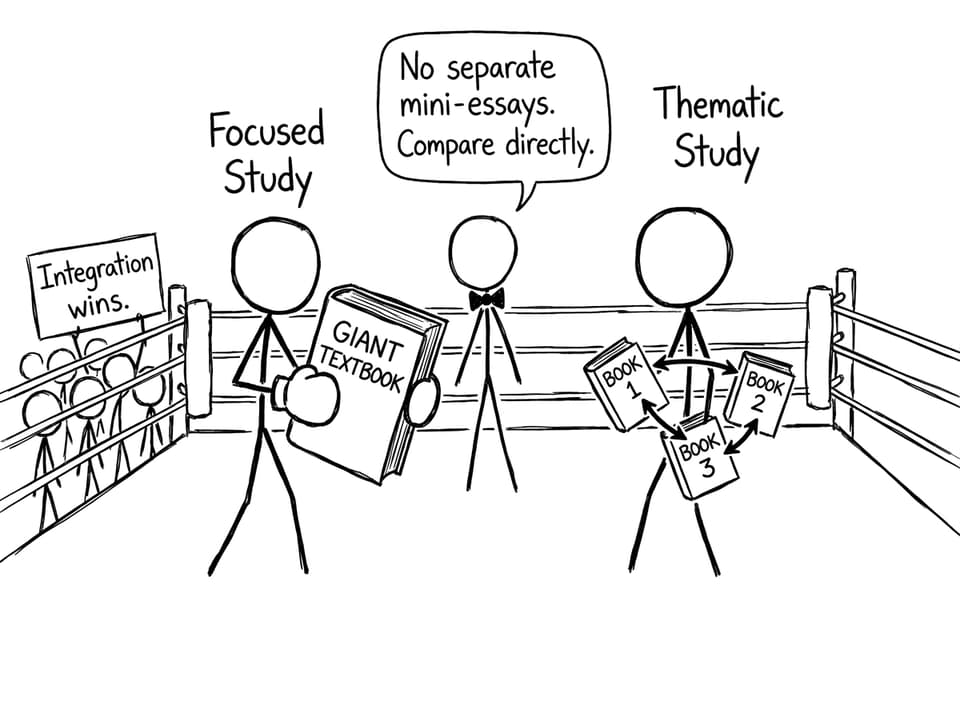
Focused studies give you depth: one setting, tighter boundaries, richer detail.
-
Thematic studies test your range: multiple settings, shared concept, comparative explanation.
Focused studies supply strong evidence. Thematic studies test whether you can connect evidence without drowning in it.
A common IB History trap is writing thematic answers that look like this:
Case study A: everything I know.
Case study B: everything else I know.
That isn’t comparison. That’s two history podcasts in paragraph form.
How thematic studies are assessed in IB History
Thematic studies show up most clearly in essay-based assessment--especially Paper 2, and Paper 3 for HL.
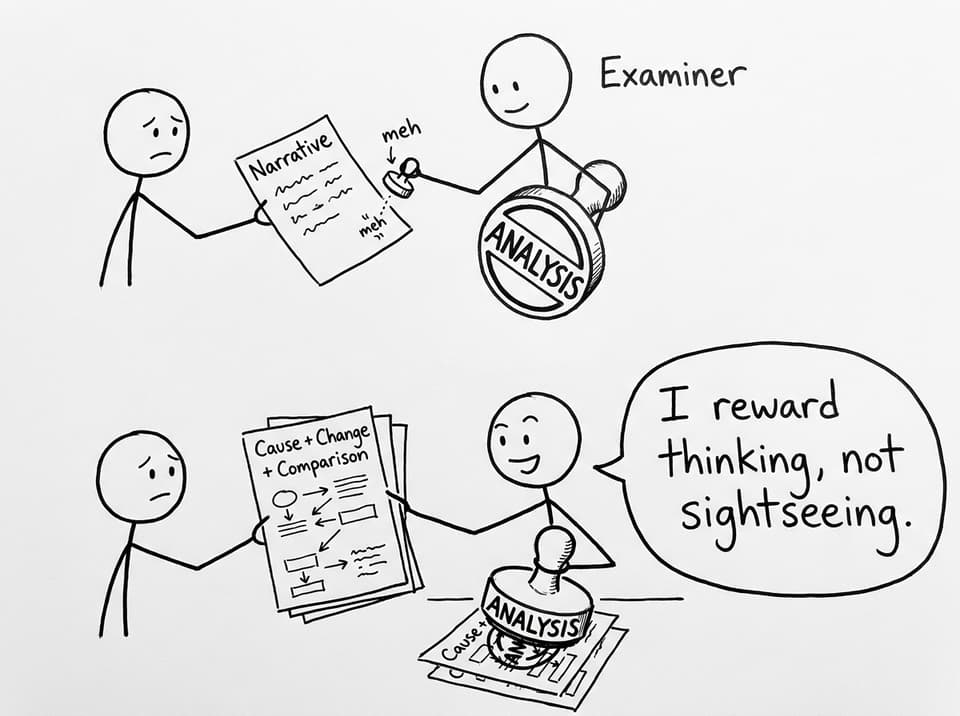
In IB History, examiners generally reward:
-
Direct comparison (similarities and differences)
-
Clear use of concepts (cause, change, significance, perspectives)
-
Evidence that is relevant and explained (not just listed)
-
Evaluation: judgement that develops through the essay, not only in the conclusion
If Paper 2 is your main battleground, keep this nearby: IB History Paper 2 explained: writing concept-driven essays (FA 2028). And for structure support, IB History essay structure: plan fast, write better is a strong companion.
The secret engine: concepts make thematic studies manageable
The fastest way to make thematic revision feel impossible is to organise it as a timeline.
The fastest way to make it feel doable is to organise it by concepts.
Try building your thematic notes around four “drawers”:
-
Causation: what drove similar developments across cases?
-
Consequence: what changed, for whom, and at what cost?
-
Continuity and change: what shifted quickly vs slowly?
-
Perspectives and significance: who interpreted events differently, and why does it matter?
RevisionDojo leans into this approach. You can start by clarifying concepts in The 4 key concepts in IB History (FA 2028), then practise applying them with the IB History Paper 2 Questionbank.
Common mistakes students make in IB History thematic studies
Most “weak thematic essays” fail for predictable reasons:
-
They describe instead of compare: paragraphs become narrative summaries.
-
They separate cases too cleanly: the essay becomes A then B, with no integration.
-
They overload evidence: lots of details, little explanation.
-
They lose the question: smart history, wrong task.
To fix that last one, practise with the same discipline you’d use in a Questionbank session: narrow the skill, run a short set, review mistakes by pattern. This article helps you do that: IB Question Bank: how to use it effectively.
A practical way to revise thematic studies (without memorising the world)
Here’s a calm routine that works for IB History thematic studies:
Choose fewer examples--then learn them deeper
Pick 2--3 case studies per theme that you can confidently use in multiple questions. Know a small set so well that you can adapt quickly.
If you like practising with topic-specific materials, explore the IB History Paper 1: Conflict and Intervention area, or build breadth through regional depth options like IB History Paper 3: History of Asia and Oceania.
Convert notes into comparisons
Instead of writing “Case A notes” and “Case B notes,” write:
-
Similar drivers (economic, political, ideological)
-
Key differences (institutions, leadership, external pressure)
-
Turning points (and why they mattered)
-
Short vs long-term outcomes
Practise integrated paragraphs
Write one paragraph where both cases appear inside the same argument. That’s the skill thematic studies reward.
Use RevisionDojo like a system, not a library
RevisionDojo works best when you rotate tools:
-
Study Notes to clarify content
-
Flashcards to retain key evidence and definitions
-
Questionbank to apply concepts under exam pressure
-
AI Chat to unstuck explanations and tighten comparisons
-
Grading tools to see what your writing is actually doing
-
Predicted Papers and Mock Exams to simulate exam performance
-
Coursework Library (coursework exemplars) to learn what quality looks like in real student work
-
Tutors when you want human feedback and accountability
If you’re building HL-specific habits, Best study techniques for IB History HL students is a strong next step.
FAQ: IB History thematic studies (FA 2028)
Do I need to know every possible case study for a thematic study in IB History?
No, and trying to do that usually backfires. In IB History, thematic studies reward the quality of comparison, not the quantity of examples. A smaller set of case studies learned in depth gives you more control in essays. It also helps you stay focused on the question instead of dumping everything you remember. The real goal is to have flexible evidence you can reuse across prompts. If you’re unsure what “enough” looks like, practise a few questions in the Questionbank and see whether your examples cover multiple angles.
Are thematic studies harder than focused studies in IB History?
They can feel harder because they punish passive revision habits. Focused studies often let you rely on a strong narrative: event leads to event, and you retell it well. Thematic studies in IB History force you to make decisions about relevance, comparison, and judgement. But once you organise by concepts and train integrated writing, thematic studies become surprisingly structured. They also become a scoring opportunity because many students stay descriptive. In other words: harder at first, calmer later.
How do I stop writing “two mini-essays” in a thematic IB History answer?
Start by planning arguments, not case studies. Write your topic sentence as a claim that already implies comparison (for example, “Both states used repression, but institutional capacity shaped outcomes differently”). Then build each paragraph using a consistent pattern: point, evidence from case A, evidence from case B, and a direct comparative explanation of why they differ. Use linking phrases that force integration: “whereas,” “by contrast,” “similarly,” “however this mattered less because…” Finally, after writing, underline every sentence that answers the question directly. If large sections don’t, revise them into analysis.
Conclusion: make the big questions your advantage
The point of thematic studies is not to make IB History bigger. It’s to make your thinking sharper.
Under first assessment 2028, the students who score well won’t be the ones who memorised the most content. They’ll be the ones who can compare, evaluate, and explain patterns across time and place without losing the question.
Build a concept-first system, practise integrated writing, and use RevisionDojo to turn revision into a repeatable loop: notes, flashcards, Questionbank, AI feedback, and exam simulations.
When you’re ready, start from the IB History Resources hub and make thematic studies the part of IB History that finally feels under control.