

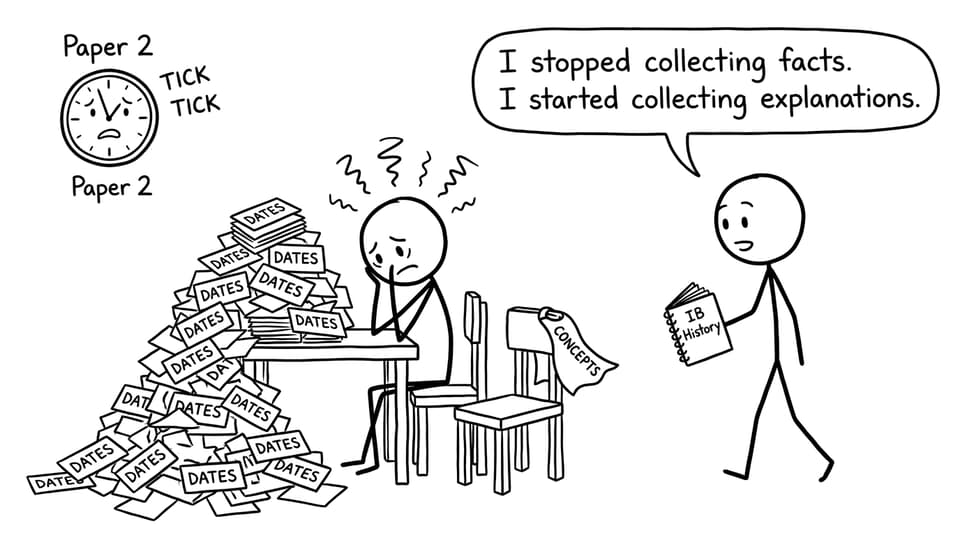
When people say IB History is “a lot of content,” they are usually describing a familiar fear: that one missing date, one forgotten name, one blurred treaty will cost them the grade.
But from first assessment 2028, the game is more honest -- and more demanding.
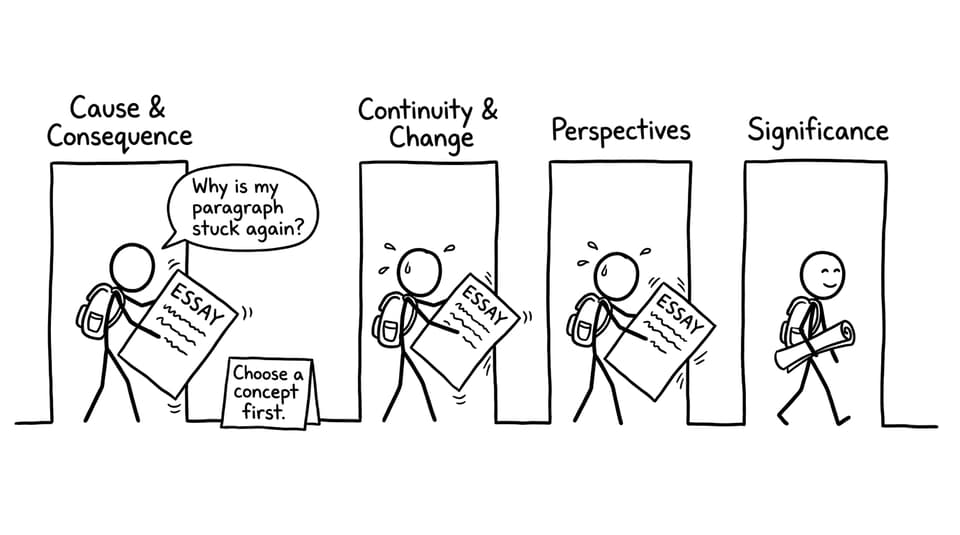
In IB History, the highest marks will go to students who can explain the past using a small set of powerful lenses. Knowledge still matters. Evidence still matters. Yet what matters most is whether you can turn that evidence into analysis through the course’s four key concepts.
If you want a quick home base as you revise, keep the IB History resources hub open in another tab. It helps you shift from “reading history” to thinking like the exam wants.
Quick checklist: the concept-driven way to score higher in IB History
Use this short list before any timed practice for IB History:
-
Can I spot which concept the question is testing?
-
Can I state a one-sentence argument that answers the question directly?
-
Do my paragraphs prioritise evidence (not dump it)?
-
Do I explain relationships, patterns, viewpoints, and criteria -- not just events?
-
Can I finish with a conclusion that returns to the key concept?
To make this routine repeatable, RevisionDojo is built around the same loop: Study Notes to get clear, Flashcards to retain, Questionbank to apply, AI Chat when you are stuck, and Grading tools to show what your writing is actually doing.
Why IB History concepts matter more after first assessment 2028
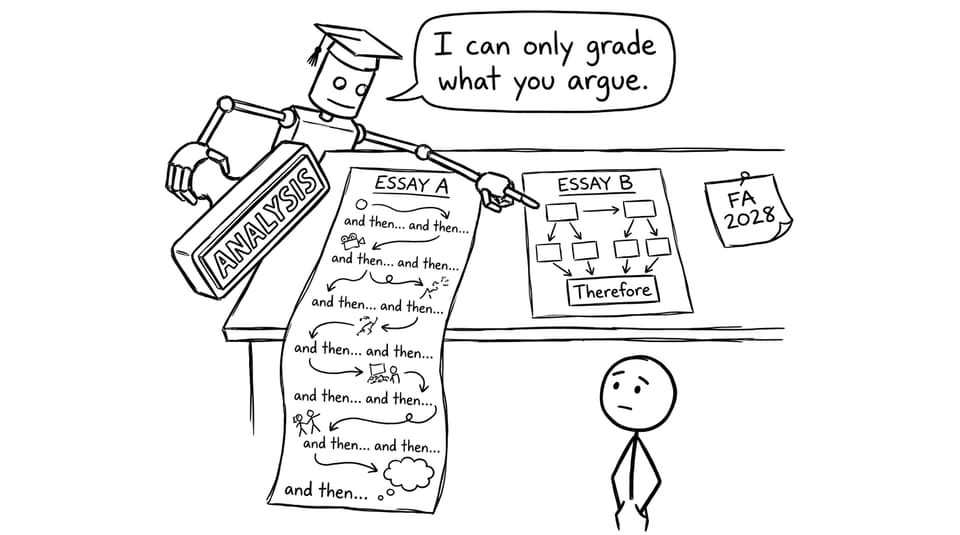
Here is the quiet truth about IB History: a technically accurate answer can still feel “thin” if it is mostly narrative.
The FA 2028 direction makes that difference visible in marking. Concepts are not decoration. They are the framework.
Concept-driven writing tends to do four things examiners reward:
-
It turns facts into explanation.
-
It shows you can control time periods (what changes, what persists).
-
It handles competing interpretations rather than pretending history is one voice.
-
It justifies why something matters instead of assuming importance.
If you have ever read a markscheme and thought, “But I included so much detail,” the missing piece was probably conceptual control.
For targeted practice that trains this directly, use a paper-specific set like the Paper 1: Conflict and Intervention questionbank or a topic set such as the Paper 2 questionbank.
Cause and consequence in IB History
Cause and consequence asks a simple question with a difficult expectation: why did this happen, and what changed because it happened?
In IB History, strong causation is not a list. It is a hierarchy.
What examiners look for:
-
Short-term and long-term causes, clearly separated
-
Triggers versus deeper conditions
-
Interaction between causes (how one factor strengthened another)
-
Intended versus unintended consequences
A practical paragraph pattern for IB History is:
-
claim (most significant cause)
-
evidence (selective, specific)
-
explanation (mechanism: how it produced the outcome)
-
evaluation (why it mattered more than another cause)
If you want an example of how topic knowledge becomes causal analysis, try revising one case study using notes like China under Deng Xiaoping (1976--1997), then immediately test with a Questionbank set.
Common mistake with cause and consequence
Many IB History students stack causes like bricks: economic, political, social, ideological -- and never show the architecture. The fix is to add one sentence that explains the relationship: “This mattered because it enabled X” or “This only became decisive once Y happened.”
Continuity and change in IB History
Continuity and change is where students often panic because it feels like you must cover “everything.” You do not.
In IB History, the skill is selecting a timeframe and then proving two things at once:
-
what changed (direction, speed, turning points)
-
what stayed the same (structures, institutions, constraints)
The best answers avoid the easy exaggeration that “everything transformed.” History rarely behaves like that.
To practice this concept, it helps to work from structured notes and then write timed plans. A good starting point is the Paper 1: The Move to Global War topic page because it naturally forces you to track shifting policy alongside recurring aims.
Common mistake with continuity and change
A lot of IB History essays talk about change for four paragraphs and then add continuity as a single sentence at the end. Instead, build continuity into each paragraph as a contrast line: “Despite this shift, X remained stable because…”
Perspectives in IB History
Perspectives is the concept that reminds you history is not just what happened. It is also how people understood what happened, and why.
In IB History, perspectives show up everywhere:
-
in source work (tone, purpose, audience)
-
in essays (different groups experiencing the same policy differently)
-
in evaluation (bias, reliability, limitations)
A strong way to write perspectives is to anchor them to position and context:
-
Who is speaking?
-
What do they stand to gain or lose?
-
What information would they have access to?
-
What language choices reveal their worldview?
To sharpen this, pair concept practice with skills guidance like the IB History exam prep guide, then test yourself using Paper-style prompts.
Common mistake with perspectives
Students sometimes “name-drop” perspectives (workers, elites, women, foreign powers) without explaining why they diverge. In IB History, the mark comes from the reason for the difference, not the fact that difference exists.
Significance in IB History
Significance is about historical importance, but not in the casual sense of “this was a big event.”
In IB History, significance must be justified using criteria. Try any two or three:
-
Scale: how many people were affected?
-
Depth: how strongly were systems altered?
-
Duration: did effects last?
-
Turning point: did it redirect a trend?
-
Symbolic weight: did it reshape identity, legitimacy, or ideology?
Significance is also where you can show mature evaluation: something may be significant to one group, region, or timeframe, and less so to another.
If you want to see how high-scoring work frames significance, use the IB History Coursework Exemplars as models for how claims get justified.
Common mistake with significance
In IB History, saying “this was significant because it changed history” is almost the same as saying nothing. Replace that with one measurable criterion: “significant because it created a durable shift in state control that persisted beyond…”
How the four concepts appear in IB History exam questions
Sometimes exam questions name the concept. Often they do not. But the concepts are still there.
A quick translation guide for IB History:
-
“To what extent…” usually demands significance and continuity and change
-
“Evaluate the causes…” is clearly cause and consequence
-
“Compare and contrast…” often becomes perspectives plus change/continuity
-
“Assess the impact…” blends consequence and significance
A good habit is to underline the hidden concept before you plan.
For realistic rehearsal, use IB History predicted papers as timed practice, then patch your weak spots with the Questionbank and RevisionDojo’s AI Chat for quick clarification.
How to apply IB History concepts in essays (a simple method)
Here is a method that keeps IB History essays concept-led, not content-led:
-
Step 1: Name the concept privately. Even if you do not write it, you should know it.
-
Step 2: Write a one-sentence answer. No background, just judgment.
-
Step 3: Build 2--3 paragraphs, each with a conceptual job. One paragraph can compare causes; another can weigh significance; another can show continuity.
-
Step 4: End by returning to the concept. Your conclusion should not repeat evidence; it should sharpen the judgment.
If you want a consistent routine for this, the workflow in Why students struggle with IB History (FA 2028) pairs well with RevisionDojo’s Mock Exams, Grading tools, and Tutors when you need targeted feedback.
Closing: make IB History predictable again
FA 2028 makes IB History clearer in one important way: it tells you exactly what kind of thinking earns marks.
The four key concepts -- cause and consequence, continuity and change, perspectives, and significance -- are not extra content to memorise. They are the structure that turns your knowledge into a high-scoring explanation.
If you want to train this consistently, start in the IB History hub, practise with the Questionbank, rehearse with Predicted Papers and Mock Exams, use Study Notes and Flashcards to stay sharp, and lean on AI Chat, the Coursework Library, and Tutors when you need a faster path out of confusion.
In IB History, facts are the fuel. Concepts are the steering wheel. Use both, and the course becomes a lot less scary -- and a lot more winnable.