

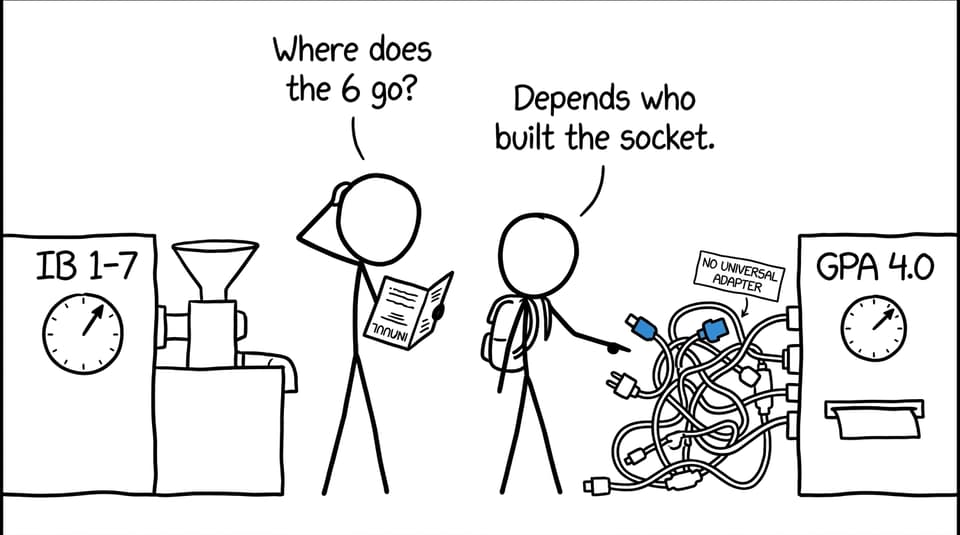
A parent can look at an IB grade of 6 and reasonably ask a simple question: “What is that on a 4.0 scale?” The frustrating answer is also the accurate one: there is no official, universal IB grade to GPA conversion.
The International Baccalaureate does not endorse a single conversion table for the United States. American schools and universities use different grading policies, and many colleges recalculate applicants’ GPAs using their own methods. Some evaluate the original IB transcript without converting it at all.
So, if your child’s school reports a GPA, use that official figure. If it does not, report IB grades in their original form unless an application specifically requests a conversion. An online calculator can provide a planning estimate, but it should not be presented as an official GPA.
The short answer for IB parents
Here is the practical checklist:
- IB subjects receive grades from 1 to 7, with 7 as the highest.
- A US GPA commonly uses a 4.0 scale, but weighted systems may extend beyond 4.0.
- The IB does not publish an official IB-to-GPA table for US admissions.
- Your child’s school may convert classroom grades under its own policy.
- A university may recalculate GPA again during application review.
- Diploma points out of 45 are not the same measurement as GPA.
- TOK and Extended Essay core points should not simply be inserted into a subject-grade conversion.
- Students should report the figures shown on official school documents unless instructed otherwise.
For a fuller explanation of the underlying system, see RevisionDojo’s guide to the IB grading scale from 1 to 45.
Why an exact IB grade to GPA conversion does not exist
The two systems measure achievement differently.
An IB subject grade is awarded on a 1-to-7 scale using subject-specific assessment criteria. The Diploma total then combines six subject grades, worth up to 42 points, with up to three core points from Theory of Knowledge and the Extended Essay. The maximum is 45 points. Creativity, Activity, Service must be completed, but it does not add points.
A GPA is generally an average of course grades accumulated over time. Yet even the phrase “4.0 GPA” hides considerable variation. One high school might add weight for every Diploma Programme course. Another might weight only Higher Level subjects. A third might cap weighted grades or calculate separate academic and cumulative GPAs.
Universities can then apply another calculation. They may exclude non-academic classes, focus on particular school years, account for available course rigor, or review the transcript without translating every IB grade.
That is why two students with similar IB results can display different GPAs. The difference may reflect school policy rather than a meaningful difference in achievement.
A cautious IB-to-GPA comparison table
Families often want a rough reference point. The table below shows one illustrative, unweighted planning scale, not an IB-approved or universally accepted formula.
| IB subject grade | Possible letter-grade comparison | Illustrative GPA value |
|---|---|---|
| 7 | A or A+ | 4.0 |
| 6 | A- | 3.7 |
| 5 | B | 3.0 |
| 4 | C+ | 2.3 |
| 3 | C- | 1.7 |
| 2 | D | 1.0 |
| 1 | F | 0.0 |
Other published scales map a 5 to 3.3 or a 4 to 2.7. Some schools treat both 6 and 7 as an A. This disagreement is precisely why the table should be used only to understand a possible range.
RevisionDojo’s guide to translating IB grades into weighted and unweighted GPA explores how different assumptions change the result.
A sample calculation
Suppose a student receives subject grades of 7, 6, 6, 5, 5, and 4. Under the illustrative table above, the assigned values would be 4.0, 3.7, 3.7, 3.0, 3.0, and 2.3.
Add the values and divide by six:
(4.0 + 3.7 + 3.7 + 3.0 + 3.0 + 2.3) ÷ 6 = 3.28
That produces an estimated unweighted GPA of 3.28 under this particular scale. It does not mean the student officially has a 3.28 GPA. A school using different mappings or weighting HL courses could produce a materially different number.
Why 45 Diploma points cannot simply become a 4.0 GPA
A common shortcut is to divide a Diploma score by 45 and multiply by four. That method looks tidy, but it is not academically sound.
An IB grade is not a percentage. A 36 out of 45 is not equivalent to scoring 80 percent in a conventional course, and a 7 does not mean 70 percent. Grade boundaries vary by subject and assessment session, while the core points measure work that does not map neatly onto a conventional semester course.
The official Diploma structure also includes award conditions beyond reaching 24 total points. Students must satisfy requirements involving HL and SL totals, individual subject grades, TOK, the Extended Essay, and CAS. For that reason, the total score communicates something different from an American cumulative GPA.
Parents trying to interpret a particular total can read RevisionDojo’s discussion of what a 32-point IB score may mean, while remembering that any GPA range remains approximate.
What US universities actually review
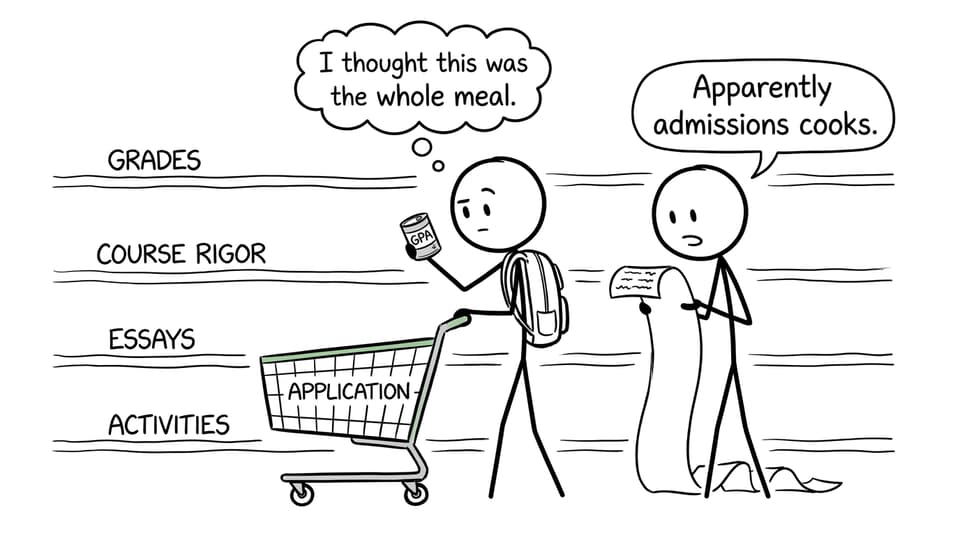
For most US applications, the safest principle is simple: report the academic record exactly as requested.
Colleges may consider:
- School-issued course grades and GPA
- IB subjects and whether they are HL or SL
- The rigor available within the student’s school
- Predicted results when requested and available
- Final IB exam results
- Essays, recommendations, activities, and school context
A student should not invent a GPA because an application happens to use American terminology. If the school does not calculate GPA, the student should use the application’s appropriate option or ask the admissions office for instructions. RevisionDojo’s guide to using the IB in US college applications explains the reporting process in more detail.
It is also important to separate admission from university credit. A college might review an applicant’s transcript one way, then use individual IB exam results under a separate policy to award credit or placement. These policies vary substantially by institution and subject, so families should check each university’s current official requirements rather than relying on a general conversion chart.
The same caution applies to international admissions. Many universities state IB requirements directly as total points and HL subject grades rather than asking for a GPA. RevisionDojo’s overview of minimum IB scores for universities can help families understand the terminology before verifying requirements on each university’s official website.
What to do when an application requests a conversion
If a form explicitly asks for a converted GPA, follow this order:
Check the school transcript
Use the GPA already printed on the official transcript. Do not replace it with an online estimate because another number appears more favorable.
Ask the school counselor or IB coordinator
The school may have a published conversion profile explaining course weighting, grade scales, and how IB rigor is represented. This context is often sent to colleges alongside the transcript.
Read the university’s instructions
Look for definitions of weighted GPA, unweighted GPA, included academic years, and eligible subjects. If the guidance remains unclear, contact admissions rather than guessing.
Keep predicted and achieved results separate
Predicted grades are forecasts, not final outcomes. They should be identified as predictions wherever requested. Students can use RevisionDojo’s IB Grade Calculator to organize practice data and estimate a Diploma total, but the output remains a planning tool rather than an official transcript.
Record the method
If self-conversion is genuinely required, save the university’s table, the grades used, the calculation, and the date. That creates a transparent record if questions arise later.
Focus on the result the student can still change
Conversion tables create an illusion of control. They turn uncertainty into a decimal. Yet the decimal is often less useful than the work happening before the next assessment.
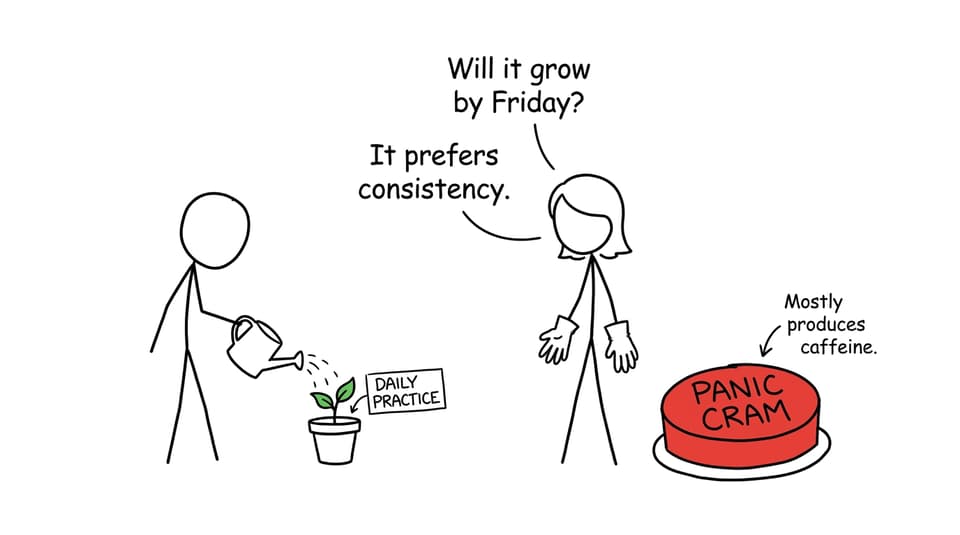
A higher subject grade can strengthen an IB total, a school transcript, and the academic story an admissions reader sees. Improvement usually comes from a repeatable loop: identify a weakness, practise it, obtain feedback, correct the mistake, and test it again.
RevisionDojo brings that loop together through its Questionbank, Study Notes, Flashcards, AI Chat, Grading tools, Predicted Papers, Mock Exams, Coursework Library, and Tutors. A student can review one weak concept, answer targeted questions, turn errors into flashcards, and then check progress under timed conditions. The step-by-step IB exam study guide offers a practical structure for doing this consistently.
For families who want to see the improvement principle in context, RevisionDojo’s student grade-improvement case studies describe students using targeted questions, feedback, and study notes to raise subject performance. Individual outcomes are never guaranteed, but the mechanism is sensible: consistent, focused revision gives students more opportunities to find and fix weaknesses before results become final.
The reassuring conclusion
An IB grade does not need a perfect American translation to be understood. Universities familiar with international applicants know that the Diploma Programme uses its own scale and demands. The most accurate approach is to preserve that context, follow each application’s instructions, and avoid presenting an unofficial estimate as fact.
For parents, the next step is not to search for a more confident-looking conversion table. It is to confirm the school’s GPA policy, review each target university’s requirements, and help the student build a calm revision routine.
The conversion may remain approximate. The preparation does not have to be. With RevisionDojo as the ultimate IB resource, students can turn concern about future results into a clear practice-and-feedback plan today.