



If you have ever stared at your IB grades and wondered how they become a U.S.-style GPA, you are not alone. One day you are living in a 1-7 world. The next, a college portal wants a number out of 4.0, and suddenly it feels like you are translating two languages that share the same alphabet but not the same meaning.
The honest truth: there is no single official IB-to-GPA conversion that every school uses. But there are patterns you can understand, ranges you can estimate, and a clean way to compute a reasonable unweighted (UW) and weighted (W) GPA for planning and applications.
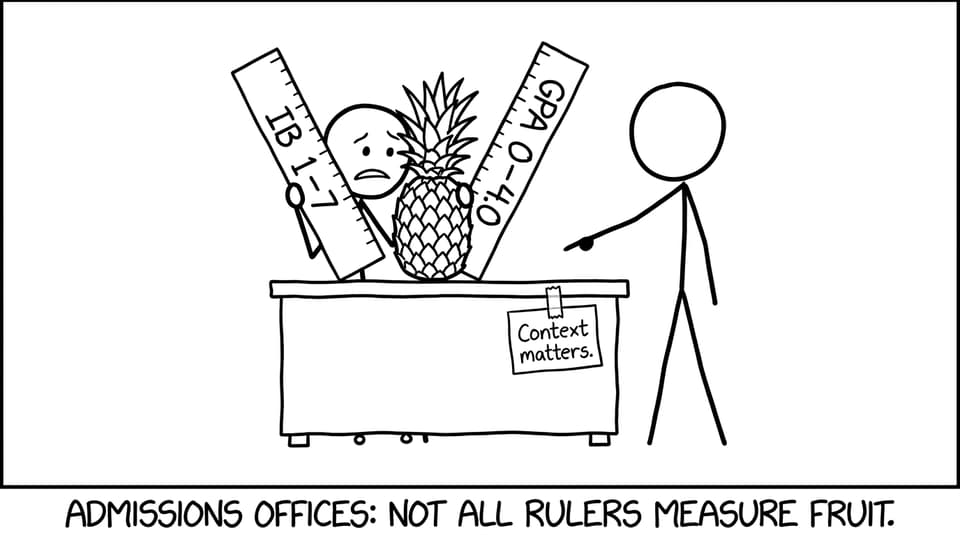
The IB-to-GPA reality (what most students miss)
The IB was built to measure achievement through criterion-referenced grading, coursework, and externally marked exams. U.S. GPA systems were built to summarize performance across classes in a school-specific context. So when you ask, “What is my GPA?”, you are really asking:
-
What does my high school report on the transcript?
-
What does a specific college recalculate internally?
-
And how does the IB course rigor (especially HL) get recognized?
Many colleges treat IB results as evidence of rigor rather than something that needs perfect conversion. Still, having a conversion estimate helps you set expectations, compare scholarship cutoffs, and sanity-check your academic profile.
For deeper context on typical conversions and why they vary, see IB Grade to GPA & Letter Grade Conversion.
Quick checklist: translate IB grades into UW/W GPA
Use this as your simple workflow:
-
Gather your six IB subject grades (predicted or final) and label each as SL or HL.
-
Choose a reasonable mapping from IB 1-7 to U.S. GPA points (see ranges below).
-
Compute UW GPA by averaging the GPA points for all subjects.
-
Compute W GPA by adding weight to HL subjects only if your school (or target college) does this.
-
Write down your assumptions so your numbers are transparent.
If you want to sanity-check your overall diploma points alongside subject performance, RevisionDojo’s IB Grade Calculator is a helpful planning tool.
A practical IB grade conversion table (UW GPA estimate)
Counselors and admissions readers commonly think in broad bands. A frequently used approximation looks like this:
-
IB 7 → 4.0 (strong A)
-
IB 6 → 3.7-4.0 (A/A- range)
-
IB 5 → 3.0-3.3 (B/B+ range)
-
IB 4 → 2.0-2.7 (C+/B- range depending on the school)
-
IB 3 → ~2.0 (C/C- range)
-
IB 2 → ~1.0 (D range)
-
IB 1 → 0.0 (F)
Notice the important nuance: IB 6 is sometimes treated as a 4.0 and sometimes as a 3.7. That single decision can swing your estimate, which is why it helps to treat the result as a range, not a verdict.
If you want a second perspective using total diploma points, see If My IB Points Are 32, What Is Likely to Be My GPA? and Is an IB Score of 36 Better or Worse Than a 3.8 GPA?.
How to calculate your unweighted GPA from IB grades
Unweighted means: you are translating your IB grades without giving “extra credit” for HL.
Step-by-step UW method
-
List each IB subject and its grade (1-7).
-
Convert each grade into a GPA point using one mapping (be consistent).
-
Add your GPA points.
-
Divide by the number of subjects.
Example (UW)
Suppose your IB grades are:
-
HL English: 6
-
HL History: 5
-
HL Biology: 6
-
SL Math: 5
-
SL Language B: 6
-
SL Visual Arts: 4
Using a simple mapping (6→4.0, 5→3.0, 4→2.0), your UW points become:
- 4.0 + 3.0 + 4.0 + 3.0 + 4.0 + 2.0 = 20.0
UW GPA = 20.0 / 6 = 3.33
How to calculate your weighted GPA from IB grades (HL bonus)
Weighted GPA depends heavily on policy. Some schools add +1.0 to HL. Some weight all IB courses. Some cap the boost. Some colleges ignore the reported weighted GPA and recalculate.
A common high school approach is:
-
Keep SL courses the same
-
Add +1.0 to HL courses
That makes a strong HL grade look like it is on a 5.0 scale.
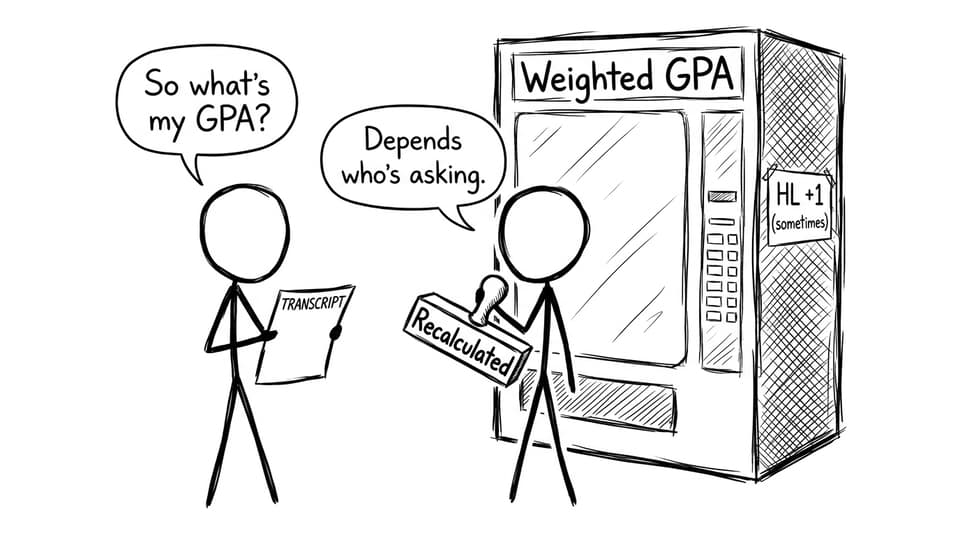
Example (W)
Using the same subject list and the same base mapping:
-
HL 6 becomes 5.0
-
HL 5 becomes 4.0
-
HL 6 becomes 5.0
-
SL 5 stays 3.0
-
SL 6 stays 4.0
-
SL 4 stays 2.0
Weighted total = 5.0 + 4.0 + 5.0 + 3.0 + 4.0 + 2.0 = 23.0
W GPA = 23.0 / 6 = 3.83
What colleges care about more than the IB-to-GPA math
A conversion is a convenience. Admissions reading is a narrative.
What often matters more than whether your IB 6 equals 3.7 or 4.0 is:
-
Course rigor (HL choices, and whether they match intended major)
-
Pattern of grades (are you strongest in core academic areas?)
-
Context (school profile, grading culture, and what is “normal” at your campus)
-
Evidence you can handle real assessment pressure
This is where your preparation becomes part of your story. If you train with realistic exam conditions, you do not just earn higher IB grades, you earn consistency.
RevisionDojo is built around that consistency loop: practice, feedback, refinement. Students use the Questionbank to drill weaknesses, then lean on Predicted Papers to rehearse full-paper stamina, and Mock Exams to turn revision into performance. When written work is the bottleneck, AI Chat, Grading tools, and the Coursework Library help you stop guessing what “good” looks like.
If you want a practical breakdown of how to use predicted exams wisely, read IB Predicted vs Specimen Papers: What They Mean.
Final takeaway: use the conversion, but don’t become it
Treat your IB to GPA translation like a map: useful, not sacred. Calculate a clean UW estimate, a clearly labeled W estimate, and then put your real effort where it actually pays off: raising the underlying IB grades through deliberate practice.
If you want that practice to feel less like chaos and more like a system, build your loop inside RevisionDojo: Study Notes to clarify concepts fast, Flashcards to keep recall alive, Questionbank to sharpen exam skill, AI Chat to get unstuck, Grading tools to learn what earns marks, and Predicted Papers and Mock Exams to rehearse under time. Your GPA story gets simpler when your IB results get stronger.