



The biggest adjustment shock in IB Film is not the equipment or vocabulary. It is discovering that liking films and understanding how they create meaning are different skills.
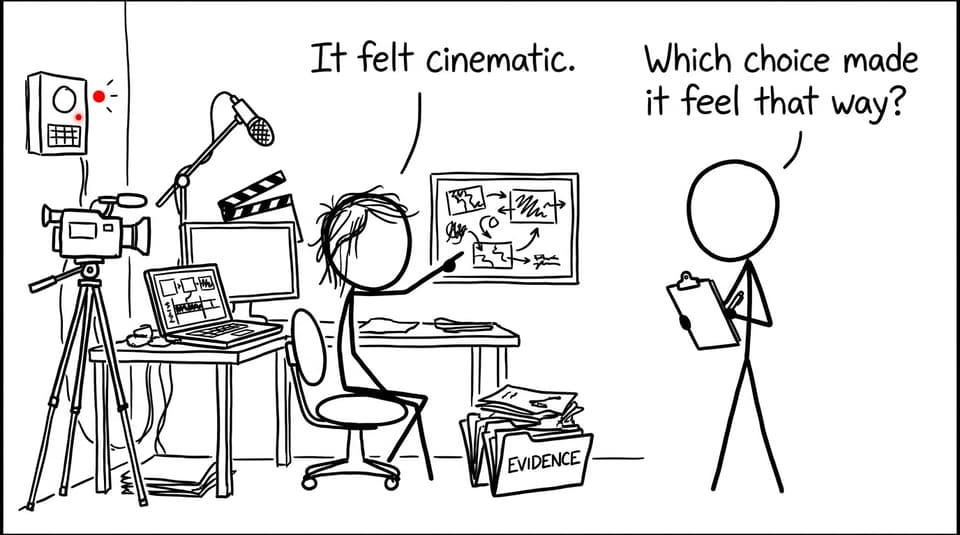
Most IB Film first term struggles begin with this shift. You may sense that a scene feels tense, intimate, or unsettling, yet struggle to explain which choices produced that response. The course asks you to identify the framing, lighting, editing, sound, performance, or production decision, then explain its effect and significance.
The same habit applies when you make films. A shot cannot merely look cinematic. It needs an intention. A failed experiment is not wasted if you can evaluate it honestly. Adjusting to IB Film becomes easier once you understand that the subject rewards visible thinking, not effortless creativity.
The first-term reset in five steps
If the course feels unexpectedly demanding, focus on five habits:
- Replace broad reactions with precise observations.
- Use the pattern choice, effect, meaning, context.
- Treat filmmaking exercises as experiments, not masterpieces.
- Record decisions and changes while they are fresh.
- Ask for feedback on your reasoning, not only the finished product.
These habits connect analysis and production. They also prevent the first term from becoming a collection of interesting experiences that you cannot later explain.
Why film appreciation is no longer enough
Before IB Film, many students discuss cinema through plot, character, and personal response. Those instincts are useful, but they often stop one step too early.
Consider the statement, “The scene is uncomfortable because the character is isolated.” It identifies an effect but not how the film constructs it. A stronger explanation might notice that the character remains at the edge of a wide frame, surrounded by empty space, while distant ambient sound makes the location feel indifferent. Now the interpretation has evidence.
A useful sequence is:
Technique: What specific choice can you see or hear?
Effect: How does it shape attention, emotion, pace, or perspective?
Meaning: What does it suggest about character, theme, or conflict?
Context: How might culture, history, industry, or artistic tradition deepen that meaning?
This method is central to connecting textual analysis with cultural context. It changes how you watch films because you begin noticing how meaning is built rather than waiting for it to announce itself.
The real source of IB Film first term struggles
The difficulty is not simply learning terms such as mise-en-scène, diegetic sound, montage, or shallow focus. Vocabulary can be memorized. Judgment takes longer.
New students often fall into one of two traps. The first is technique spotting: “There is a close-up, low-key lighting, and non-diegetic music.” The second is unsupported interpretation: “The director wants us to feel trapped.” One has evidence without an argument; the other has an argument without sufficient evidence.
Strong Film work joins the two. You might explain that a tight close-up restricts spatial information, placing the audience inside a character’s uncertainty. You can then connect that effect to the scene’s treatment of control, identity, or fear.
The IB Film syllabus guide helps show how reading film, contextualizing film, and exploring production roles support one another. Analysis teaches you to notice choices. Production reveals how difficult those choices are to execute. Reflection turns both experiences into learning.
Your early filmmaking does not need to look professional
Students sometimes assume the most polished film must be the most successful. That belief creates unnecessary pressure, especially when classmates arrive with editing experience or expensive-looking equipment.
During the first term, a controlled experiment is more valuable than an ambitious project you cannot evaluate. Test how three framing choices alter a conversation. Record the same action with different sound treatments. Edit identical footage at two rhythms and compare the results.
Before each exercise, write one sentence:
My intention is to make the audience feel or understand ___ by using ___.
Afterward, ask what worked, what contradicted the intention, and what you would change. This is the beginning of authentic reflection. The guide to linking exploring, creating, and producing provides a practical framework. For composition, lighting, and blocking, use RevisionDojo’s guide to mise-en-scène in analysis and production.
Document the process before memory edits it
Weeks after a shoot, an improvised solution can start to feel like the original plan. A technical failure becomes difficult to reconstruct, and the reasoning behind an edit may disappear entirely.
Keep a simple decision log. After each production session, record:
- the intention you started with
- one important creative or technical choice
- useful evidence, such as a storyboard, test frame, revision, or timeline screenshot
- one problem and your response
- the next experiment you would run
This should take minutes, not hours. Its purpose is to preserve evidence of development. The guide to common IB Film portfolio mistakes explains why evaluating decisions is stronger than merely describing activity. “We filmed the scene” reports an event. “I replaced handheld movement with a locked frame because the original footage distracted from the performance” reveals judgment.
A sustainable weekly routine
The best first-term system is small enough to repeat.
Watch with one analytical lens
Choose one short scene and focus on a single element, such as editing or sound. Write three precise observations, then connect each to audience effect and meaning. Do not attempt to analyze everything at once.
Make one controlled experiment
Test a narrow production question, such as whether off-screen sound creates more tension than visible action. Save the plan, result, and brief evaluation.
Apply language and seek feedback
Use RevisionDojo Study Notes to clarify concepts and Flashcards to retrieve terminology. Apply that language through the Questionbank instead of only rereading definitions. The IB Film topic collection provides focused guidance.
Use AI Chat to challenge an interpretation and Grading tools to check whether your explanation is specific. The Coursework Library and IB Film coursework examples and insights can reveal how successful work makes reasoning visible without giving you a voice to copy. Tutors provide a human checkpoint when you cannot diagnose a recurring weakness.
The adjustment is a change in attention
The first term can make capable students feel strangely inarticulate. Their old language no longer seems sufficient. That discomfort does not mean they chose the wrong subject. It often means their attention is becoming more precise.
You do not need to become a finished critic or filmmaker by winter. Observe accurately, make small choices intentionally, and preserve evidence of what changed. RevisionDojo brings that learning loop together through its Questionbank, Study Notes, Flashcards, AI Chat, Grading tools, Coursework Library, and Tutors. These resources shorten the distance between confusion, practice, feedback, and a better second attempt. In IB Film, that distance is where much of the growth happens.