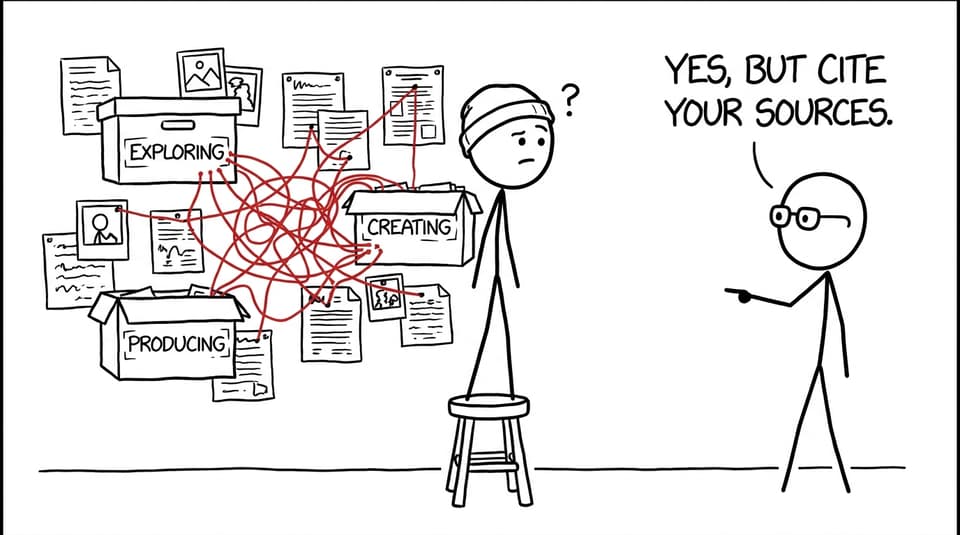
If you have ever stared at your IB Film portfolio and thought, “These parts are good… but they do not feel like the same story,” you are not alone. Most students can do Exploring, do Creating, and do Producing. The marks often come from something quieter: showing the examiner that each decision had a parent, and that parent was your research.
In IB Film, you are not collecting three separate folders. You are building one chain of cause and effect.
Quick linking checklist for IB Film
Use this as your 5-minute pre-submission scan for IB Film:
-
Exploring: 2-3 focused research angles (movement, context, technique).
-
Creating: visible experiments (script drafts, storyboard tests, style trials).
-
Producing: evidence your plan survived reality (and how it changed).
-
Reflection: clear sentences that connect “I studied X” to “I did Y” to “I learned Z.”
-
Cultural awareness: explain why context matters, not just that it exists.
For deeper coursework models, see IB Film Exemplars.
Start with Exploring that is usable (not just interesting)
The strongest IB Film Exploring work is research you can spend later. A useful test: can you turn what you read into a concrete production choice?
Try writing your Exploring notes in a two-column format:
-
What I noticed (technique + meaning)
-
What I can try (a shot, an edit pattern, a sound idea)
Examples that naturally create links:
-
Montage theory: you test pacing by cutting the same scene in three rhythms.
-
Italian Neorealism: you write a scene designed for real locations and non-actors.
-
Cinéma vérité: you plan handheld framing rules and sound priorities.
If you need a clean way to move from research to application, read How to Connect Theory and Practice in IB Film.
Use Creating as the bridge (make your thinking visible)
Creating is where IB Film portfolios quietly win marks, because it proves intention. The goal is not perfection. It is traceability.
What to include so the links are obvious:
-
A script draft with margin notes like “inspired by New Wave jump cuts” or “blocking designed for long takes.”
-
A storyboard version 1 and version 2, with one paragraph explaining what changed and why.
-
One mini-experiment: a lighting test, sound test, or framing test, even if it fails.
RevisionDojo’s How to Plan and Execute a Storyboard for IB Film is ideal when your Creating stage feels vague.
Let Producing show application (and smart adaptation)
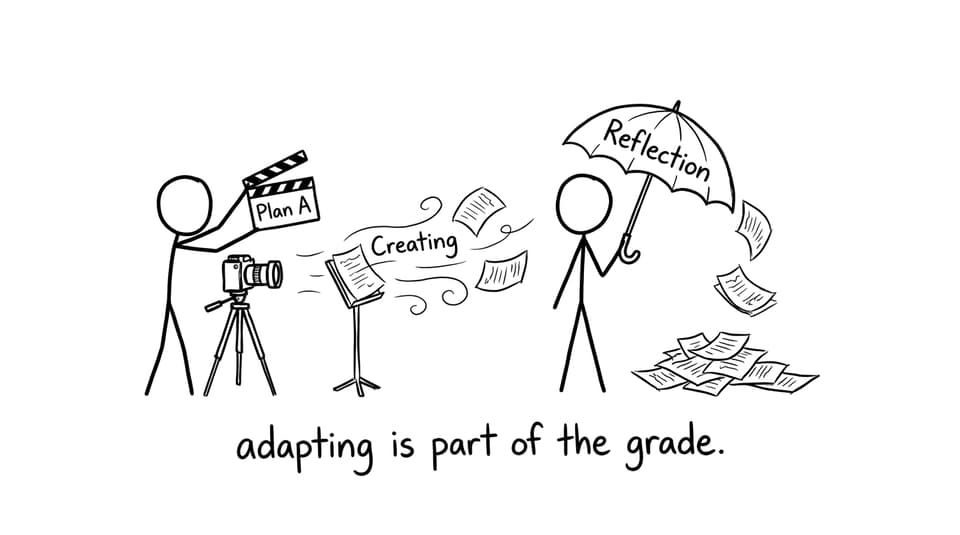
Producing is not just “here is the final film.” In IB Film, it is “here is what the real world did to my plan, and here is how I responded like a filmmaker.”
Show the examiner three things:
-
Carry-through: where the Exploring idea appears on screen (shot choice, edit rhythm, sound design).
-
Constraints: what got in the way (location, time, performance, equipment).
-
Decision: what you changed, and how it still matches your intention.
For practical technique boosts, use Tips for Recording and Editing Your IB Film Project and How to Manage a Film Set for IB Coursework.
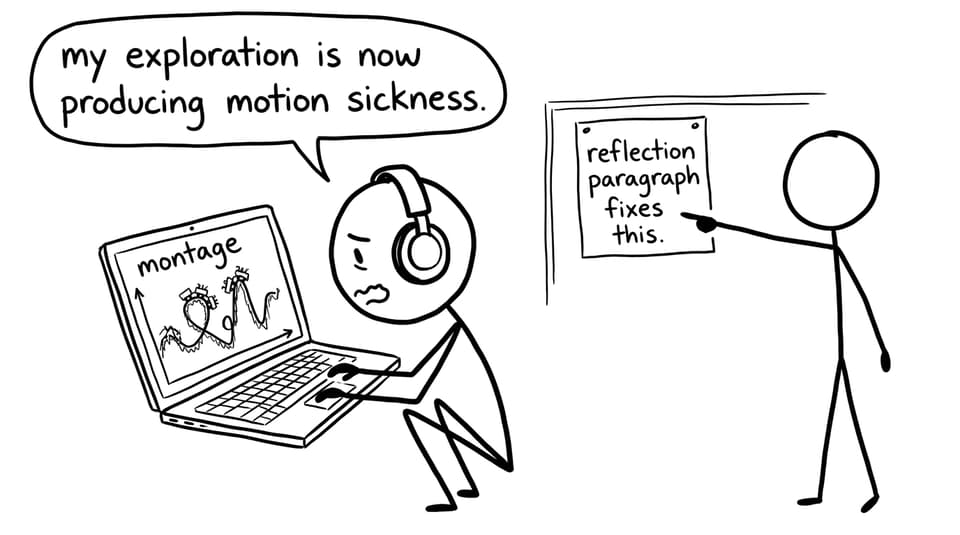
Reflection is the glue: write in “because” sentences
Most portfolios lose cohesion because reflection becomes a diary. In IB Film, reflection should read like a director explaining choices.
Use this sentence pattern:
- “Because I explored [film tradition/technique], I created [planning experiment], which led me to produce [final decision].”
Two strong examples:
-
“Because I explored metaphor in Iranian cinema, I created a script draft built around symbolic props, which led me to produce a final mise-en-scène that communicates theme without dialogue.”
-
“Because I explored vérité sound priorities, I created a sound test and shot list that favors proximity, which led me to produce cleaner dialogue and intentional room tone in post.”
Want a broader portfolio standard to aim for? See How to Achieve a Level 7 in IB Film.
Cultural awareness: make it specific, not decorative
In IB Film, “global” is not a buzzword. It is evidence that you understand how cinema emerges from history, economics, politics, and audience expectations.
A simple way to show this:
-
Name the context (place, era, movement).
-
Name the constraint or value it created (censorship, realism, studio systems, performance style).
-
Name the technique you borrowed and why it fits your story.
If you are still choosing what to study, How to Choose Films for IB Film Comparative Analysis helps you pick contrasting contexts that give you more to say.
Conclusion: make IB Film feel like one continuous story
A high-scoring IB Film portfolio feels inevitable: Exploring leads to Creating, Creating shapes Producing, and reflection ties the whole process into one clear argument about your choices. If you build those links on purpose, your work becomes easier to evaluate, harder to dismiss, and more satisfying to present.
When you want everything in one place, RevisionDojo supports the full loop: drill technique with the Questionbank, tighten knowledge with Study Notes and Flashcards, get unstuck with AI Chat, check quality with Grading tools, rehearse under pressure with Predicted Papers and Mock Exams, pull inspiration from the Coursework Library, and get targeted help from Tutors. Build the chain now, and your IB Film work will read like a filmmaker thinking on the page.

