

The biggest of the IB Design Technology first term struggles is rarely sketching, CAD, or learning material properties. It is accepting that a promising idea is not enough. Students must show how evidence from users, research, modelling, and testing shaped each important decision.
You may have joined the course because you enjoy inventing and making things, only to find your teacher repeatedly asking, “Why?” That question does not restrict creativity. It turns creative work into defensible design.
This matters across design in theory, design in practice, and design in context. It is especially important in the 50-hour design project, where the journey from understanding a user to presenting a solution must remain visible.
The first-term adjustment checklist
If you are adjusting to IB Design Technology this fall, focus on five habits:
- Identify a specific user before imagining a solution.
- Record observations and research as usable evidence.
- Turn broad wishes into measurable requirements.
- Make several rough models before polishing one concept.
- Document each test, change, and trade-off as it happens.
The IB Design Technology resources hub provides a useful map of the current course. Keep it nearby while building these habits.
Why good ideas suddenly feel insufficient
Imagine a hypothetical student designing a desk organizer. Their first concept looks elegant and includes a wireless charger. An IB teacher may ask whether the intended user needs wireless charging, whether the organizer fits the available space, and what observation revealed the storage problem.
The student hears criticism of the idea. The teacher is actually asking for its chain of reasoning.
This is the central shock: the object is only one part of the assessed work. Your understanding of the user, selection of evidence, comparison of alternatives, testing method, and evaluation also matter. Creativity remains valuable, but it must leave a trail.
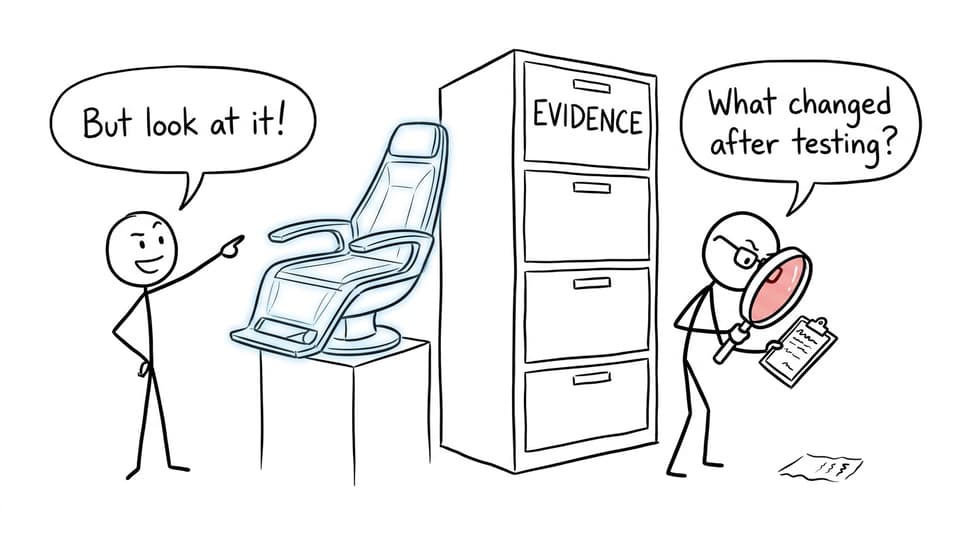
The guide to how the IB design cycle shapes the subject is worth reading early. The cycle is not a decorative diagram. It connects your decisions.
The habit that fixes most early problems
Start an evidence and decisions log during your first week. It can be a document, spreadsheet, or notebook page. After every research activity, model, critique, or test, record four things:
| Prompt | What to record |
|---|---|
| Evidence | What did you observe, measure, or learn? |
| Meaning | What does that evidence reveal about the user or product? |
| Decision | What will you change, retain, or investigate? |
| Trade-off | What disadvantage or constraint accompanies that choice? |
Suppose a user takes 18 seconds to reach an item stored at the back of a container. That result might justify changing the opening, reducing depth, or creating compartments. You can then retest the revised model and compare the outcome.
The important movement is evidence to interpretation to decision. Once this rhythm becomes automatic, documentation stops feeling like a report written after the interesting work. It becomes part of the work.
RevisionDojo’s design process study notes clarify the roles of research, problem definition, specification, ideation, modelling, and testing.
Research should reduce uncertainty
New students often confuse the quantity of research with its usefulness. Ten pages about materials add little if the design has not reached material selection. A short observation of the intended user may be more valuable.
Before collecting information, finish this sentence: I need to learn this because it will help me decide...
If you cannot complete it, the research question is probably too broad. Useful research might help you determine:
- where and when the problem occurs
- which task causes frustration or error
- the user’s physical, emotional, or accessibility needs
- relevant dimensions and ergonomic limits
- weaknesses in an existing product
- how success could later be tested
The current design project begins with understanding users and examining an existing product that could be redesigned. Focused observation now therefore prepares you for later coursework. The step-by-step Design Technology project guide explains how research can become testable requirements rather than background decoration.
Replace polished answers with rough experiments
Another common mistake is falling in love with the first feasible idea. Students spend hours improving its appearance because polished work feels like progress. Yet polish can make an untested assumption harder to abandon.
Use low-fidelity models to answer one question at a time. Cardboard might test scale. Foam could test grip. A paper interface could reveal whether controls make sense. A crude joint could show whether an assembly method is practical.
The model does not need to impress anyone. It needs to teach you something.
Try this repeatable loop:
- State the uncertainty.
- Choose the quickest meaningful model or test.
- Define what you will observe or measure.
- Run the test with the appropriate user where possible.
- Record the result immediately.
- Make one justified change.
Use the syllabus-aligned IB Design Technology Study Notes to strengthen decisions about ergonomics, prototyping, materials, sustainability, and product evaluation.
Build a manageable first-term routine
Adjustment does not require large amounts of work every night. It requires a small feedback loop before misunderstandings accumulate.
After each lesson
Write down one important term, one example, and one question. If something remains unclear, use RevisionDojo’s AI Chat to ask a narrow question.
Once each week
Review effective Design Technology revision notes. Convert definitions and processes into Flashcards, then use the Questionbank to practise applying them. Every definition should eventually connect to a product, user, or decision.
After every practical activity
Save photographs, measurements, rejected alternatives, and feedback while their meaning remains clear. Add one sentence explaining what changed next. This prevents the end-of-term problem of having many images but no reliable account of the reasoning behind them.
At the end of each month
Ask whether another person can trace your decisions from evidence to outcome. RevisionDojo’s Grading tools and Design Technology coursework exemplars can reveal the difference between attractive presentation and assessable evidence. Tutors can help when the problem is conceptual rather than technical.
What progress should look like by the end of term
You do not need a perfect portfolio or sophisticated prototype. A successful first term means you can define a narrow problem, gather purposeful evidence, generate alternatives, test an uncertainty, and explain why the design changed.
This can seem slower than immediately building your favourite idea. In reality, it prevents expensive mistakes. A student who documents small decisions early enters the major design project with a system instead of trying to reconstruct weeks of reasoning.
RevisionDojo supports that journey. Use Study Notes and Flashcards to establish vocabulary, the Questionbank and Mock Exams to practise application, AI Chat when a concept blocks progress, and Grading tools to improve written reasoning. As coursework becomes more demanding, the Coursework Library, Predicted Papers, and Tutors provide deeper support.
The first-term shock fades when you stop treating evidence as paperwork. It is simply the record of becoming a better designer.