Join 650k+ students breezing through the IBReady to breeze through the IB?
Comparing Jewish denominations can look simple from a distance. Orthodox Judaism preserves traditional Jewish law, Reform Judaism gives greater authority to informed individual choice, and Conservative Judaism seeks continuity through historically responsive interpretation.
The deeper orthodox vs reform judaism question concerns authority. What is the relationship between divine revelation, the Torah, rabbinic interpretation and changing human circumstances? Orthodox, Conservative and Reform Jews share foundational texts and concepts, but often answer that question differently.
For IB World Religions SL, a strong comparison connects visible practices to key concepts, primary texts, the three fundamental questions and the five required themes. It also recognizes diversity within every movement.
Comparison checklist for IB students
A focused answer should cover:
Authority: How does each movement understand Torah and halakhah?
Practice: How do those views shape Shabbat, diet, prayer and gender roles?
Shared foundations: Which beliefs and texts unite the movements?
Internal diversity: Why does a denominational label not describe every individual?
IB framework: How do the differences connect to the five required themes?
Shared foundations before denominational differences
Judaism is not simply a collection of competing branches. Orthodox, Conservative and Reform communities share a historical and textual inheritance centred on the one God, the Jewish people, Torah, covenant and communal memory.
The Shema, beginning in Deuteronomy 6:4, declares: “Hear, O Israel: the Lord is our God, the Lord is one.” This commitment to monotheism is tied to b’rit (בְּרִית), meaning covenant. Biblical narratives associate covenant with Abraham and Moses, while Exodus presents Israel’s liberation and encounter with God at Sinai as decisive events.
min read
min read
min read
min read
Torah (תּוֹרָה) can refer specifically to the Five Books of Moses or more broadly to Jewish teaching. Mitzvot (מִצְווֹת) are commandments, while halakhah (הֲלָכָה), literally connected with “walking” or “the way,” is the developing body of Jewish law and practice. The RevisionDojo notes on Torah, mitzvot and halakhah provide a useful foundation for this distinction.
Other primary sources include the Tanakh (תַּנַ״ךְ), the Hebrew Bible; the Mishnah, an early written compilation of rabbinic oral traditions; and the Talmud, which records layers of legal discussion, narrative and interpretation. These texts do not function identically in every movement, but all three branches engage with the Jewish textual tradition.
Orthodox, Conservative and Reform Judaism compared
Area
Orthodox Judaism
Conservative Judaism
Reform Judaism
Torah and revelation
Generally affirms the divine authority of the Written and Oral Torah
Affirms Torah as sacred while using historical scholarship and an evolving interpretive process
Understands Torah as sacred and foundational while emphasizing its historical development and continuing interpretation
Halakhah
Binding and interpreted through established rabbinic legal processes
Binding and capable of development through recognized legal interpretation
A source of guidance and obligation approached through informed choice rather than a uniformly binding legal system
Worship
Usually retains extensive Hebrew liturgy and traditional structures
Often combines substantial Hebrew liturgy with historical adaptation
Often combines Hebrew and the local language, with forms varying by congregation
Gender roles
Traditional synagogues distinguish some ritual roles by gender; approaches vary within Orthodoxy
Most communities are egalitarian, though practice can vary
Egalitarian participation is standard in most communities
Daily observance
Commonly emphasizes detailed observance of Shabbat, kashrut and prayer
Encourages observance interpreted through Conservative legal decisions
Practices vary according to informed commitment, community and personal conviction
Orthodox Judaism
Orthodox Judaism generally understands the Written and Oral Torah as divinely authoritative. Halakhah is binding, although applying it requires interpretation. Its central claim is that legitimate change must remain accountable to inherited legal sources and recognized halakhic reasoning.
Orthodoxy contains multiple communities. Modern Orthodox Jews typically combine halakhic observance with wider education and society. Haredi communities often maintain stronger boundaries around modern cultural influences. Hasidic Judaism, which emerged in eighteenth-century Eastern Europe, includes distinctive spiritual traditions and communities organized around revered rabbinic leaders.
Practices may include keeping kashrut (כַּשְׁרוּת), observing Shabbat restrictions and praying through traditional Hebrew liturgy. These practices express kedushah (קְדֻשָּׁה), holiness, by bringing ordinary time, food and conduct into a covenantal framework. RevisionDojo’s notes on kedushah, teshuvah and the Shekhinah explain how holiness and divine presence shape Jewish life.
Conservative Judaism
Conservative Judaism, often called Masorti Judaism outside North America, developed to preserve Jewish tradition while responding to historical knowledge and modern conditions. It regards halakhah as authoritative but understands the legal tradition as having developed throughout Jewish history.
This position is not simply halfway between Orthodox and Reform Judaism. Conservative scholars reason from biblical and rabbinic sources but may reach different conclusions from Orthodox authorities. Many communities have adopted egalitarian worship and full ritual participation for women, while recognized practices can vary.
The important analytical point is method. Conservative Judaism seeks change through a communal halakhic process rather than treating every inherited rule as fixed or leaving each decision entirely to the individual.
Reform Judaism
Reform Judaism emerged in nineteenth-century Europe and developed differently across countries. It emphasizes Judaism’s ethical and prophetic dimensions, critical engagement with tradition, and the responsibility of individuals and communities to make informed religious choices.
Reform Judaism does not mean abandoning Torah or mitzvot. Contemporary Reform thought encourages study of the full tradition without regarding every classical halakhic requirement as universally binding in its inherited form. A Reform Jew may observe Shabbat or dietary practices because they create holiness, identity and ethical discipline.
Reform congregations are generally egalitarian. Worship may include the local language and musical accompaniment, although Hebrew and traditional forms remain important in many communities. Practice differs between regions and individuals, so an IB answer should not equate Reform Judaism with low observance.
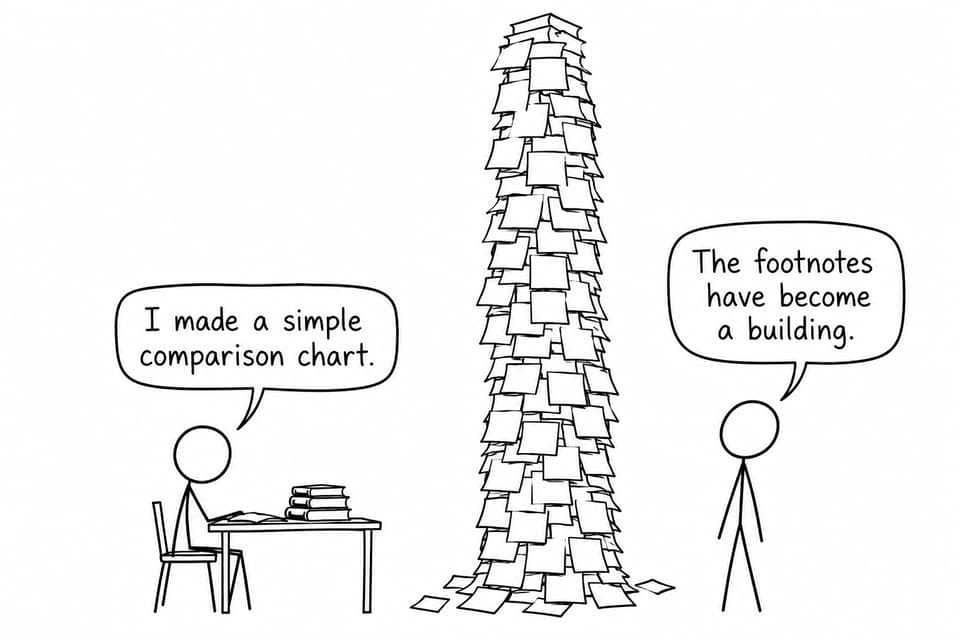
A student explains that a simple comparison chart has grown into a building-sized tower of footnotes
The three fundamental questions
IB World Religions organizes comparison around three questions. Denominational differences become clearer when placed inside this structure.
What is the human condition?
Judaism presents humans as created b’tzelem Elohim (בְּצֶלֶם אֱלֹהִים), in the image of God, based on Genesis 1:27. Humans possess dignity and moral responsibility but can misuse freedom. Rabbinic tradition describes yetzer ha-tov and yetzer ha-ra, often understood as inclinations toward good and toward wrongdoing or self-directed desire.
All three movements take moral responsibility seriously. They differ more sharply over how divine expectations are known and how inherited commandments govern contemporary decisions.
Where are we going?
Jewish thought often focuses more on faithful life before God than on constructing one detailed account of the afterlife. Olam Ha-Ba (עוֹלָם הַבָּא), resurrection and a messianic future appear in Jewish sources, but interpretations vary.
Some Orthodox perspectives maintain traditional expectations of a personal Messiah and resurrection. Conservative Judaism preserves traditional eschatological ideas while allowing interpretive diversity. Reform Judaism has often emphasized a messianic age of justice and peace rather than a personal Messiah. These are broad tendencies, not universal descriptions.
How do we get there?
Orthodox Judaism emphasizes covenantal faithfulness through binding halakhah. Conservative Judaism also treats halakhah as authoritative but permits development through historical and legal interpretation. Reform Judaism stresses Torah study, ethical action and informed engagement with mitzvot.
Across the movements, teshuvah (תְּשׁוּבָה), meaning return or repentance, offers a path of moral restoration. Justice, charity and compassionate action are expressed through tzedakah (צְדָקָה) and tikkun olam (תִּקּוּן עוֹלָם), repairing the world.
Connecting the comparison to the five themes
The five themes give an IB answer analytical structure:
Rituals: Compare Shabbat, dietary practice, prayer and lifecycle ceremonies. Explain how practice follows beliefs about halakhic authority.
Sacred texts: Discuss the Torah, Tanakh, Mishnah and Talmud, including contrasting approaches to revelation and interpretation.
Doctrines and beliefs: Explore monotheism, covenant, creation, human responsibility and the messianic future.
Religious experience: Consider prayer, festivals, Torah study and experiences of the Shekhinah (שְׁכִינָה), God’s indwelling presence.
Ethics and moral conduct: Connect mitzvot to justice, repentance, charity and Leviticus 19:18 on love of one’s neighbour.
A weak response says Orthodox Jews are traditional, Conservative Jews are moderate and Reform Jews are modern. Those labels are vague and potentially misleading.
A stronger paragraph follows a belief-practice-analysis sequence. Identify a view of Torah or halakhah, show how it may influence Shabbat worship, and explain what this reveals about covenant, holiness or moral responsibility. Add a primary-text reference when it supports the argument.
The real contrast is not tradition against change. Every Jewish movement inherits a tradition, and every living community must interpret it. The sharper question is where interpretive authority rests and what makes an interpretation legitimate.
That question turns a memorized table into religious analysis. RevisionDojo helps you make that transition through syllabus-aligned Study Notes, Flashcards, the Questionbank and AI Chat. Grading tools reveal gaps in written comparisons, while Predicted Papers and Mock Exams support timed practice. The Coursework Library and Tutors can help you refine terminology, source use and argument while keeping the work your own.