
Death creates a strange problem for every religious community. Something deeply personal has happened, yet the community must respond through public words, gestures, objects, and spaces.
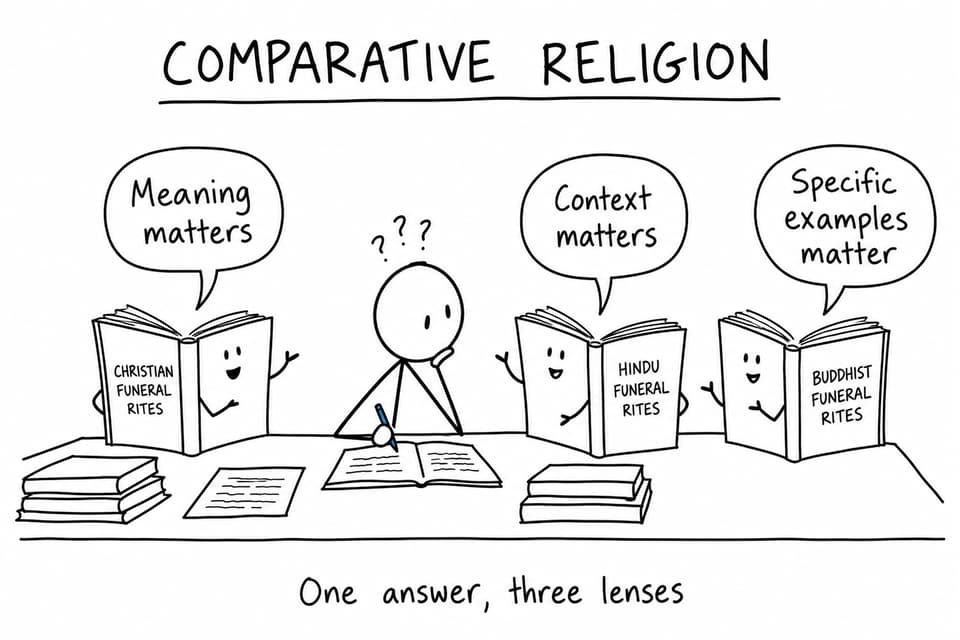
For IB World Religions SL students, the essential point is this: funeral rites express beliefs about the person, the body, the afterlife, and the responsibilities of the living. A strong comparison does not merely list whether a community buries or cremates. It explains why a practice makes sense within a specific tradition.
That distinction matters in both papers. Paper 1 rewards accurate identification and explanation. Paper 2 requires you to turn knowledge into an argument. In either case, phrases such as “all Christians believe” or “Buddhists always cremate” suggest that greater precision is needed.
RevisionDojo’s guide to common IB World Religions misconceptions reinforces this point: religions are internally diverse, historically shaped, and lived differently across communities. Funeral practices make that diversity especially visible.
A quick comparison checklist
Before answering a funeral rites world religions question, ask:
- What happens to the body?
- Who performs the rites?
- Which beliefs give the actions meaning?
- How are the dead remembered?
- How does the community support mourners?
- Which denomination, school, region, or community am I describing?
- What similarity or difference could become an argument?
The last question transforms revision into analysis. Facts are necessary, but comparison begins when facts are placed in a meaningful relationship.
Funeral rites across selected traditions
This table is a starting point, not a universal map. It describes widely recognised examples, while local customs and individual choices may differ.
| Tradition and example | Specific practices | Beliefs and purposes expressed |
|---|---|---|
| Hindu traditions | Antyeshti rites often include cremation, ash immersion, and later shraddha offerings | The temporary body, karma, samsara, atman, and duties to ancestors shape the rite |
| Theravada Buddhist communities | Monastic chanting, offerings to the sangha, merit sharing, and often cremation | Impermanence, non-attachment, karma, and beneficial action frame mourning |
| Sunni Muslim communities | Ghusl washing, kafan shrouding, salat al-janazah, and timely burial | Human equality, bodily dignity, accountability before God, and communal duty are emphasised |
| Roman Catholic Christianity | Vigil, funeral liturgy, prayers for the deceased, and burial or permitted cremation | Resurrection, salvation through Christ, prayer, and the Church community give meaning |
| Jewish communities | Taharah purification, simple shrouding, burial, Kaddish, and shiva | Dignity, equality in death, remembrance, and support for mourners are central |
| Sikh communities | Washing and clothing the body, prayer, scriptural hymns, and usually cremation | Hukam, remembrance of Waheguru, and the temporary body shape the response |
The table helps with recall, but an examination answer must connect outward practice with inward meaning.
Hindu antyeshti and Buddhist funeral practice
A useful comparison begins with two traditions in which cremation is common. The outward similarity can be deceptive.
In many Hindu communities, antyeshti, meaning the final sacrifice or last rite, marks the body’s return to the elements. Cremation is commonly understood alongside samsara, karma, and the continuing journey of the atman. A close relative may initiate cremation, while later shraddha rites can express ongoing duties toward the deceased and ancestors. Practices vary by region, caste community, family tradition, age, and the status of the deceased.
The underlying doctrine can be revised through RevisionDojo’s notes on atman, samsara, and karma. These concepts stop cremation from becoming an isolated fact.
Cremation also occurs in many Buddhist communities, but Buddhism does not generally explain it through an eternal atman. At a Theravada funeral, monks may chant, receive offerings, and support acts through which merit is shared or dedicated. The rite can confront mourners with anicca, or impermanence, while encouraging generosity and non-attachment.
The analytical contrast is powerful: similar treatment of the body does not prove identical beliefs about the self. Hindu traditions may connect death with the journey of atman, while Buddhist teaching questions the existence of a permanent, independent self. RevisionDojo’s Buddhist rites of passage notes place the funeral within a wider ritual framework.
Muslim and Jewish burial practices
Sunni Muslim and Jewish rites offer another productive comparison. Both may prioritise timely burial, respectful preparation of the body, and communal responsibility. Yet the practices belong to distinct theological frameworks.
In many Sunni communities, relatives or trained community members perform ghusl, the ritual washing of the body. The deceased is wrapped in a simple kafan, and the community performs salat al-janazah before burial. Simplicity can communicate equality before Allah, while burial reflects bodily respect and belief in resurrection and final accountability. Legal requirements may cause delays, so “as soon as reasonably possible” is more accurate than claiming burial always occurs within a fixed number of hours.
RevisionDojo’s notes on Islamic rites of passage and death provide a focused sequence for revision.
In traditional Jewish practice, members of a chevra kadisha, or burial society, may perform taharah, treating the body with dignity and care. Simple shrouds and a plain coffin, where local rules require one, can express equality in death. After burial, shiva provides a structured period in which mourners receive communal support. Kaddish is associated with mourning, but its words primarily praise God rather than describe the deceased.
The comparison therefore moves beyond “both bury quickly.” Both make care for the dead a communal obligation, but Islam connects that duty to submission and accountability before Allah, while Judaism may emphasise divine command, covenantal community, dignity, and remembrance. RevisionDojo’s Jewish rites of passage notes develop that second framework.
Christian funerals and broad labels
Christianity demonstrates why denominational precision matters.
A Roman Catholic funeral may include a vigil, funeral Mass or liturgy, biblical readings, prayer for the deceased, and committal at the burial place. Burial is preferred in official Catholic teaching because it visibly expresses hope in bodily resurrection. Cremation is permitted when it is not chosen to deny Christian doctrine, and Catholic guidance normally expects ashes to be placed in a sacred location rather than scattered.
Other Christian communities may use different liturgical forms or emphasise remembrance, preaching, resurrection, or celebrating the person’s life. Orthodox Christian practice has its own patterns and ordinarily favours burial. Consequently, “Christians cremate” and “Christians reject cremation” are both too broad.
RevisionDojo’s Christian rites and sacraments notes clarify that a funeral is a major rite of passage, but not one of the seven Catholic sacraments.
Sikh funeral rites and hukam
In many Sikh families, the body is washed and dressed before the community gathers for prayers and scriptural hymns. Cremation is usual, although the method of disposal is less important than the spiritual understanding surrounding death. Prayers may include the Kirtan Sohila, while readings from the Guru Granth Sahib direct attention toward Waheguru.
The concept of hukam, divine order, is especially significant. Grief is real, but the rite encourages acceptance rather than ritual excess. Remembrance of the divine matters more than preserving the temporary body.
This supports a careful comparison with Hindu practice. Both may involve cremation, but Sikh teachings should not be collapsed into Hindu categories. Sikh belief has its own scriptural authority, vocabulary, community, and understanding of liberation.
How comparison strengthens Paper 1
Paper 1 preparation depends on controlled specificity. When responding to a stimulus, use three steps:
- Identify the practice or concept precisely.
- Explain its meaning within a named tradition.
- Support the explanation with one accurate example.
If a stimulus shows a shrouded body and congregational prayer, identifying salat al-janazah is only the beginning. Explain that the prayer is a communal appeal for mercy and a duty toward the deceased. Then connect the simple kafan to dignity and equality before Allah.
Do not force comparison when the question does not request it. Comparative knowledge still helps because it prevents confusion between similar actions. RevisionDojo’s World Religions mock exam preparation guide can help combine recall drills with timed responses.
How comparison strengthens Paper 2
Paper 2 rewards an argument sustained through evidence. Instead of organising an essay as one paragraph per religion, organise it around claims.
A stronger thesis might be: “Funeral rites reveal beliefs about death, but their social role in supporting the living is equally important.” You could compare Muslim janazah and Jewish shiva as expressions of communal responsibility, or Hindu shraddha and Catholic prayer as continuing relationships with the dead. Buddhist merit sharing and Sikh acceptance of hukam can support an argument about different responses to attachment and grief.
Within each paragraph, address similarity, difference, and significance. Explain not only that practices differ, but why the difference changes your interpretation. Comparison becomes analysis when it answers “so what?”
RevisionDojo supports this process from recall to evaluation. Study Notes and Flashcards secure terminology; the Questionbank and Predicted Papers develop evidence selection; and Mock Exams test timing. Jojo AI Chat can challenge an overgeneralisation, while Grading tools reveal whether an essay is explaining or merely describing. The Coursework Library and Tutors provide modelled reasoning and individual guidance when a comparison remains uncertain.
From ritual list to religious understanding
The deepest lesson of comparative religion is not simply that communities approach death differently. One visible action can carry several meanings, while very different actions may answer the same human need.
Burial can express resurrection, covenant, equality, or accountability. Cremation can reflect impermanence, the temporary body, or detachment. Washing can prepare the dead, honour human dignity, and give the living a final act of care.
That is the standard to aim for in IB World Religions: name the community, describe the rite, explain its beliefs, acknowledge diversity, and compare with purpose. RevisionDojo brings those stages together, turning separate facts into the structured understanding that stronger Paper 1 and Paper 2 answers require.