



An IB coordinator and school leadership team can sit in the same meeting and hear two different stories.
Leadership hears that registrations are complete, coursework is progressing, and the examination calendar has been circulated. The coordinator hears the quieter version: a teacher needs urgent training, deadlines are converging, a student support request requires evidence, and the timetable is undermining collaborative planning.
The misunderstanding is simple. The Diploma Programme is not a collection of advanced courses held together by an efficient administrator. It is an interconnected academic system. Protecting its quality requires authority, time, trained people, and sustained attention.
What coordinators need leadership to understand
The reality can be summarized in five points:
- Coordination is pedagogical leadership, not clerical support.
- DP complexity grows through connections, not only student numbers.
- Deadlines belong to a programme-wide system.
- Strong results depend on structures built long before examinations.
- Sustainable programmes rely on shared responsibility, not coordinator heroics.
These principles sit behind the broader responsibilities of an IB coordinator. The visible calendar is only the surface.
The coordinator is not simply the person with deadlines
A coordinator may spend Monday discussing curriculum alignment, Tuesday checking assessment procedures, Wednesday resolving a timetable conflict, and Thursday explaining Diploma requirements to a family. On Friday, leadership may ask why strategic development has not moved faster.
That is often role design failing in plain sight.
Official IB expectations treat the coordinator as a trained pedagogical leader with a clear job description, release time, support, resources, and sufficient organizational authority. The role also includes high-consequence administration, including candidate registration, communication with the IB, assessment arrangements, secure examination administration, and results-period availability.
When leadership defines the job mainly through calendars and uploads, urgent work consumes important work. Curriculum coherence, teacher development, policy review, and student wellbeing are left for whatever time remains.
Leadership should compare the coordinator's actual week with the role described in this whole-school guide for IB coordinators. Strategic responsibilities that exist only in a job description have not been properly resourced.
DP complexity is nonlinear
Schools often estimate coordination workload using enrolment. More students usually create more work, but numbers alone miss the larger pattern.
Complexity also comes from subject combinations, teacher experience, access needs, local graduation requirements, core-component timelines, staffing changes, and competing assessments. A small cohort with fragmented schedules and several new teachers may demand more coordination than a larger, stable cohort.
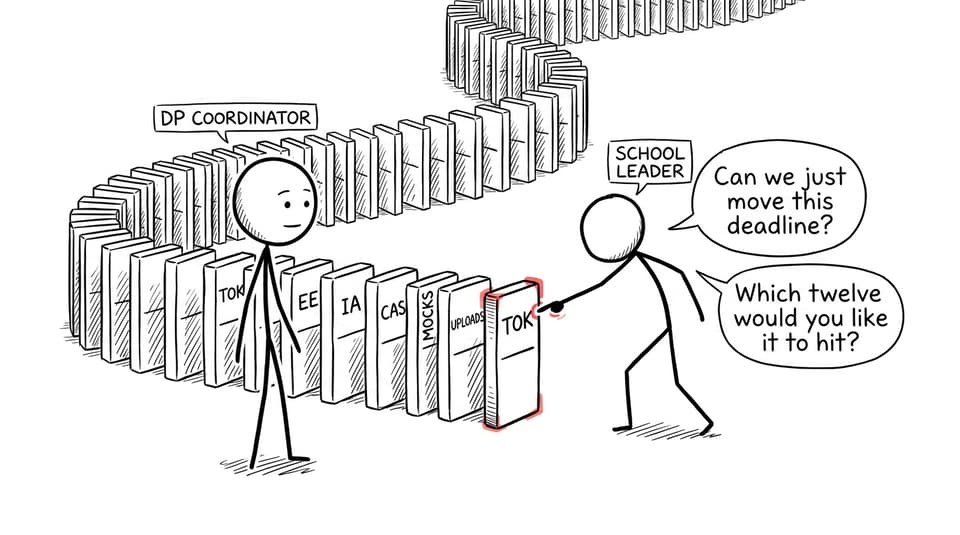
Moving one internal deadline can affect feedback time, student workload, another subject's assessment, a school event, and the Extended Essay calendar. A request that sounds local may have programme-wide consequences.
Strong professional learning communities in IB schools give teachers protected time to compare demands, interpret expectations, and identify collisions before students experience them.
Results are lagging indicators
A disappointing result appears on one day. Its causes may have accumulated for two years.
A subject may have experienced staff turnover. Collaborative planning may have disappeared whenever the calendar became crowded. Students may have completed major tasks simultaneously because departments planned independently. Teachers may have received training without time to translate it into curriculum.
Leadership teams understandably want measurable outcomes. The mistake is waiting for terminal outcomes before asking whether the system is healthy. Better questions arrive earlier:
- Are subject teams teaching the current course confidently?
- Where are students repeatedly losing marks or missing deadlines?
- Are teachers interpreting criteria consistently?
- Is the core integrated into programme planning?
- Which interventions improved performance after reassessment?
Data should support earlier judgment, not surveillance. RevisionDojo's guidance on data-informed improvement for IB coordinators connects diagnosis, targeted practice, support, and reassessment into one cycle.
A resilient programme cannot depend on one person
There is a dangerous compliment often paid to capable coordinators: "They always find a way."
They answer messages during holidays, repair missing processes manually, hold institutional knowledge in private spreadsheets, and absorb anxiety from students, families, teachers, and leaders. The school begins to mistake personal endurance for organizational strength.
A programme that works only because one person remembers everything is fragile. Leadership should know what happens if the coordinator is absent during registration, examinations, or results. Procedures should be documented, essential duties covered, and responsibilities distributed among subject leaders, the core team, learning support, examinations staff, and senior leadership.
Building collaborative IB departments is therefore a form of risk control. Shared knowledge protects students, reduces bottlenecks, and makes honest challenge possible.
Inclusion and compliance begin early
Access arrangements illustrate another common gap. Leadership may see them as examination logistics. Coordinators know they begin much earlier.
IB access requests must reflect a student's usual way of working, meet eligibility expectations, include appropriate evidence when required, and follow the proper process. Classroom practice, learning support, documentation, family communication, and assessment planning must therefore align over time.
Academic integrity works similarly. A policy stored on a drive does not create ethical practice. Students need explicit teaching, teachers need consistent procedures, and leadership must support fair responses when concerns arise. Assessment, language, admissions, and inclusion policies also become meaningful through daily systems.
Technology can reduce friction, but it cannot own professional judgment. RevisionDojo for IB teachers and departments connects Questionbank practice, Study Notes, Flashcards, AI Chat, Grading tools, Predicted Papers, Mock Exams, the Coursework Library, and Tutors. Teachers and coordinators must still verify alignment, interpret evidence, and apply school and IB policy.
Advocating for the DP program requires candour
Advocacy is sometimes mistaken for promotion. Celebrating university recognition, academic challenge, and international-mindedness matters, but those qualities do not make a programme sustainable by themselves.
Effective advocating for the DP program means translating educational value into operational choices. If leadership values inquiry, teachers need planning time. If it values inclusion, support must begin before assessment pressure peaks. If it values strong outcomes, departments need current training, stable staffing, useful evidence, and time to respond.
The strongest requests connect resources to programme risks or student benefits:
- Release time protects strategic and compliance work.
- Professional development reduces inconsistency.
- A coordinated assessment calendar protects student workload.
- Administrative support reduces avoidable errors.
- Shared learning systems enable earlier intervention.
This is also the logic behind coordinating whole-school improvement through shared analytics. Evidence becomes useful when it leads to a named decision, an owner, and a review date.
What supportive leadership looks like
Coordinators do not need leaders to master every procedural detail. They need leaders to understand the work and remove predictable obstacles.
A constructive termly conversation can ask:
- What are the programme's greatest risks this term?
- Which deadlines create the highest workload concentration?
- Where does the coordinator lack authority?
- Which teachers need training or protected collaboration?
- What evidence suggests students need intervention?
- Which recurring task should be delegated or documented?
The answers should influence staffing, timetables, budgets, meetings, and accountability. They should not become another report that receives no decision.
Platforms cannot fix weak governance, but RevisionDojo for Schools gives coordinators and departments a shared environment for resources, assessment practice, feedback, and cohort-level patterns. Used carefully, it reduces fragmentation and clarifies where support is needed.
The conversation worth having
Most coordinators are not asking leadership to lower expectations. They are asking leaders to understand what those expectations cost in time, expertise, coordination, and care.
The stronger model is partnership. Leadership supplies authority and structure, the coordinator supplies programme expertise, and teachers share ownership of implementation. RevisionDojo supports that partnership by connecting student practice, teacher feedback, and coordinator oversight, helping responsible adults see the same reality before a manageable gap becomes a result-day surprise.