


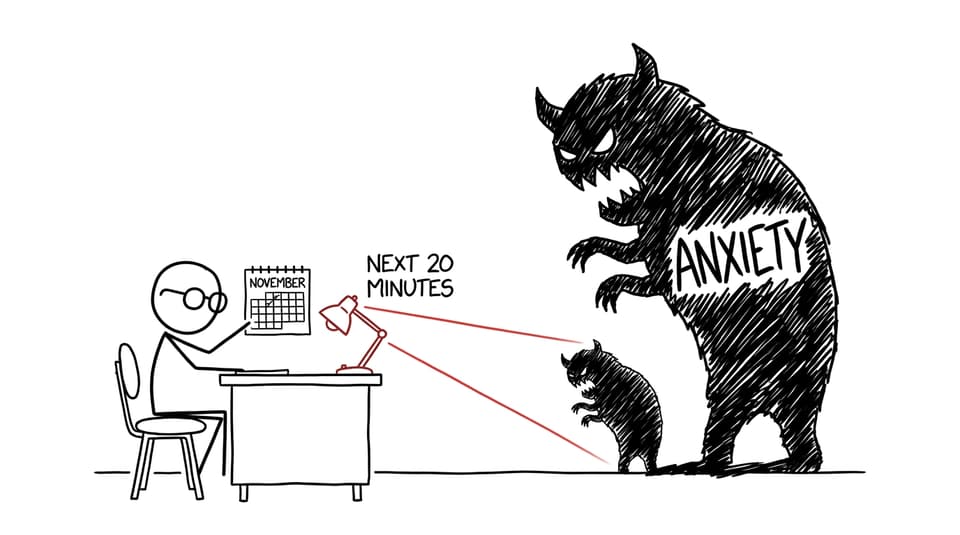
Managing exam anxiety in the weeks before November is not about eliminating every nervous feeling. It is about making anxiety smaller than the next action you can take.
For students sitting the 2026 session, the official examination window runs from 23 October to 13 November. Confirm your papers, start times, and exam zone with your school coordinator. Begin with the November 2026 exam schedule and study plan, then plan around the timetable you will actually sit.
The practical answer is simple: reduce uncertainty, practise pressure gradually, protect recovery, and seek support when anxiety becomes difficult to manage. You need a repeatable final month, not a heroic one.
Your September-to-November checklist
- Copy every paper and local start time into one calendar.
- Circle consecutive papers and demanding morning-afternoon combinations.
- Choose one weak topic and one measurable task each day.
- Use active recall and questions rather than relying on rereading.
- Introduce timed practice gradually.
- Keep sleep, meals, movement, and breaks reasonably consistent.
- Tell a trusted adult if anxiety affects sleep, eating, attendance, or daily functioning.
RevisionDojo’s IB Study Planner can turn your examination dates into a visible schedule. Vague pressure feels limitless; a dated task has edges.
Separate the exam from the story around it
Anxiety often combines two problems.
The first is practical: perhaps you cannot complete a Mathematics section on time, recall a Biology process, or structure an evaluation clearly. The second is interpretive: “If I cannot do this today, November will go badly.”
Solve the practical problem first. Turn “I am behind in Chemistry” into “I will complete ten equilibrium questions and classify each error.”
A useful error log has four labels:
- Knowledge: the relevant fact or concept was missing.
- Method: you knew the content but could not apply it.
- Technique: you misread a command term or structured the response poorly.
- Timing: you understood the task but could not finish efficiently.
This prevents one disappointing score from becoming a judgment about your ability. The RevisionDojo Questionbank guide shows how question practice can become a targeted repair cycle rather than a stream of scores.
Use a three-phase plan for the November session
The session begins in late October, which can surprise students who treat November as the starting line. Plan backwards from your first paper.
| Period | Main purpose | Practical focus |
|---|---|---|
| September | Diagnose and rebuild | Weak topics, Study Notes, untimed questions, daily recall |
| Early to mid-October | Apply under pressure | Mixed Questionbank sets, timed sections, feedback, corrections |
| Final 7-10 days | Stabilise performance | Exam routines, selected simulations, light recall, sleep, logistics |
During September, use RevisionDojo Study Notes to repair one defined gap at a time. Follow with a small Questionbank set, then turn fragile definitions, formulas, or processes into Flashcards. The platform’s IB Flashcards with spaced repetition return difficult cards more frequently, keeping recall active without another enormous review session.
In October, shift toward application. Use AI Chat when a misconception blocks progress and Grading tools to see why a written response missed particular requirements. The goal is not reassurance from every answer. It is useful feedback.
Practise pressure in manageable doses
Avoiding timed work provides immediate relief, but it preserves the fear of being timed. Gradual exposure is more useful.
Start with 15-20 minutes on a familiar topic. Work without notes, stop when the timer ends, and review the attempt calmly. Several days later, increase either the duration or difficulty.
By October, one weekly simulation can become part of your plan. RevisionDojo’s custom IB Mock Exams let you begin with selected topics before progressing to broader papers. Predicted Papers provide fresh, syllabus-aligned rehearsal, but they are simulations rather than forecasts of exact questions. Use the IB Predicted Papers collection under realistic conditions and review recurring errors.
After a simulation, ask:
- Where did I lose time?
- Which mistake appeared more than once?
- What small practice task could correct it?
This turns the mock from a verdict into a map. If full simulations intensify anxiety too sharply, read the RevisionDojo guide to beating IB exam anxiety and reduce the exposure before rebuilding it.
Build a routine that works on anxious days
The best routine is not designed for your most motivated afternoon. It is one you can follow when concentration is imperfect.
Try this 60-minute structure:
- 5 minutes: write one outcome.
- 15 minutes: review a narrow concept in Study Notes.
- 25 minutes: complete questions without notes.
- 10 minutes: mark, classify, and correct errors.
- 5 minutes: write tomorrow’s first task.
On a difficult day, halve the session rather than abandoning it. Twenty focused minutes preserve continuity and reduce the guilt that can feed tomorrow’s anxiety.
If an IA, EE, or TOK task is competing with revision, use RevisionDojo’s Coursework Library and Grading tools to identify the next legitimate improvement instead of rereading the whole draft. If a concept continues to resist self-study, Tutors can offer a human explanation.
Protect the body that has to sit the exam
Sleep, food, hydration, and movement are part of preparation, not rewards for finishing it.
Keep waking and sleeping times reasonably consistent. Avoid late-night study marathons designed to compensate for unrealistic plans. Regular meals and moderate movement can make the physical sensations of stress easier to tolerate. Be cautious about increasing caffeine if you already experience shakiness, a racing heart, or disrupted sleep.
Use a short reset routine before timed practice. Sit upright, release your shoulders, and breathe slowly from the abdomen for 1-2 minutes. Then identify the first concrete action, such as reading the command term or answering the easiest accessible question.
Explore more IB exam stress management strategies if you need additional routines.
Know when ordinary exam stress needs more support
Some nervousness before an IB examination is understandable. Support becomes especially important when anxiety persistently interferes with sleep, eating, school attendance, concentration, or daily activities. Frequent panic symptoms, hopelessness, or feeling unable to cope should not be carried alone.
Tell a parent or guardian, school counsellor, teacher, IB coordinator, doctor, psychologist, or another trusted professional. Ask early, even if you are unsure whether the problem is serious enough. If you feel at risk of harming yourself or cannot stay safe, contact local emergency services or an appropriate crisis service immediately.
Make the next step smaller than the fear
The November session can feel like one enormous event. Preparation happens through ordinary actions: one corrected mistake, one timed section, one stable night of sleep, and one honest conversation when support is needed.
RevisionDojo brings that process together. Use Study Notes for clarity, Flashcards for recall, the Questionbank for application, and AI Chat plus Grading tools for feedback. Add Mock Exams and Predicted Papers when you are ready to rehearse pressure. The Coursework Library and Tutors can help keep other IB demands manageable.
You do not have to feel completely calm before beginning. Open one topic, choose one task, and make the next 20 minutes clear.