

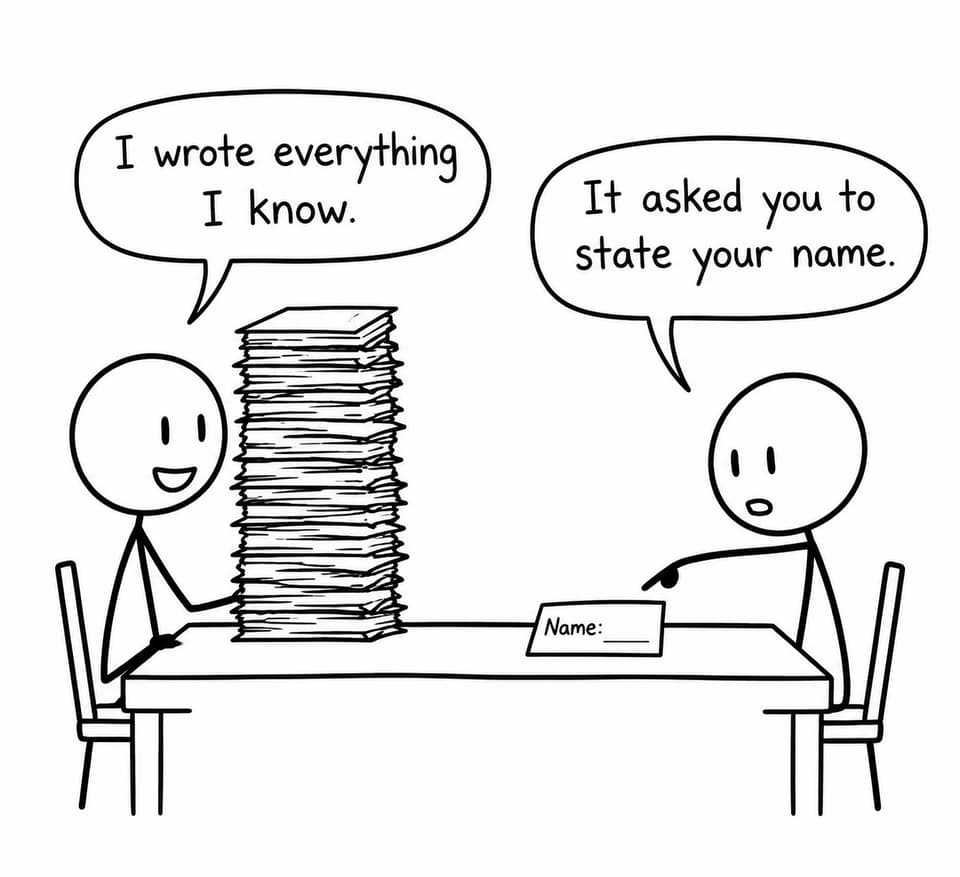
Understanding a topic does not always mean answering the question. In DP1, you may revise carefully and still lose marks because you described something when the instruction asked you to evaluate it.
This printable IB command terms list translates common instructions into practical answer moves. Identify the term, decide what kind of thinking it requires, and build your response around that task. Your knowledge supplies the material; the command term tells you what to do with it.
Your printable cheat sheet checklist
Print the reference table below, then add your own examples and reminders. Your working sheet should contain:
- The command term and its meaning
- A practical action to guide your answer
- One example from your current subjects
- A reminder about a recurring mistake
Keep it beside you during homework. The aim is not immediate memorization, but repeated, accurate use. RevisionDojo's guide to understanding command terms before your first assessment offers additional context.
For a cleaner printout, copy the table into a document and use landscape orientation if the columns become cramped. Leave space beneath each row for handwritten examples. You can also keep a separate page for each subject when the same instruction needs different reminders. The useful version is the one you can read quickly while planning an answer.
The essential IB command terms list
Definitions and expectations can vary by subject, so follow your current subject guide and teacher's guidance. This table is a working reference, not a replacement for those instructions.
| Command term | What it asks you to do | Practical answer move |
|---|---|---|
| Define | Give the precise meaning | Write an accurate definition without unnecessary discussion |
| State | Give a brief, specific answer | Provide the name, value, or fact directly |
| Identify | Recognize and name a relevant feature | Select the feature and state it briefly |
| Outline | Give a brief account or summary | Present the main features without extensive detail |
| Describe | Give a detailed account | Set out what happens, what is present, or what a pattern looks like |
| Explain | Give reasons or causes | Connect a claim to why or how it happens |
| Compare | Present similarities between items | Refer to both items throughout |
| Contrast | Present differences between items | Link each difference across the two items |
| Analyse | Examine parts and their relationships | Identify components or patterns and connect them |
| Discuss | Give a balanced, considered review | Examine perspectives and reach a supported conclusion |
| Evaluate | Weigh strengths and limitations | Apply relevant criteria before making a judgment |
| Justify | Support an answer or conclusion | Give specific evidence or reasoning |
| Calculate | Obtain a numerical answer with relevant working | Show the method, stages, and appropriate units |
| Determine | Obtain the required answer | Use the information to reach the appropriate result |
| To what extent | Judge how far a claim is valid | Weigh supporting and limiting evidence, then judge the degree |
The distinction between describe and explain deserves attention. Description establishes what happens. Explanation adds a mechanism, reason, or cause. More detail alone does not turn a description into an explanation.
How to personalize your command-term template
Translate the instruction into an action
Copy each term accurately from your subject materials. Add unfamiliar instructions such as annotate, deduce, or sketch rather than forcing them into another category. The guide to reading an IB subject guide effectively can help you locate course-specific expectations.
Next, rewrite the meaning in plain language. For evaluate, you might write: “Weigh strengths and limitations using criteria, then make a judgment.” Add a visible answer move, such as comparing evidence against those criteria. A definition explains the instruction; an answer move helps you act on it.
Add a subject example and personal reminder
Choose material you are studying now. A Biology student could explain an enzyme process; a History student could evaluate one factor's importance. RevisionDojo's DP1 Study Notes, Flashcards, and Questionbank guidance can help connect this exercise to everyday revision.
Record a specific mistake beside the example. “Explain how the evidence supports my conclusion” is more useful than “write better.” Update the reminder after feedback so the sheet reflects your actual difficulties.
A completed command-term example
Consider this hypothetical Biology question:
Explain how denaturation can reduce the rate of an enzyme-controlled reaction.
| Template field | Completed entry |
|---|---|
| Command term | Explain |
| Meaning | Give an account including reasons or causes |
| Answer move | Connect the structural change to its effect on reaction rate |
| Subject example | Denaturation changes the enzyme's three-dimensional structure. The active site becomes less complementary to the substrate, so fewer enzyme-substrate complexes form and the reaction rate falls. |
| Personal reminder | Explain why the shape change reduces the reaction rate. |
The response builds a causal chain: structural change → altered active site → reduced binding → lower reaction rate. It does not stop at reporting an outcome. If the question instead asked you to state the effect, a shorter answer could be appropriate. The knowledge overlaps, but the required response changes.
Try the same contrast with another topic you already understand. Write a description first, then underline the sentences that only report observations. To turn it into an explanation, add the relevant reasons rather than extra adjectives or background information. This exercise makes the difference visible and helps you notice when a longer answer is still doing the wrong job.
Use the sheet before, during, and after answering
Before writing, circle the command term and check for multiple tasks. A question asking you to describe a pattern and explain it requires both an observation and a reason. Addressing only one leaves part of the question unanswered.
Write a short planning cue: “cause and effect,” “similarities throughout,” or “strengths, limitations, judgment.” Then check the available marks and context. These help indicate depth, but they do not create a universal rule about sentences or paragraphs per mark.
During writing, follow the planned action rather than listing everything you remember. Afterwards, ask whether the response actually explains, compares, or justifies. A polished answer can still miss the instruction. RevisionDojo's guide to planning for the IB workload can help make this check routine.
When reviewing feedback, separate a knowledge gap from an instruction gap. An incorrect definition needs content revision; an accurate description submitted for an explanation needs a different response structure. Both can occur together. Naming the problem precisely helps you choose the next practice task instead of rereading an entire topic without a clear purpose.
Make command terms part of normal revision
Use Flashcards for difficult distinctions and the Questionbank for subject-specific practice. Grading tools can support review of whether an answer fulfils its instruction. AI Chat can help you compare response structures, while Mock Exams and Predicted Papers provide opportunities to practise under timed conditions. Check feedback against subject criteria rather than accepting it uncritically.
For longer work, the Coursework Library can support your study of argument structure, and Tutors can clarify expectations that remain confusing. Together with Study Notes, these resources make RevisionDojo a comprehensive IB study companion, connecting understanding, application, and feedback.
Start small. Choose two commonly confused terms and practise them across a week. The first-month guide for IB Diploma students and advice on setting realistic goals for your first IB term can help keep that routine manageable.
Print the table, add examples from your subjects, and revise it when feedback reveals a misunderstanding. With RevisionDojo supporting the practice around it, a simple reference sheet becomes a repeatable habit: understand the instruction before trying to prove what you know.